Key Notes
- NVIDIA used Microduck and its expanded Isaac platform to show how local development, cloud training and robot deployment could create new demand for AI computing.
- The same conference exposed the gap between strong demand and the capital cloud operators need to build infrastructure, with borrowing costs and deployment schedules shaping project returns.
- Modular AI factories and financing partnerships address parts of that challenge, while sustained robotics adoption and customer cash flow remain the tests of whether the strategy succeeds.
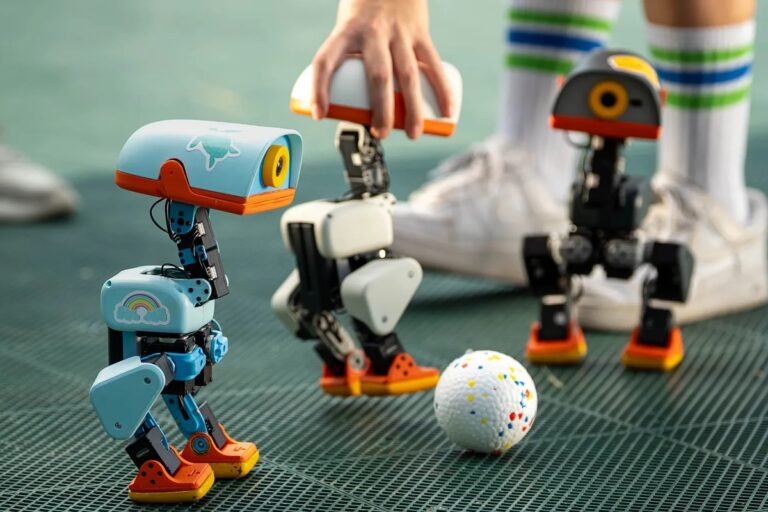
Four small robot ducks helped Jensen Huang explain where NVIDIA wants AI to go next. At GTC Berlin, the company’s chief executive brought Microduck robots onstage as the culmination of a pitch spanning personal computers, cloud training and machines that interact with the physical world. The spectacle made a complicated computing strategy easy to watch.
The harder question was being discussed elsewhere at the conference: who will finance the infrastructure needed to turn that strategy into a business? As specialized AI cloud providers came under renewed market pressure, Huang argued that demand remained strong and working capital was scarce. NVIDIA’s next phase depends on both sides of that equation: useful new applications and infrastructure operators able to pay for the systems serving them.
The Robot Ducks Explain NVIDIA’s Bigger Ambition
Microduck comes from Pollen Robotics, the Bordeaux team at Hugging Face. Its specifications describe a 25-centimeter biped with 15 motors, a camera, depth sensing and a beak that can grasp objects. The introductory price is $399 before taxes and shipping, with initial deliveries targeted before Christmas. Its software is open source; its mechanical and electronic designs are not covered by that statement.
NVIDIA’s technical overview describes an agent-assisted training workflow using RTX Spark, Isaac Lab, Hermes Agent and Nemotron. Rather than teaching every behavior through repeated physical attempts, developers can practice skills in simulation, evaluate a learned policy and transfer it to a robot. The cloud can supply training capacity while a local machine supports development and evaluation.
That division of labor matters more than the novelty of a mechanical duck. It gives NVIDIA a role at several stages of robotics development, from generating and testing behavior to running models on the finished machine. It also gives students and smaller teams a manageable way to learn techniques used in more expensive systems, although a successful demonstration remains different from a reliable commercial deployment.
From a Desktop Robot to Industrial Physical AI
The larger robotics announcement was an Isaac expansion. NVIDIA made Isaac Lab 3.0 generally available and introduced Isaac OS, a runtime connecting models, sensors, controls and robot hardware. Agile Robots also announced Agile ONE SN, a reference humanoid using Isaac GR00T and Jetson Thor, scheduled for early 2027. Integration with NVIDIA’s Halos safety stack is planned.
RobotsBeat’s coverage of the robot-learning tools explains how the pieces fit together: collect data, train and evaluate skills, then connect them to physical hardware. Reducing the integration work could let researchers spend more time testing useful behavior. It does not remove the task-specific engineering needed for safe operation around people, machinery or unpredictable objects.
Europe supplies a natural setting for that pitch because it already has manufacturers, specialist robotics companies and industrial expertise. Our reporting on the German partnership examined the effort to connect those capabilities with AI. MarketSpeaker’s account of the investment plans adds the commercial context: commitments and cooperation need to become products that businesses repeatedly use.
The distinction is crucial to assessing the opportunity. A robot that handles a narrow task reliably can create value without matching a human’s general capabilities. Conversely, an impressive general-purpose demonstration may still require extensive validation before an employer can depend on it through a full shift.
Why Robot Training Is Also a Cloud Business
Physical AI creates demand for computing before a machine reaches a customer. Teams need to process sensor recordings, generate training examples, run simulated environments and compare policies across many conditions. Much of that work can happen away from the robot itself, making the development process a potential customer for cloud infrastructure.
CoreWeave made that connection explicit at GTC with Physical AI Launchables. Its October 21 announcement describes tested templates for Isaac Sim, CARLA, MuJoCo, AlpaSim and Cosmos 3, covering work such as data generation, evaluation and policy training. Customers supply their own scenes and data, while the service packages the computing environment around them.
As RobotsBeat explains in its simulation coverage, that is an effort to remove setup work from robotics development. For a cloud operator, it also offers a way to compete on software and workflow support alongside access to GPUs. Whether those workloads become a substantial source of revenue will depend on adoption, usage and pricing; the product launch alone does not establish their commercial scale.
The Market’s Doubts Reach the Conference Floor
The optimism about new applications coincided with a difficult session for neocloud stocks. CNBC reported that CoreWeave closed October 22 down 10% and Nebius fell 7%. Its reporting from GTC described concern among infrastructure executives about borrowing and access to capital, even as Huang defended the strength of underlying demand.
The same tension appeared across the wider market. MarketSpeaker’s selloff coverage tracked the pressure on technology shares during that session. Falling share prices do not establish that AI demand has disappeared. They can reflect a reassessment of how much investors should pay for future growth, and how much funding will be required before that growth produces cash.
Neoclouds face a particularly demanding timing problem. They must secure facilities, power and expensive equipment before all the revenue from long-term contracts arrives. A customer backlog can support a business plan while leaving a substantial financing gap. Delays, higher borrowing costs or weaker utilization can then change the returns on a project that still has willing customers.
That is why demand and financing cannot be treated as interchangeable evidence. A robotics developer may want more simulation capacity, but the cloud operator still needs to deliver it at a price that covers equipment, energy, operating costs and financing. More workloads expand the opportunity; sustainable margins determine how much of it can be built.
Shipping AI Factories Faster Addresses Only Part of the Problem
NVIDIA is also trying to shorten the construction process. Its keynote account describes DSX POD, a reference design for Vera Rubin AI factories integrated and validated inside modular containers before delivery. NVIDIA says onsite deployment can fall from six months to 14 days once site utilities are ready.
The qualification about utilities is central to understanding that claim. A preassembled computing system can reduce installation work, but the site still needs suitable power, cooling connections and the other conditions required to operate it. The stated deployment interval is not a promise that an entire data-center project can move from an empty plot to production in two weeks.
Faster deployment nevertheless has a clear economic purpose. Hardware waiting to be commissioned has already consumed capital without generating the intended service revenue. Moving more assembly and validation into the supply chain could narrow that interval, provided the receiving site and customer workload are ready.
The scale of the remaining funding requirement is enormous. Goldman Sachs presents a roughly $7.6 trillion baseline for AI-related capital spending from 2026 through 2031 in its scenario analysis. It emphasizes that assumptions about chip replacement, facility costs and construction constraints can materially change that figure. The number is a conditional framework, rather than committed expenditure.
NVIDIA Is Helping Fund the Ecosystem It Wants to Expand
NVIDIA’s response already extends beyond supplying technology. An August financing initiative with six financial institutions targets more than $500 billion of third-party capital over time. Announced through memorandums of understanding and subject to definitive agreements, it is intended to help finance infrastructure. It is not a commitment for NVIDIA itself to spend $500 billion.
Different arrangements transfer different risks. NVIDIA’s quarterly filing lists cloud-service commitments and leases intended for third parties, alongside conditional guarantees. A cloud purchase can provide computing resources in return; a guarantee creates a payment obligation under defined circumstances. Neither should automatically be described as a loss already incurred.
We examined those mechanisms in our financing analysis. They help explain NVIDIA’s position in the debate: supporting a customer’s access to capital can accelerate the deployment of its own platform. It can also leave NVIDIA more exposed to how successfully the wider ecosystem turns computing demand into revenue.
What Will Show Whether the Robotics Pitch Is Working?
The practical tests will be less theatrical than the keynote. For robotics, useful evidence includes repeated performance on real tasks, the amount of human intervention required and the cost of operating a system over time. For cloud providers, it includes utilization, customer collections, debt service and the ability to commission capacity on schedule.
Those measures connect the two halves of Huang’s presentation. Better simulation tools could reduce the expense of developing a useful robot. Useful robots could support recurring spending on training and evaluation. Reliable infrastructure, financed on workable terms, would make that development cycle easier to sustain.
The Microducks offered an accessible glimpse of that cycle. NVIDIA’s challenge is to extend it from an engaging demonstration into dependable services and machines that customers can justify buying. GTC Berlin showed how broad the technical ambition has become; the financing debate will help determine how quickly the industry can afford to realize it.
Disclaimer: AIstify is an independent media brand owned and operated by NuvexMedia LLC, publishing news, research, and insights on artificial intelligence, emerging technologies, automation, and related industries. NuvexMedia LLC invests in and collaborates with companies across the AI, technology, software, and digital innovation sectors. These relationships do not influence AIstify’s editorial coverage, and the publication maintains full editorial independence to provide accurate, timely, and objective information. © 2026 NuvexMedia LLC. All rights reserved. This content is for informational purposes only and should not be considered legal, tax, investment, financial, or other professional advice.