
NVIDIA announced on July 15, during CEO Jensen Huang’s visit to Tokyo, that many of Japan’s leading robotics and manufacturing companies are building on its physical-AI software stack, spanning the Cosmos, Isaac, Metropolis and Jetson platforms.
Alongside the announcement, NVIDIA unveiled Cosmos 3 Edge, a new 4-billion-parameter world model built on its Nemotron technology that runs directly on edge computers rather than in the cloud. A world model is an AI system that understands physical dynamics, how objects move and interact, so it can help a robot or camera see its surroundings, reason about them in real time and predict the actions a machine should take. Running it locally matters for robots, which need to react instantly without waiting on a network connection.
NVIDIA is pitching Cosmos 3 Edge as a fast path from prototype to deployment. Using the open Cosmos framework, developers can adapt the model to a specific robot, vehicle or sensor setup in about a day, and it runs on NVIDIA’s RTX GPUs, DGX systems and Jetson robotics computers, including the newly announced T2000 and T3000 modules.
The company also released new Metropolis libraries it says let developers build video-intelligence systems at least six times faster using coding agents. These speed and performance figures come from NVIDIA and are not independently verified. Cosmos 3 Edge completes the Cosmos 3 family that NVIDIA launched on June 1, joining the higher-accuracy Super and fast Nano variants.
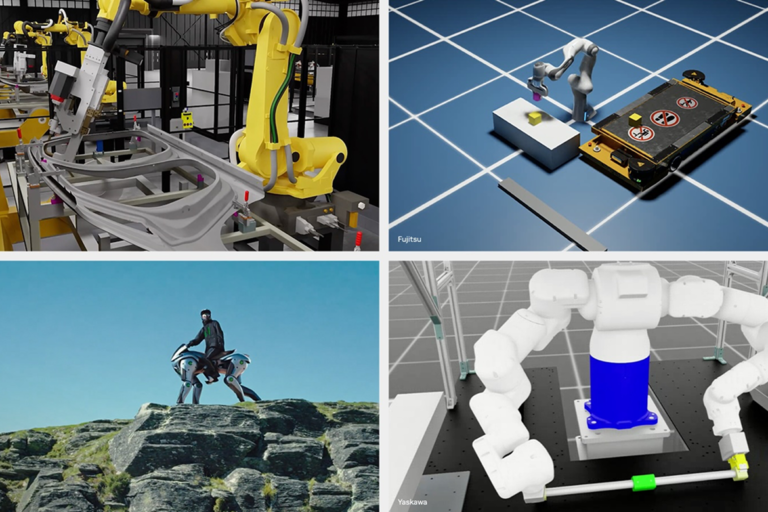
The centerpiece is the expansion of NVIDIA’s Cosmos Coalition to Japan, an effort to pool the country’s industrial heavyweights around open world models. More than 20 companies are said to intend to join, including the robotics makers FANUC, Yaskawa Electric and Kawasaki Heavy Industries, the electronics and IT groups Sony, Hitachi, NEC and Fujitsu, and telecom operator SoftBank, along with Honda R&D, Kubota, and specialists like companion-robot maker GROOVE X and elder-care robotics firm Enactic.
Fujitsu is leading a collaborative-control platform integrating NVIDIA’s stack with FANUC, Yaskawa and Kawasaki. In a parallel move reported by the Japan Times, NVIDIA also expanded its long-running partnership with Toyota to cover smart cities, factory digital twins and its Woven City project.
Why Japan, and Why Now
The push reflects NVIDIA’s bet that the next wave of AI moves from software into machines, a shift Huang has described by saying every industrial company will become a robotics company. Japan is a logical anchor: it has a deep heritage in precision manufacturing and robotics but faces a shrinking, aging workforce that makes automation an economic necessity rather than a luxury. Huang called it a “once-in-a-generation opportunity for Japan,” framing NVIDIA’s platforms as the tools to reinvent the manufacturing methods Japan pioneered.
The strategic prize for NVIDIA is establishing Cosmos as the default foundation for physical AI the way its chips became the default for training large language models, locking a new industry into its full hardware-and-software stack. The timing also rode a wave of enthusiasm, with SoftBank’s Masayoshi Son dismissing fears of AI overinvestment as “foolish” at his SoftBank World event the same week.
The Vertical Integration Bet
For all the marquee names, the announcement warrants a careful read. The Japanese companies are said to “intend to join” the coalition, language that signals directional interest rather than binding commercial commitments, and much of the described work is exploratory, framed as companies “exploring” or “advancing R&D” rather than shipping products at scale.
Physical AI remains early, and the gap between compelling demos and reliable, deployed robots on factory floors is wide; world models are promising but unproven in the messy, safety-critical reality of industrial settings. NVIDIA also faces real competition in robotics from open frameworks and rivals building their own stacks.
The deeper significance is strategic: by supplying the chips, the models and the simulation software together, NVIDIA is working to make its ecosystem the indispensable layer beneath the entire robotics industry. Whether that vision materializes depends on these non-binding intentions turning into genuine, large-scale deployments, which will take years to prove out.
Disclaimer: AIstify is an independent media brand owned and operated by NuvexMedia LLC, publishing news, research, and insights on artificial intelligence, emerging technologies, automation, and related industries. NuvexMedia LLC invests in and collaborates with companies across the AI, technology, software, and digital innovation sectors. These relationships do not influence AIstify’s editorial coverage, and the publication maintains full editorial independence to provide accurate, timely, and objective information. © 2026 NuvexMedia LLC. All rights reserved. This content is for informational purposes only and should not be considered legal, tax, investment, financial, or other professional advice.