
Key Notes
- Germany’s Economy and Research ministries have signed a joint declaration of intent with Nvidia to advance industrial AI through a new physical AI initiative.
- The program will focus on specialized open models for robotics, manufacturing, autonomous systems and digital twins, building on Nvidia’s Nemotron and Cosmos families.
- Germany plans to use Platform Industrie 4.0 as the network linking companies, researchers and smaller manufacturers, while keeping industrial data, applications and deployment needs at the center.
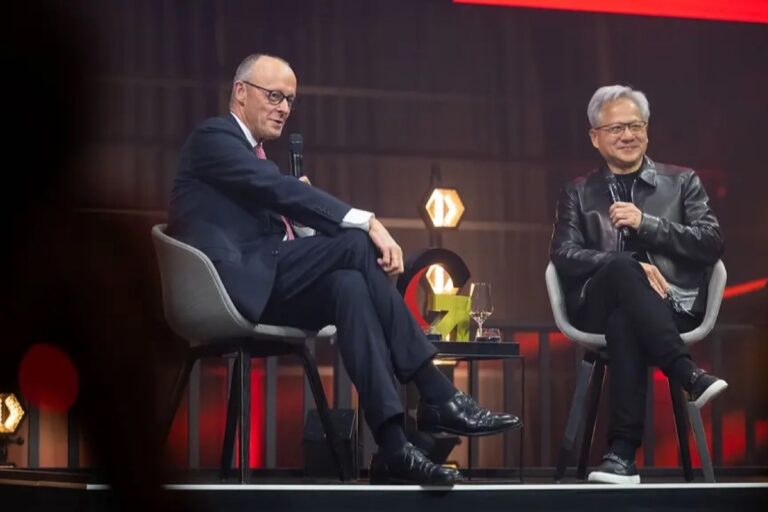
Germany’s federal government has signed a joint declaration of intent with Nvidia to accelerate industrial AI, placing robotics, manufacturing and autonomous systems at the center of the effort. The agreement was announced at the Invest in Germany Summit in Berlin and involves the Federal Ministry for Economic Affairs and Energy and the Federal Ministry of Research, Technology and Space.
The initiative is focused on what Nvidia and the German government call physical AI: systems that can understand, simulate and act in the physical world. For Germany, that means applying advanced AI to its established strengths in engineering and manufacturing rather than treating the technology as only a tool for chatbots or office work. The government said the work will draw on industrial data, manufacturing expertise and research institutions to develop modern AI models and move them into wider use.
Industry 4.0 Becomes the Organizing Platform
Germany plans to use its Platform Industrie 4.0 as the core strategic network for the project. The long-running collaboration already brings together government, manufacturers, researchers and trade groups; it is now being refocused around industrial AI, from computing infrastructure through deployment on the factory floor.
The arrangement is intended to make the ecosystem accessible to large companies, research organizations and small and medium-sized businesses. That matters in Germany, where the Mittelstand supplies much of the country’s specialized industrial base. A program that remains limited to major manufacturers would miss many of the component makers, machine builders and engineering firms that will need to integrate AI into their own products and operations.
Open Models for Industrial Workloads
The government said a key part of the collaboration will be specialized, open AI models for industrial use, building on Nvidia’s Nemotron and Cosmos model families. The aim is to support workloads such as robot training, digital twins, factory planning and autonomous mobility while letting German organizations adapt systems to their own equipment, data and safety requirements.
That is a different problem from deploying a general-purpose assistant. Industrial settings require a model to work with equipment specifications, physical constraints, sensor data and tightly controlled workflows. We recently covered Nvidia’s Nemotron releases, which are also positioned for tool use, visual documents and multi-step agent tasks. In a factory, those capabilities could support an engineer’s workflow, but real-world decisions still require validation, human oversight and integration with existing safety systems.
AI Sovereignty Remains Part of the Argument
A partnership with a US chipmaker raises an obvious question about European technological sovereignty. Nvidia provides the accelerated computing stack and its open models, while the German government’s announcement emphasizes that the initiative will be rooted in domestic industrial data, applications and research. The practical distinction is important: using global AI infrastructure is not the same as surrendering control of a company’s operational data or production process.
The agreement does not announce a finished national AI platform or guarantee a new set of factory deployments. It creates a framework for cooperation, and its impact will depend on which models are built, how companies gain access to compute, and whether the tools work reliably on real production lines. Still, it gives Germany a clear industrial-AI agenda: combine its engineering base with AI systems built for the physical economy, where the race will be decided as much by reliable deployment as by benchmark scores.
Disclaimer: AIstify is an independent media brand owned and operated by NuvexMedia LLC, publishing news, research, and insights on artificial intelligence, emerging technologies, automation, and related industries. NuvexMedia LLC invests in and collaborates with companies across the AI, technology, software, and digital innovation sectors. These relationships do not influence AIstify’s editorial coverage, and the publication maintains full editorial independence to provide accurate, timely, and objective information. © 2026 NuvexMedia LLC. All rights reserved. This content is for informational purposes only and should not be considered legal, tax, investment, financial, or other professional advice.