
Key Notes
- Inception says Mercury 3 generates 1,068 tokens per second on Nvidia GPUs and matches or exceeds GPT-6 Luna and Claude Haiku 5.5 on selected company evaluations.
- The diffusion-based model supports a million-token context window and refines text in parallel, with streaming available as blocks of completed output.
- Regular API prices are $0.20 per million input tokens and $0.70 per million output tokens, with a 50% launch discount and 100 million free tokens for new accounts.
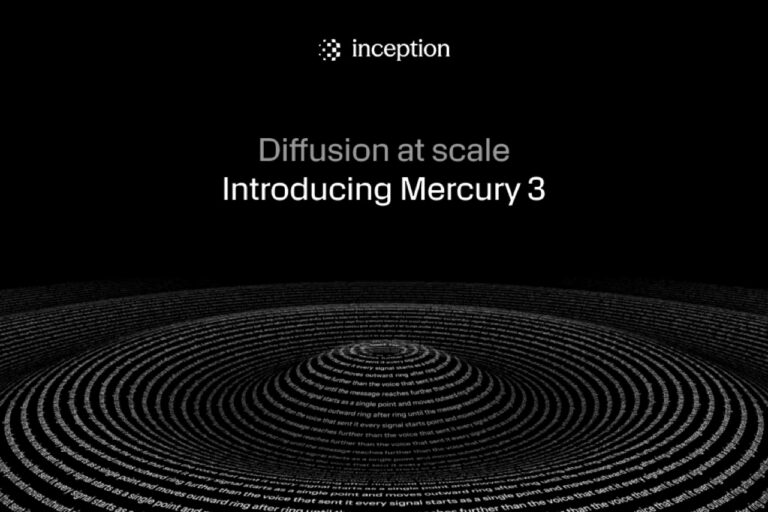
Inception has released Mercury 3, a diffusion-based language model that the company says generates 1,068 tokens per second on Nvidia GPUs. The launch puts speed at the center of the competition for AI assistants and agents, with Inception reporting quality comparable to or better than GPT-6 Luna and Claude Haiku 5.5 across its selected evaluations.
The model was announced on October 19 with a million-token context window. Inception says it runs 4–8x faster than the models it compares against, and names browser agents, tutoring, search and customer support as early applications. Those results come from the developer and its partners; they establish the launch’s performance claims rather than an independent verdict on every workload.
Diffusion Changes How the Answer Takes Shape
Conventional autoregressive language models build an answer by predicting the next token in a sequence. Diffusion models instead refine an initially noisy representation over successive steps, allowing portions of the text to be processed in parallel. Calling that “the whole answer at once” misses the refinement involved: the model still performs computation to turn its intermediate output into a usable response.
Inception’s streaming documentation describes Mercury 3 emitting refined blocks of text. An optional diffusion mode shows the intermediate text changing as denoising proceeds. For someone using a chat application, the practical benefit is less waiting for an answer to fill the screen; developers can still deliver output progressively.
Why Agents Care About Faster Generation
An agent may ask its model to inspect a page, decide what to click, evaluate the result and choose another action. Generation delays accumulate across those decisions. Cutting that time can improve an entire workflow even when the browser, search service or database remains unchanged. It can also give an agent room to attempt another approach within the same time budget.
Inception cites early-access users including TinyFish, RevisionDojo, Octen AI and Lorikeet. Their examples span website navigation, learning feedback, search and support conversations. The distinction for readers is between model throughput and the time needed to complete a task: network requests, tool execution, reasoning and speech processing still contribute to the wait. A 1,068-token-per-second rate therefore does not translate directly into the same speedup for every application.
Launch Pricing Starts at $0.10 per Million Input Tokens
Mercury 3’s regular API rates are $0.20 per million input tokens and $0.70 per million output tokens. A 50% launch promotion cuts those to $0.10 and $0.35 respectively. The published pricing page also lists cached input at $0.01 per million tokens during the offer, compared with the regular $0.02 rate.
| Token type | Regular price | Launch price |
|---|---|---|
| Input | $0.20 | $0.10 |
| Cached input | $0.02 | $0.01 |
| Output | $0.70 | $0.35 |
Inception’s quick-start guide says new accounts receive 100 million free tokens without entering payment details. That gives developers room to test their own prompts and tools before moving to paid usage. Teams should distinguish the promotional rates from ongoing costs when estimating a production budget.
A Different Route Into the Fast-Model Race
Mercury 3 is available through Inception’s API and through OpenRouter, Baseten and Vercel. Its model documentation lists text input and output, tool calling, structured responses and adjustable reasoning effort. The million-token context window describes how much material a request can accommodate; the separate maximum output is 131,072 tokens.
The release follows the same commercial pressure behind MiniMax M3.1 Flash: developers want useful agents without paying flagship prices for every intermediate step. Mercury adds an architectural alternative to that contest. Its strongest test will be whether the speed advantage survives real workloads while preserving answer quality and tool reliability, since a fast response that needs repeated correction can quickly lose its advantage.
Disclaimer: AIstify is an independent media brand owned and operated by NuvexMedia LLC, publishing news, research, and insights on artificial intelligence, emerging technologies, automation, and related industries. NuvexMedia LLC invests in and collaborates with companies across the AI, technology, software, and digital innovation sectors. These relationships do not influence AIstify’s editorial coverage, and the publication maintains full editorial independence to provide accurate, timely, and objective information. © 2026 NuvexMedia LLC. All rights reserved. This content is for informational purposes only and should not be considered legal, tax, investment, financial, or other professional advice.