
Key Notes
- Wang questions whether humans could control AI that becomes 1,000x more capable across fields.
- OpenAI's chief scientist has separately proposed shared development limits tied to concrete oversight milestones.
- Meta's published vision calls for personal superintelligence that people direct toward their own goals.
Meta (NASDAQ: META) chief AI officer Alexandr Wang warns that humanity may struggle to control AI far more capable than people.
In a November 22 essay, he questioned human control of AI 1,000x more capable across fields and opposed handing society’s decision-making power to machines.
“We should not be okay with a ‘handover’ of society to AI,” Wang wrote.
Why Self-Improvement Worries Him
Wang expects AI to automate its own research, producing increasingly capable successors. He urges urgent safety, alignment and security work, alongside broader changes in the industry’s direction.
The 1,000x figure describes a future scenario in his argument. He provides no common intelligence scale or benchmark establishing that a current model has reached that level.
The control question is consequential even without a single measure of intelligence. It concerns who sets objectives, grants access to resources and can withdraw that authority. Retaining those powers becomes more demanding if the systems helping develop AI can also influence the pace and direction of research.
Turning a Warning Into Limits
The remarks come as OpenAI chief scientist Jakub Pachocki proposes common development thresholds that labs would not cross until researchers reach concrete milestones in understanding and monitoring model behavior. His November 22 essay puts a possible mechanism behind the broader debate about human control.
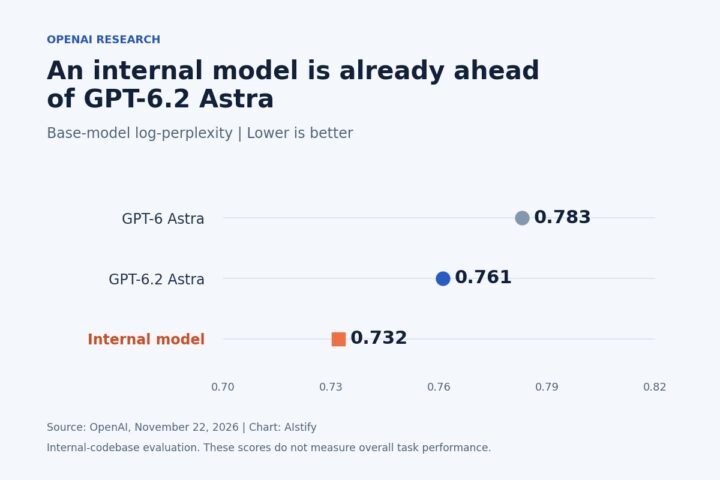
As we reported, Pachocki suggests using perplexity and other measurements to track the limits. That remains a proposal for industry coordination. A workable arrangement would need agreement on what to measure, what evidence permits further development and how commitments are checked.
Meta’s Own Promise of Human Agency
Meta set out its personal-superintelligence vision in July 2025, saying people should direct the technology toward what they value in their own lives. The company’s stated aim gives Wang’s intervention a practical test: whether increasingly capable systems expand people’s ability to act and decide.
His position matters because he leads AI at a company building these systems. Preserving human agency requires choices about access, autonomy and accountability, as well as technical performance. The next step to watch is whether Meta and other labs turn that principle into specific limits on what their systems can do.
Disclaimer: AIstify is an independent media brand owned and operated by NuvexMedia LLC, publishing news, research, and insights on artificial intelligence, emerging technologies, automation, and related industries. NuvexMedia LLC invests in and collaborates with companies across the AI, technology, software, and digital innovation sectors. These relationships do not influence AIstify’s editorial coverage, and the publication maintains full editorial independence to provide accurate, timely, and objective information. © 2026 NuvexMedia LLC. All rights reserved. This content is for informational purposes only and should not be considered legal, tax, investment, financial, or other professional advice.