
Key Notes
- XPANCEO plans to demonstrate its first integrated smart contact lens in March 2027.
- Its partnership with China's JBD focuses on a custom microdisplay for an extremely small, low-power device.
- Existing prototypes test separate functions, and the planned demonstration is not a consumer product launch.
XPANCEO plans to demonstrate its first integrated smart contact lens in March 2027, as the Dubai-based startup works to move digital information from phone screens into the wearer’s field of view.
Founder Roman Axelrod outlined the milestone at Dubai Future Week, Emirates News Agency WAM reported on November 20. The intended prototype would bring a display, connectivity, power and health sensing together in one lens. The target is an integrated demonstration, rather than the start of consumer sales.
A Display Built for the Eye
The project involves Chinese micro-LED manufacturer JBD. XPANCEO announced an expanded collaboration in July to develop a display specifically for direct integration into a contact lens, building on earlier work connecting a microdisplay to a processing unit.
The companies are targeting a display only a fraction of a millimeter across, with components thin enough to fit the lens format. The challenge includes making an image that the eye can focus on at extremely close range, while keeping brightness and power consumption appropriate for the application.
XPANCEO says the teams are also redesigning the circuitry that drives the pixels for very low-current operation. A successful optical demonstration alone would therefore leave other questions to resolve, including efficient power delivery and a design that can be manufactured consistently.
Separate Prototypes, One Integration Challenge
In its June VivaTech update, XPANCEO described more than 28 prototypes developed across several technology generations. Those demonstrations tested individual capabilities, rather than showing all of the promised functions in a single finished product.
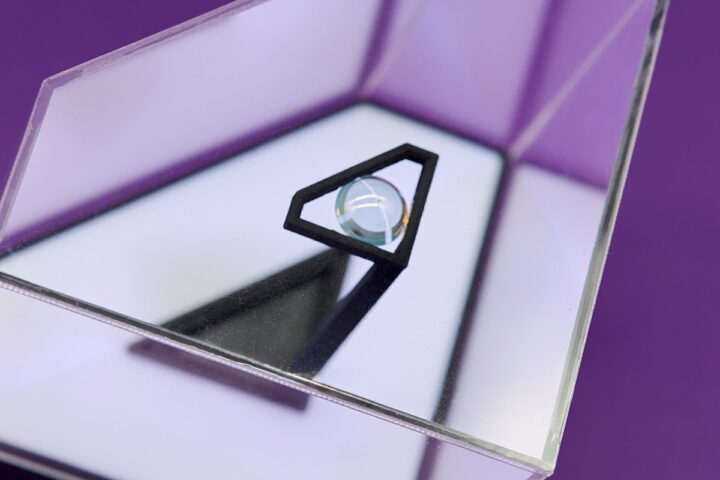
The display demonstration used a compact holder brought close to the eye. Other work covered a lens communication module, an embedded rechargeable microbattery, sensor-data transmission and transparent flexible conductors made from extremely thin gold layers.
The architecture includes an external companion device for computing and power management. That distinction matters to the AI pitch: the lens is being developed as an interface to digital services, rather than evidence that a general-purpose AI model can run inside a contact lens.
Beyond the Smartphone Screen
XPANCEO’s product roadmap envisages visual information appearing only when needed, including hands-free instructions, contextual data and alerts. Its broader ambition is to support consumer, workplace, sports and other applications through a display integrated into normal vision.
As AI glasses begin reaching buyers, smart contact lenses represent a more demanding version of the same interface idea: making useful information accessible without repeatedly reaching for a phone. The next meaningful test for XPANCEO is whether its separate systems can operate together on the eye.
The announcements do not establish a consumer launch date or retail price. For now, March 2027 is a prototype milestone, and replacing the smartphone screen remains the company’s ambition.
Disclaimer: AIstify is an independent media brand owned and operated by NuvexMedia LLC, publishing news, research, and insights on artificial intelligence, emerging technologies, automation, and related industries. NuvexMedia LLC invests in and collaborates with companies across the AI, technology, software, and digital innovation sectors. These relationships do not influence AIstify’s editorial coverage, and the publication maintains full editorial independence to provide accurate, timely, and objective information. © 2026 NuvexMedia LLC. All rights reserved. This content is for informational purposes only and should not be considered legal, tax, investment, financial, or other professional advice.