Key Notes
- Thinking Machines released Inkling 2 Mini on November 20 with downloadable weights and support for Macs with at least 32GB of memory.
- The model accepts text and images, produces text, and reuses its middle layers to devote more computation to reasoning.
- Its reported coding strengths come with limitations in multi-turn conversation and instructions containing many constraints.
Thinking Machines Lab has released Inkling 2 Mini, an open-weight AI model designed to bring coding assistants and software agents onto local computers. The November 20 release supports Macs with at least 32GB of memory, offering developers an alternative to sending every request to a hosted model.
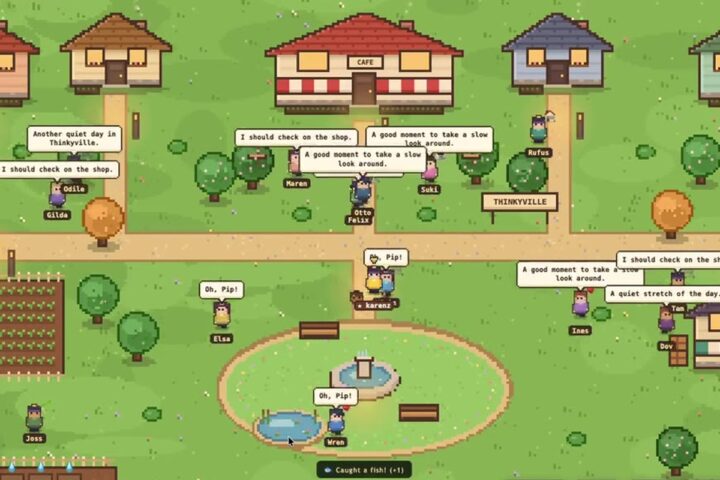
The company demonstrated the model powering 20 villagers in an offline pixel-art town, where characters plan activities and respond to messages. It also showed the model building a playable flight simulator on a MacBook during a flight. Those demonstrations illustrate possible uses rather than a guarantee that an autonomous agent will reliably complete any assignment.
What You Need to Run It
The model card lists a roughly 20GB checkpoint and support for Apple silicon systems with 32GB or more memory, including MacBooks, Mac minis and Mac Studios. Other GPU platforms are possible, with at least 32GB of video memory recommended. The download size should not be confused with the total memory needed to run it.
Inkling 2 Mini accepts text and images and produces text. Its maximum context window is one million tokens, although that specification does not mean a minimum-memory laptop can comfortably process a conversation of that size. The weights are available under Apache 2.0, allowing developers to modify and deploy the model subject to the license terms.
Developers can obtain the weights through Hugging Face and use local software such as Ollama. Hosted inference and fine-tuning are also available through Tinker. This follows the company’s earlier Inkling 2 Small release, extending its lineup with a model explicitly aimed at local hardware.
A Smaller Model That Reuses Its Layers
Inkling 2 Mini contains 26.4 billion parameters, with 3.4 billion active in its mixture-of-experts architecture. Its distinguishing feature is a loop through the middle of the network, giving it additional computation without storing three separate copies of those layers.
Goodfire’s accompanying interpretability research describes a 24-layer design: the first six layers run once, the middle 12 run three times, and the final six run once. Reusing those layers changes how computation is allocated inside the model; it does not eliminate the processing cost of extra passes.
Strong Coding Results, With Clear Limits
Thinking Machines reports a 48.2% score on DeepSWE v1.1 and 46.5% on Vals Index v2.2, placing Mini ahead of the under-100-billion-parameter open-weight models in its comparisons. These are task-specific results. The company acknowledges that Mini trails Qwen3.8-27B on multi-turn conversation and instructions with numerous constraints.
ARC Prize separately lists verified semi-private scores of 84.5% on ARC-AGI-1 and 49.3% on ARC-AGI-2 at the model’s xhigh reasoning setting. Those scores measure abstract puzzle-solving, rather than the reliability of an agent operating a real computer.
The practical appeal is control over where a model runs and how it is adapted. For developers choosing a local assistant, the useful next test is their own workload: whether it completes the task accurately, within the memory and time their hardware can provide.
Disclaimer: AIstify is an independent media brand owned and operated by NuvexMedia LLC, publishing news, research, and insights on artificial intelligence, emerging technologies, automation, and related industries. NuvexMedia LLC invests in and collaborates with companies across the AI, technology, software, and digital innovation sectors. These relationships do not influence AIstify’s editorial coverage, and the publication maintains full editorial independence to provide accurate, timely, and objective information. © 2026 NuvexMedia LLC. All rights reserved. This content is for informational purposes only and should not be considered legal, tax, investment, financial, or other professional advice.