Key Notes
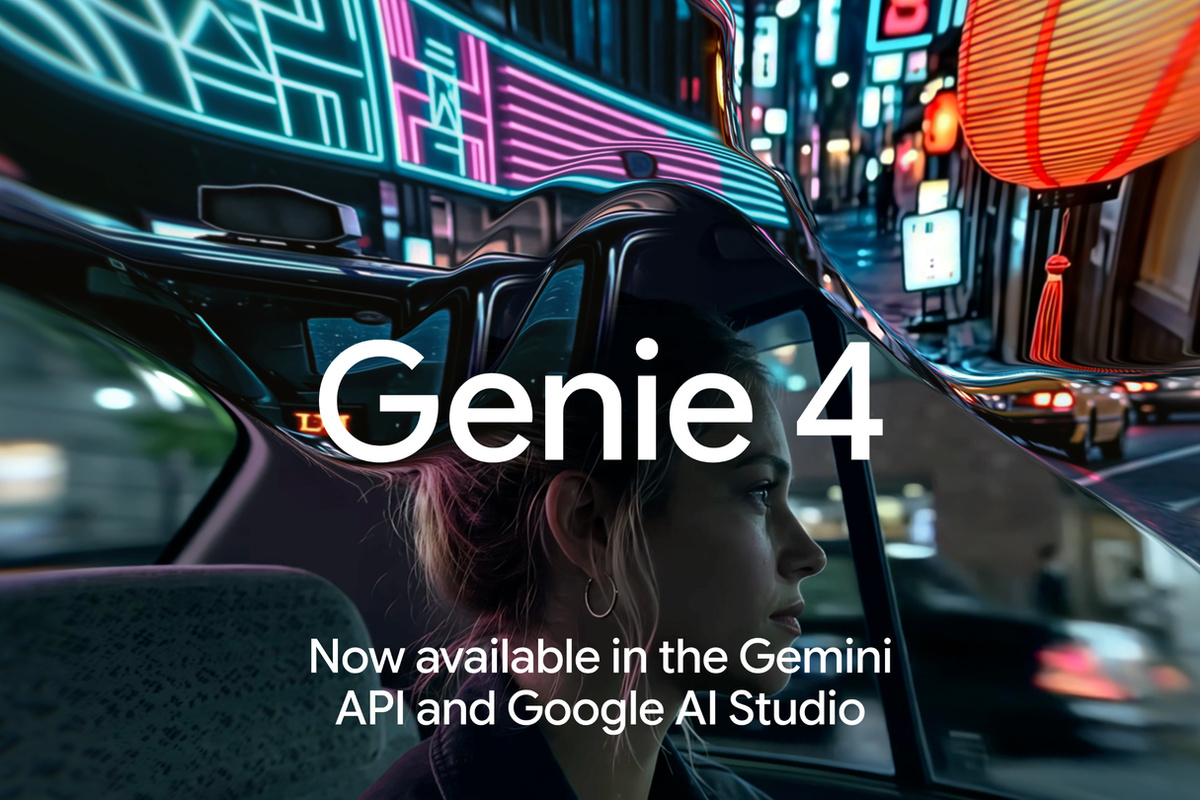
- Google opened Genie 4 through the Gemini API and AI Studio on November 19, with live 720p worlds at 24 frames per second and synchronized audio.
- The paid API charges about $6.05 per minute for video output with audio included, with input and text-output charges separate.
- Eligible Google AI Ultra subscribers can also use the updated Project Genie, while Google continues to identify consistency and interaction limits.
Google opened Genie 4 to developers on November 19, taking its interactive world model beyond a research preview and into the Gemini API and Google AI Studio. Instead of requesting a finished video clip, developers can build experiences that keep generating as someone moves through them.
The company announced access through its Interactions API, with 720p visuals running at 24 frames per second and synchronized sound. A text prompt, a reference image or both can establish the scene; keyboard input and further prompts steer what happens next.
The release follows the previous day’s rollout to eligible Google AI Ultra subscribers in Project Genie. It gives developers a separate route to experiment with the technology inside their own applications.
A World That Changes While You Explore
Genie 4 responds to instructions during a session. Developers can let a user change weather, lighting, objects or events while navigating, with audio generated alongside the evolving scene. Google lists interactive prototypes, spatial-design visualization and environments for testing robots and AI agents among potential applications.
That changes the design problem for an application. The next user action affects what the model must generate, so an experience needs to respond to unpredictable choices rather than play the same sequence for every viewer.
Google’s official DeepMind video, embedded above, demonstrates the wider Project Genie experience, including live direction and keyboard-controlled events. The API launch is the developer-access announcement; the video illustrates the underlying world model and consumer creation tools.
About $6.05 a Minute for Video Output
Google’s pricing page lists Genie 4 on the paid API tier, with no free tier. Video output costs $17.50 per million tokens, including stereo audio. At the documented rate of 5,760 video tokens a second, that works out to approximately $6.05 per minute.
Input text and reference images are charged separately at $1.50 per million tokens, while text output costs $9 per million. The minute figure therefore describes the video stream, rather than an all-inclusive price for every part of an application.
The developer documentation also flags a billing detail: closing a browser tab or disconnecting the client does not immediately stop server-side generation. Applications must explicitly complete an active session to end generation and its charges. For a public demo, session management becomes part of the operating budget.
A Research Model With Wider Access
The updated Project Genie lets eligible Ultra subscribers create and remix worlds through a conversational agent and share them in a community gallery. Google AI Pro members can join a waitlist. Those subscription arrangements are distinct from the paid developer API.
Google still describes Genie 3 and Genie 4 as frontier research systems. Its consumer launch post identifies camera latency, complex physical interactions, audio precision and persistent scenes as continuing challenges. Generated video and audio carry SynthID watermarks.
Our earlier coverage examined the gap between an impressive generated scene and a dependable simulator. Opening the API makes that question easier for developers to test: whether a world remains useful after repeated actions, edits and returns to the same objects.
Disclaimer: AIstify is an independent media brand owned and operated by NuvexMedia LLC, publishing news, research, and insights on artificial intelligence, emerging technologies, automation, and related industries. NuvexMedia LLC invests in and collaborates with companies across the AI, technology, software, and digital innovation sectors. These relationships do not influence AIstify’s editorial coverage, and the publication maintains full editorial independence to provide accurate, timely, and objective information. © 2026 NuvexMedia LLC. All rights reserved. This content is for informational purposes only and should not be considered legal, tax, investment, financial, or other professional advice.