Key Notes
- Gemini 4 Neon ranks second on the Vals Index, ahead of Opus 5.5 and GPT-6.2 Sol but behind Claude Fable 5.2.
- Standard API prices are $3 per million input tokens and $15 per million output tokens, with a one-million-token context window.
- Google is rolling out the general model broadly while reserving its cyber-focused version for approved defenders.
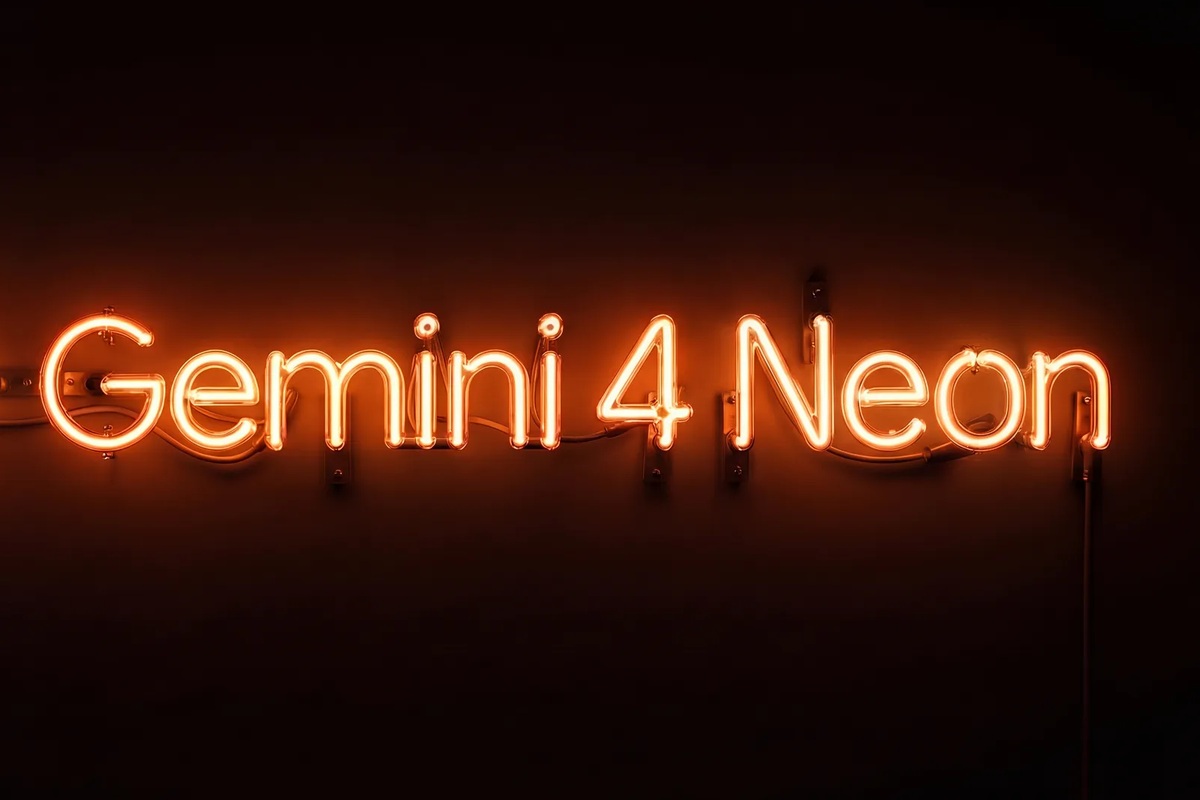
Google launched Gemini 4 Neon on November 18, targeting coding, analysis and AI agents that must carry out long, multi-step assignments.
The release follows OpenAI‘s GPT-6.2 launch and Anthropic‘s Claude refresh. Independent results put Neon close to the leaders, while showing why benchmark performance and the cost of getting work done need to be considered together.
Strong Results, With Trade-Offs
Vals AI ranks Neon second on its November 18 index at 70.87%, behind Claude Fable 5.2 at 71.31%. Claude Opus 5.5 scores 70.14%, while GPT-6.2 Sol reaches 66.06%. The index combines finance, coding, legal and tax tasks, weighted by their share of the American economy.
That leaderboard also puts Neon’s evaluation cost at $7.40 per test, compared with $24.77 for Opus 5.5 and $3.18 for GPT-6.2 Sol. Neon offers a stronger score than Sol in this evaluation, but Sol remains cheaper. These are benchmark costs under the evaluator’s setup, rather than subscription prices or quotes for a company’s workload.
Artificial Analysis records an Intelligence Index score of 61 at Neon’s xhigh reasoning setting. It also measures 21.5 minutes per index task, against a 12.1-minute median for comparable models. High reasoning effort can improve answers while increasing the time and tokens needed to produce them.
Google’s comparison also leaves Opus 5.5 ahead on Terminal-Bench 4.1 and FrontierCode 2.0. Neon’s advantages do not amount to a clean sweep.
Watch Neon Build a Ski Simulator
The official video above shows a ski simulator Google says Neon built in Antigravity using Mont Blanc and Chamonix terrain, custom shaders and spatial audio.
It is a useful illustration of the work Google wants agents to handle: coordinating code, graphics and interactive behavior within one project. A selected vendor demo, however, cannot establish how consistently the model will deliver a working application from a different request.
A Cybersecurity Lead With Restricted Access
The SEC-bench Pro leaderboard lists Neon at 90.5% success, ahead of GPT-6.2 Sol at 88.34%. Its overall ranking aggregates 183 V8 and Firefox instances. The benchmark evaluates vulnerability discovery and proof-of-concept generation in prepared environments; the score does not mean Neon can find 90.5% of the flaws in an arbitrary production system.
Google says the cyber-focused Neon will reach eligible Fairwind Program defenders over the coming days.
Fairwind restricts access to approved organizations and defensive or academic research. Participants must apply access controls and track employee use. That is a separate access path from the standard model’s public API rollout.
Pricing and Availability
Standard API pricing is $3 per million input tokens and $15 per million output tokens, with cached inputs priced at $0.15 per million. Neon supports a one-million-token context window, accepts text, images, audio and video, and returns text.
Google is rolling out Neon through the paid Gemini API in AI Studio, Gemini for business, and the Gemini app and Antigravity for Google AI Pro and Ultra subscribers.
For teams choosing an agent model, the useful comparison is the bill and elapsed time for a successfully completed task, including retries and human review. Token prices and leaderboard scores each capture only part of that decision.
Disclaimer: AIstify is an independent media brand owned and operated by NuvexMedia LLC, publishing news, research, and insights on artificial intelligence, emerging technologies, automation, and related industries. NuvexMedia LLC invests in and collaborates with companies across the AI, technology, software, and digital innovation sectors. These relationships do not influence AIstify’s editorial coverage, and the publication maintains full editorial independence to provide accurate, timely, and objective information. © 2026 NuvexMedia LLC. All rights reserved. This content is for informational purposes only and should not be considered legal, tax, investment, financial, or other professional advice.