Key Notes
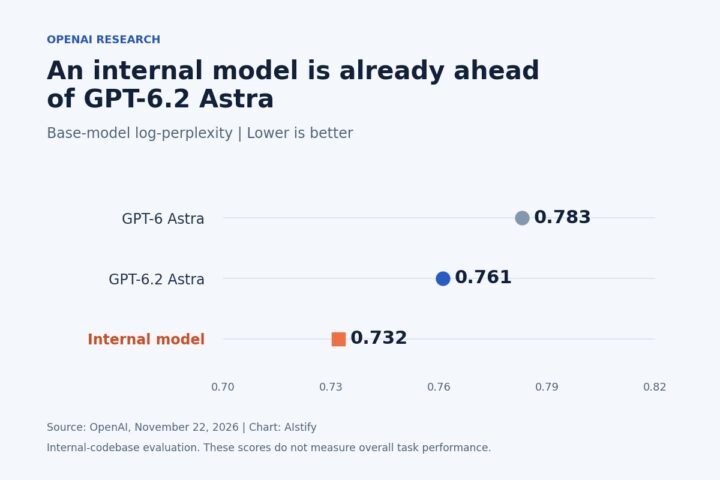
- An unnamed internal model scores better than GPT-6.2 Astra on OpenAI's base-model log-perplexity measure.
- Its 0.029-point lead is larger than the 0.022-point gap between GPT-6 Astra and GPT-6.2 Astra.
- The chart reveals training progress without announcing a new product or establishing overall task performance.
OpenAI has disclosed an unnamed internal model that beats GPT-6.2 Astra on its base-model training measure. The gap is larger than the previous improvement between the two released Astra generations shown in the company’s chart.
Chief scientist Jakub Pachocki shared the comparison in a November 22 essay. The internal model records log-perplexity of 0.732, against 0.761 for GPT-6.2 Astra. Lower scores are better.
A Bigger Step on OpenAI’s Own Measure
The chart gives GPT-6 Astra a score of 0.783. Its successor improved that by 0.022 points; the internal model is another 0.029 points below GPT-6.2 Astra. Both the latest public-model entry and the internal entry are dated November 2026.
That comparison suggests OpenAI’s research frontier has advanced beyond the base model underlying its newest released Astra system. The plotted gap is a concrete sign of further progress inside the lab. Translating that advance into better answers, more reliable agents or lower operating costs would require additional evidence.
What the Training Score Measures
Perplexity measures how well a model predicts unseen data. OpenAI’s scores use a fixed snapshot of its internal codebase, giving the company a consistent way to track pretraining progress across generations.
The distinction between a base model and a finished assistant matters. Pachocki notes that reasoning techniques can improve capabilities without reducing pretraining perplexity. A product’s usefulness also depends on how that underlying model is trained and configured for tasks.
The 0.029-point difference is therefore not a percentage increase in intelligence, coding accuracy or productivity. A direct comparison on the work users actually perform would be needed to establish those gains. The chart also does not supply the internal model’s name, price or availability date.
The Public Release and the Internal Frontier
OpenAI introduced GPT-6.2 Astra for demanding professional work, programming and scientific research, with Sol serving as a faster, more efficient everyday model. The company announced API access and a gradual rollout in ChatGPT Work and Codex.
For the released Astra model, OpenAI reported a 5.2-percentage-point improvement over GPT-6 Astra on Agents’ Last Exam at less than a third of the cost. That is a task-based result from the GPT-6.2 launch; the new internal-model point is a different kind of evidence about what comes next.
Pachocki published the training curve as part of his call for shared limits on AI development, tied to better understanding and monitoring of model behavior. For users watching the model race, the notable disclosure is that OpenAI already has a stronger base-model result than the one associated with GPT-6.2 Astra.
Disclaimer: AIstify is an independent media brand owned and operated by NuvexMedia LLC, publishing news, research, and insights on artificial intelligence, emerging technologies, automation, and related industries. NuvexMedia LLC invests in and collaborates with companies across the AI, technology, software, and digital innovation sectors. These relationships do not influence AIstify’s editorial coverage, and the publication maintains full editorial independence to provide accurate, timely, and objective information. © 2026 NuvexMedia LLC. All rights reserved. This content is for informational purposes only and should not be considered legal, tax, investment, financial, or other professional advice.