
Key Notes
- The startup reports a 4.59x geometric-mean efficiency gain across 25 workloads against an unnamed in-order core.
- The lead falls to 3.83x on 15 workloads excluded from design tuning.
- The results remain pre-silicon, with broader processor comparisons still planned.
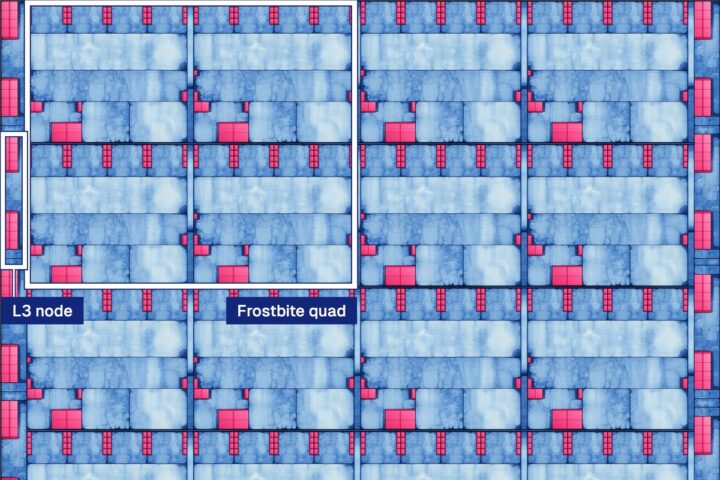
Architect Labs says its AI agents developed Frostbite, a new CPU architecture spanning software and hardware. The startup unveiled the project on November 18, reporting 4.59x the performance per watt of its comparison core.
The design has not been manufactured in silicon, Tom’s Hardware reported on Sunday. The results therefore describe a processor design evaluated before fabrication, rather than measurements from a finished chip.
The Number Behind the Headline
It compared four Frostbite tiles with a similarly sized, unnamed dual-issue, in-order core; the held-out efficiency gain was 3.83x.
Testing programs excluded from design tuning is a useful check of whether an improvement extends beyond the optimization targets. It still does not establish how Frostbite would compare with a high-end desktop processor or a multicore server CPU. An energy-efficiency advantage over one core is not a ranking of the wider processor market.
Keeping Parallel Work Visible
Frostbite uses interaction nets and Vine. Agents worked across its compiler, instruction set, hardware descriptions and verification, according to Architect Labs.
The developers of Vine explain interaction nets as graphs whose computations change small, local parts of a program. Independent operations can execute in parallel while preserving the result. Values are used once, making ownership explicit; duplication is itself an operation.
In that model, the compiler preserves information about which calculations depend on each other. Conventional instruction streams can discard that information, leaving the processor to reconstruct some of it at runtime. The attraction is a possible reduction in the circuitry and energy spent discovering work that can run together.
Humans selected the workloads used to guide development. For developers, the practical question is whether the gains survive porting useful programs, compiling them and running several applications together.
A Broader Chip-Design Race
OpenAI disclosed on November 18 that its models improved power, performance and area in parts of AMD‘s GPU design by up to 14%. Some changes were included in a design sent for manufacturing. Those circuit-level changes address a different engineering problem from creating a new architecture; the figures are not directly comparable.
Architect Labs plans FPGA access, public hardware descriptions and broader SPEC and PARSEC comparisons. Those steps would help outside developers test the design and assess how much of its advantage extends to their own software.
For chip buyers, the opportunity is a wider search for efficient hardware, with AI exploring changes across software and circuits. Broader comparisons and working hardware would provide a firmer basis for judging where Frostbite belongs.
Disclaimer: AIstify is an independent media brand owned and operated by NuvexMedia LLC, publishing news, research, and insights on artificial intelligence, emerging technologies, automation, and related industries. NuvexMedia LLC invests in and collaborates with companies across the AI, technology, software, and digital innovation sectors. These relationships do not influence AIstify’s editorial coverage, and the publication maintains full editorial independence to provide accurate, timely, and objective information. © 2026 NuvexMedia LLC. All rights reserved. This content is for informational purposes only and should not be considered legal, tax, investment, financial, or other professional advice.