Inception Launches Mercury 3 With 1,068 Tokens per Second
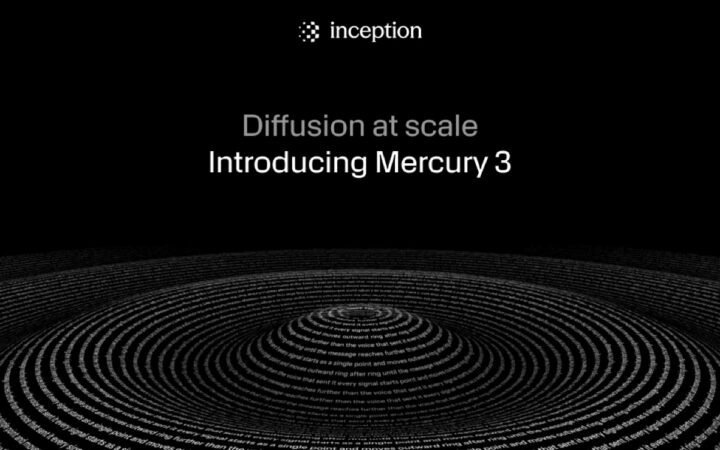
Inception says Mercury 3 delivers 1,068 tokens per second with a million-token context window, bringing diffusion-based AI to fast agents, tutoring and customer support.

Latency measures the delay between an AI request and the resulting response. Interactive generative systems often track time to first token, which reflects how quickly output begins, and time to last token, which captures total completion time. Latency comes from model computation, queueing, network transfer, retrieval, tool calls, safety checks, and application logic. It varies with prompt length, output length, model size, hardware, batching, cache use, and current load. Optimizing only average latency can hide poor experiences, so teams also monitor percentile values and separate each stage of the request. The right target depends on whether the product is conversational, analytical, offline, or safety-critical.
Inception says Mercury 3 delivers 1,068 tokens per second with a million-token context window, bringing diffusion-based AI to fast agents, tutoring and customer support.

MiniMax has released M3.1 Flash for AI agents, coding and computer use, with API pricing from $0.15 per million input tokens and claimed speeds above 200 tokens per second.
Germany has signed a joint declaration with Nvidia to advance industrial AI models for robotics, manufacturing and autonomous systems through its Industry 4.0 network.
World has introduced a bank-facing World ID suite that lets financial firms request proof of humanity, presence or selected attributes as AI deepfakes and agents reshape trust online.
Anthropic says Claude-driven development pushed code changes past 30,000 a day, turning Git infrastructure into a bottleneck and leading to its new Scion source-control system.
Anthropic says its new Public Benefit Fund will begin with 5% of company shares and could grow with its valuation to support major grants and direct distributions.
Anthropic is reportedly consulting law firms on how Claude agents could negotiate prices, disputes and work terms while acting for human users.
YC-backed Outlit says its AI agents continuously combine internal records and public signals to flag churn risk and sales opportunities across business accounts.
Anthropic co-founder Jack Clark said an internal scenario puts US GDP at $44 trillion by 2030 if rapidly improving AI drives new industries and faster scientific discovery.
Anthropic’s draft federal AI bill would allow a court-ordered halt only when a frontier model poses an imminent risk of more than $1 billion in damage or over 50 deaths or serious injuries.