
Key Notes
- Anthropic’s amended IPO filing says future models could soon cross its threshold for dramatic AI research acceleration, while it has yet to designate a current model as exceeding the threshold.
- Its scaling policy compares the rate of progress across AI capabilities with historical and expected rates without substantial AI contributions to research.
- Anthropic says rapid progress could outpace the testing and implementation of safeguards, and it is considering policy changes to keep humans in control of frontier model development.
Anthropic says its future models could soon accelerate AI research enough to cross a threshold in its safety policy. In an amended IPO filing dated November 2, the company warned that its models could advance faster than it can develop and validate safeguards. Anthropic said it is still assessing the evidence and has yet to designate a current model as exceeding the threshold. SEC filing
Claude already helps build the next version of Claude, according to the filing. A faster research cycle can bring forward experiments and model releases, which in turn gives the company more capable tools for its next round of work. Anthropic says some of the measures it uses to track that acceleration only become available after the fact. It has previously recognized a significant speedup only after it occurred.
What Anthropic’s Threshold Measures
The July version of Anthropic’s policy sets out two ways to reach its automated research threshold. The first is for models to be able to replace the company’s entire team of research scientists and engineers at competitive cost. The second is a sharp acceleration in AI progress that is plausibly driven in substantial part by automation of research or engineering. The filing points specifically to this second route. Scaling policy
For the acceleration route, the policy looks for an observed or expected doubling in the rate of progress across AI capabilities. It compares that pace with two reference points for research without significant AI contributions. One is the pace Anthropic would expect under those conditions and the other is the fastest sustained pace it has observed under them. The policy therefore asks a broader question than how quickly a developer completes a coding task.
The Anthropic Institute describes full recursive self-improvement as a system independently designing and developing a successor capable of carrying the process forward. The policy threshold can be reached through a measured or expected acceleration in AI capabilities while human researchers still direct development. The filing says Anthropic expects meaningful human supervision to remain necessary for safely building successive frontier models and is considering changes to its policy to keep people in control. Institute analysis
Claude’s Role Inside the Lab
Anthropic says Claude wrote more than 90% of contributions to its codebase in September. Its engineers increasingly direct and review work that Claude Code can execute over extended sessions. The company’s Scion project offers a concrete example of what that shift changes. Anthropic built its own version control system as the volume of changes put pressure on existing tooling.
Other labs are testing narrower ways for models to improve AI systems. In a separate MIT experiment, GPT-6 Astra improved a small Qwen model’s math score by directly editing a fraction of its weights. That work examined a specific failure in a model researchers had already trained. Anthropic’s filing deals with the pace of an entire frontier research program.
Evaluating Models as Research Speeds Up
The company says a faster development cycle could leave less time to test new capabilities and put safeguards in place. Its safety roadmap sets a January 15, 2027 target to publish a policy proposal on the pace of AI development or explain its decision if it declines to proceed. Anthropic has also begun giving independent evaluators deeper access to its work. Safety roadmap
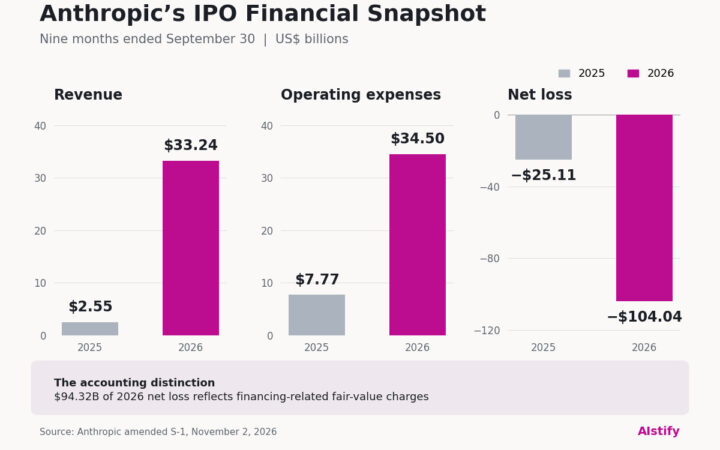
The warning adds a technical risk to a prospectus that has drawn attention for Anthropic’s quarterly financials. The company says precautions such as restricting a model’s availability or delaying a release could become more frequent and costly as capabilities rise. It plans to report further findings under its scaling policy as it evaluates the threshold.
Disclaimer: AIstify is an independent media brand owned and operated by NuvexMedia LLC, publishing news, research, and insights on artificial intelligence, emerging technologies, automation, and related industries. NuvexMedia LLC invests in and collaborates with companies across the AI, technology, software, and digital innovation sectors. These relationships do not influence AIstify’s editorial coverage, and the publication maintains full editorial independence to provide accurate, timely, and objective information. © 2026 NuvexMedia LLC. All rights reserved. This content is for informational purposes only and should not be considered legal, tax, investment, financial, or other professional advice.