Key Notes
- Microsoft plans to make Maia the primary inference system for its products and services, with Maia 300 production deployments and multi-gigawatt expansion starting in 2027.
- Maia 300 brings 96 accelerators per rack and 288 GB of HBM4 memory per accelerator, while Microsoft’s throughput and energy-efficiency claims still require assessment in deployed workloads.
- Nvidia and AMD remain Microsoft partners for model training, and Maia chips are not currently offered to outside companies as hourly rentals, according to CNBC.
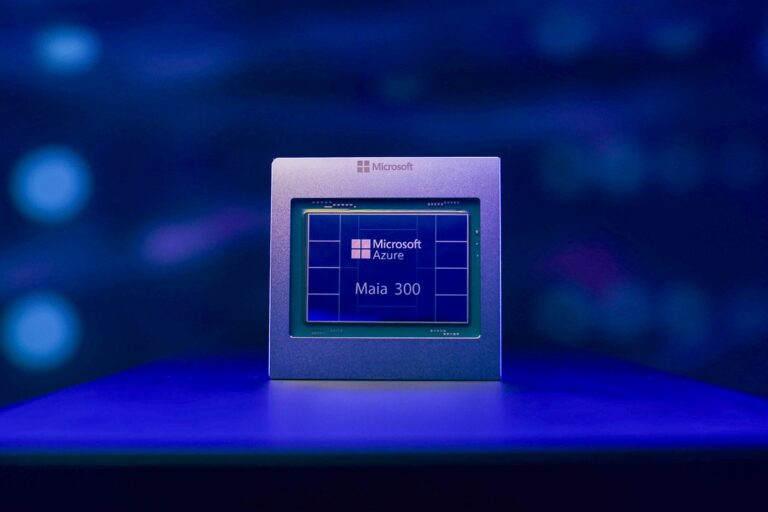
Microsoft plans to make its homegrown Maia chips the main inference system behind its products and services, setting up a larger role for custom silicon in a business that has depended heavily on Nvidia GPUs. Its newly unveiled Azure Maia 300 will begin production deployments in 2027, with the Maia family set to expand to multi-gigawatt scale starting that year.
The shift targets the repeated work of running AI models after they have been trained: answering questions, generating code and handling requests from agents. Microsoft’s October 12 announcement makes inference efficiency a central part of its infrastructure strategy as those workloads grow.
Maia Becomes Microsoft’s Main Inference Platform
The new generation builds on Maia 200, which Microsoft introduced in January. That chip is now serving production workloads, including Copilot. GitHub Copilot and Microsoft Foundry are expected to follow by the end of 2026, according to the company.
For Microsoft, owning the accelerator creates another way to tune the economics of its own services. A model that is trained once may answer millions of requests, making the cost of serving those responses a recurring operating issue. Hardware built around that work can be valuable even if it does not replace every GPU in the data center.
The change also gives Microsoft more influence over how software and hardware develop together. Copilot usage can inform the next chip design, while application teams can adapt their workloads to the hardware. The potential advantage comes from that coordination as much as from a processor’s headline specifications.
What Changes With Maia 300
Microsoft’s architecture breakdown describes a system built for long-context reasoning and sustained agent tasks. Maia 300 uses compute chiplets manufactured on TSMC’s N2P process, alongside separate memory-controller and input/output functions.
Each accelerator has eight HBM4 memory stacks, providing 288 GB of capacity and 18 TB/s of peak bandwidth. The rack doubles the previous generation’s accelerator count to 96, within a 167-kilowatt power envelope. Microsoft also describes an Ethernet-based network that can connect up to 12,288 accelerators in one superpod.
| Maia 300 specification | Microsoft’s stated figure |
|---|---|
| Accelerators per rack | 96 |
| Memory per accelerator | 288 GB HBM4 |
| Peak memory bandwidth | 18 TB/s per accelerator |
| Rack power envelope | 167 kW |
| Maximum superpod size | 12,288 accelerators |
Those specifications address different constraints. Memory capacity affects how much model and working state can stay close to the processor, while bandwidth determines how quickly that data can move. More accelerators only help when the network and software can keep them working together rather than waiting for one another.
Why Tokens per Megawatt Matter
Microsoft expects Maia 300 to deliver 40% more tokens per megawatt than leading GPU-based systems. It also claims up to 7x the rack-scale token throughput of Maia 200 in the full 96-accelerator configuration. These are company performance claims, with different comparison baselines, rather than interchangeable measures of speed.
Neither figure means an individual Copilot answer will arrive seven times faster. Rack throughput measures aggregate output, which can increase by serving more requests simultaneously. A customer’s experience also depends on the model, prompt length, response length and the time spent retrieving information or calling external tools.
The distinction matters for agents, which alternate between model inference and other work. AMD’s newly announced Helion racks emphasize CPU capacity for agent execution, with options for separate or integrated inference. Maia addresses the model-serving side of that wider infrastructure problem; the two announcements should not be treated as a direct performance comparison.
Nvidia and AMD Still Have a Role
A larger Maia deployment does not mean Microsoft is abandoning outside chip suppliers. General manager Alistair Speirs told CNBC that the company continues to partner with Nvidia and AMD for model training. CNBC also reported that Maia accelerators are not currently available for outside companies to rent by the hour, and that Speirs declined to give a firm timetable for the full multi-gigawatt expansion.
That leaves two practical questions for the rollout: how quickly Microsoft can add capacity, and how efficiently real workloads run on it. The 2027 production target establishes when the next generation is expected to arrive, but it does not establish the pace of adoption across every product.
For users, the eventual benefits would be more available AI capacity, lower serving costs or faster responses where the software can use the new hardware effectively. Those outcomes will need to be assessed as Maia 300 enters production. The announcement sets out Microsoft’s direction; sustained service performance will determine how much that direction changes everyday AI use.
Disclaimer: AIstify is an independent media brand owned and operated by NuvexMedia LLC, publishing news, research, and insights on artificial intelligence, emerging technologies, automation, and related industries. NuvexMedia LLC invests in and collaborates with companies across the AI, technology, software, and digital innovation sectors. These relationships do not influence AIstify’s editorial coverage, and the publication maintains full editorial independence to provide accurate, timely, and objective information. © 2026 NuvexMedia LLC. All rights reserved. This content is for informational purposes only and should not be considered legal, tax, investment, financial, or other professional advice.