Key Notes
- Microsoft has moved systems powered by Cisco Silicon One P200 into production, according to a Microsoft engineering executive quoted in Cisco's October 12 announcement.
- The P200 is a 51.2Tb/s deep-buffer routing processor designed to move network traffic, serving a different role from chips that perform AI calculations.
- Cisco has not disclosed Microsoft's exact system configuration, deployment size or measured performance gains, making this a customer deployment milestone rather than a new chip launch.
Microsoft has put systems powered by Cisco Silicon One P200 into production, marking a customer deployment milestone for networking hardware designed to connect large computing environments. Cisco disclosed the move on October 12, with confirmation from a Microsoft engineering executive.
In Cisco’s announcement, Microsoft corporate vice president of engineering Anand Ramakrishna said: “Microsoft has moved into production on systems powered by the Cisco Silicon One P200.” He cited the technology’s speed and buffering capabilities as support for the company’s growing cloud and high-performance services.
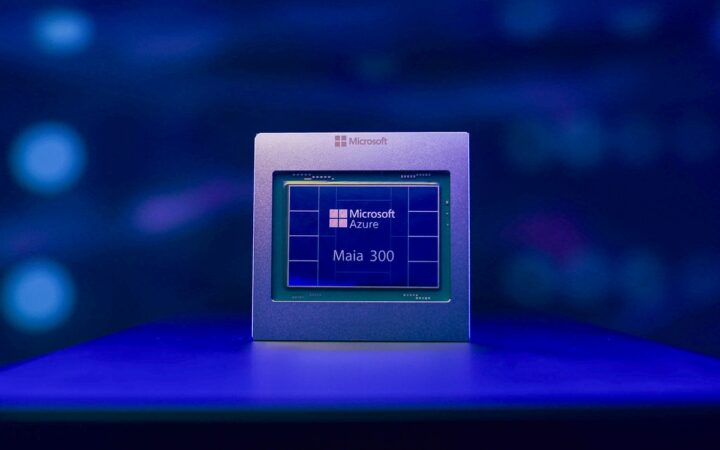
The milestone concerns routing processors, which move data through networks. P200 serves a different role from the accelerators that train AI models or generate their responses. For Microsoft, it adds to the infrastructure story surrounding its Maia chips, addressing how systems communicate rather than how they perform AI calculations.
Why Deep Buffers Matter for AI Traffic
Cisco’s P200 specifications describe a programmable, deep-buffer routing processor with 51.2Tb/s of full-duplex capacity. It can be used in standalone routers, modular equipment and larger distributed systems. That gives network builders several ways to incorporate the same silicon into their infrastructure.
Buffers temporarily hold packets when incoming traffic exceeds the capacity available to forward it immediately. They can help absorb bursts and reduce packet loss, although they do not create additional bandwidth or remove the physical distance between facilities. For distributed computing, the challenge is to manage those bursts without allowing communication to become a persistent bottleneck.
Cisco positions P200 around “scale-across” networking, which connects computing capacity across separate data centers. Its broader architecture combines deep-buffer systems and optical links for coordinated AI workloads, where congestion or network recovery can affect how efficiently a shared job progresses.
The company’s router overview shows how that silicon can translate into equipment. P200-based Cisco 8000 systems include a fixed three-rack-unit design with 51.2Tb/s capacity and 64 ports of 800 Gigabit Ethernet, as well as modular configurations. The portfolio supports Cisco IOS XR and open-source SONiC, with inline MACsec encryption for data in transit.
Those are capabilities of Cisco’s product portfolio; the announcement does not identify Microsoft’s exact router model or operating system. It also does not quantify the number of deployed systems, the investment involved or a measured performance improvement for Microsoft’s services.
A Deployment Milestone After the P200 Launch
P200 is not a newly unveiled chip. Cisco introduced it in October 2025 alongside its 8223 routing system, a launch we covered in our earlier report. Today’s development is Microsoft’s move into production, rather than the arrival of a new processor generation.
Microsoft is not the only named customer in Cisco’s update. Alibaba Cloud said it has deployed P200-powered Quantum Cat routers at scale in its eCORE backbone, pairing Cisco silicon with its own hardware and SONiC. That deployment illustrates a separate route to using the technology, without establishing that Microsoft has chosen the same configuration.
The update also sits alongside Nvidia and Cisco’s proposed USFP optics, which target denser connections for future AI networks. P200’s production deployment and USFP’s development plans represent different stages of that buildout. For cloud operators, the common question is how to keep computing resources connected as capacity expands across racks, buildings and locations.
Disclaimer: AIstify is an independent media brand owned and operated by NuvexMedia LLC, publishing news, research, and insights on artificial intelligence, emerging technologies, automation, and related industries. NuvexMedia LLC invests in and collaborates with companies across the AI, technology, software, and digital innovation sectors. These relationships do not influence AIstify’s editorial coverage, and the publication maintains full editorial independence to provide accurate, timely, and objective information. © 2026 NuvexMedia LLC. All rights reserved. This content is for informational purposes only and should not be considered legal, tax, investment, financial, or other professional advice.