OpenAI Launches Codex for Windows
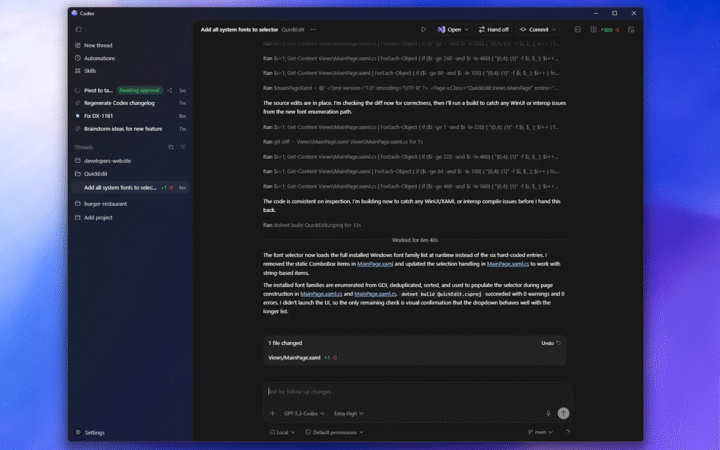
OpenAI has released the Windows version of its Codex agentic coding application following strong adoption on Mac. The tool brings AI-driven coding agents and native Windows workflows to more developers.
Causal language modeling, abbreviated CLM, is a training objective in which a model predicts the next token from tokens that came before it. A causal attention mask prevents information from later positions from leaking into each prediction. Repeating this task across large text collections teaches an autoregressive model statistical patterns of language, knowledge associations, and ways to continue a sequence. At inference time, the model generates text token by token using the same left-to-right dependency. CLM differs from masked language modeling, which hides selected tokens inside a sequence and uses surrounding context on both sides. The objective supports open-ended generation but does not guarantee factual or intentional understanding.
OpenAI has released the Windows version of its Codex agentic coding application following strong adoption on Mac. The tool brings AI-driven coding agents and native Windows workflows to more developers.

Nvidia CEO Jensen Huang said the company’s $30 billion investment in OpenAI could be its last before the AI startup pursues an initial public offering. The chipmaker also indicated its $10 billion investment in Anthropic may mark the end of its funding commitments to major AI model developers.
OpenAI is reportedly developing a new code hosting platform that could compete with Microsoft-owned GitHub. The project follows service disruptions affecting GitHub and reflects OpenAI’s expanding developer platform strategy.
Anthropic’s annualized revenue has surged to nearly $20 billion even as the U.S. government classifies the company as a supply chain risk. The AI firm plans to challenge the designation while demand for its Claude models continues to grow.
Google introduced Gemini 3.1 Flash-Lite, a faster and lower-cost model designed for high-volume developer workloads. The model emphasizes speed, efficiency, and scalable reasoning for real-time applications.
OpenAI is considering a deal to deploy its AI models across NATO’s unclassified networks days after securing a Pentagon agreement. The discussions highlight expanding military adoption of generative AI technologies.
Multiple U.S. federal agencies, including State, Treasury, and HHS, have ceased using Anthropic’s Claude following a White House directive. Agencies are transitioning to alternatives such as OpenAI amid national security and ethical concerns.
Anthropic’s Claude rose to No. 1 on the U.S. App Store as backlash grew over OpenAI’s Pentagon deal. Market data shows surging downloads for Claude and a sharp spike in ChatGPT uninstallations.
OpenAI reached a rapid agreement with the Department of Defense to deploy its AI models in classified environments, following the breakdown of Anthropic’s negotiations. The move sparked debate over safeguards, deployment, and AI ethics in national security operations.
Despite President Trump’s directive to cease federal use of Anthropic’s Claude AI, U.S. military forces reportedly employed the model for intelligence, target selection, and battlefield simulations in airstrikes on Iran.