After Anthropic’s Newest Models Were Banned Abroad, Europe and Canada Rush to Build Their Own AI
Anthropic’s Fable 5 and Mythos 5 shutdown, the first US export control on an LLM, has Carney and EU lawmakers pushing to reduce reliance on American AI.
Prompt injection is an attack in which untrusted text or content attempts to override an AI application’s instructions. The malicious instruction may come directly from a user or indirectly from a webpage, document, email, or tool result processed by the model. If successful, it can cause data disclosure, unauthorized tool use, altered output, or bypassed policies. Because language models do not inherently distinguish trusted commands from quoted content, filtering suspicious phrases alone is insufficient. Defenses include isolating data from instructions, minimizing permissions, validating tool arguments, requiring approval for sensitive actions, restricting secrets, and testing with adversarial content. Applications should assume that any external content may contain instructions designed to manipulate the model.
Anthropic’s Fable 5 and Mythos 5 shutdown, the first US export control on an LLM, has Carney and EU lawmakers pushing to reduce reliance on American AI.
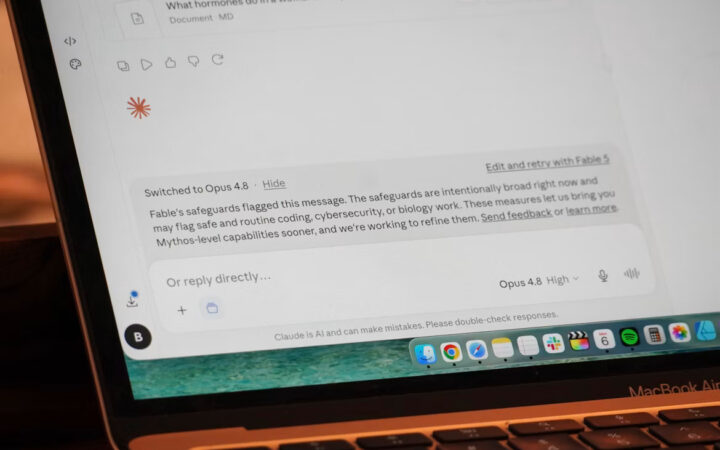
Anthropic has disabled Claude Fable 5 and Claude Mythos 5 globally after a U.S. government export-control directive restricted access to the models for foreign nationals, prompting the company to challenge the decision publicly.
Anthropic CEO Dario Amodei published an essay urging binding, FAA-style safety testing for frontier AI models, marking a shift from the company’s earlier focus on transparency.
OneSoil has partnered with Rainbow Weather to bring hyperlocal AI-powered rainfall forecasting to farmers worldwide, helping improve field operations and reduce weather-related losses.
Anthropic says cybercriminals are increasingly using AI for advanced post-compromise operations and autonomous attack chains. The company argues that existing cybersecurity frameworks may no longer fully capture how AI-powered threats operate.
Anthropic is expanding Project Glasswing to approximately 200 organizations using Claude Mythos Preview to identify software vulnerabilities. The initiative aims to strengthen cybersecurity defenses as increasingly powerful AI models become widely available.
Anthropic released a new security plugin for Claude Code that reviews AI-generated code for vulnerabilities while it is being written. The system uses a separate Claude instance to scan changes in the background and automatically suggest fixes before code reaches pull requests.
BNP Paribas says it is strengthening cybersecurity defenses as increasingly powerful AI systems accelerate the discovery of software vulnerabilities across the financial sector.
Anthropic co-founder Chris Olah told the Vatican that AI development cannot be left solely to technology companies, warning about commercial incentives, labor disruption, and the growing complexity of frontier AI systems.
Anthropic says its unreleased Mythos AI model has identified more than 10,000 high- and critical-severity software vulnerabilities as part of Project Glasswing, a cybersecurity initiative focused on protecting critical infrastructure and open-source software.