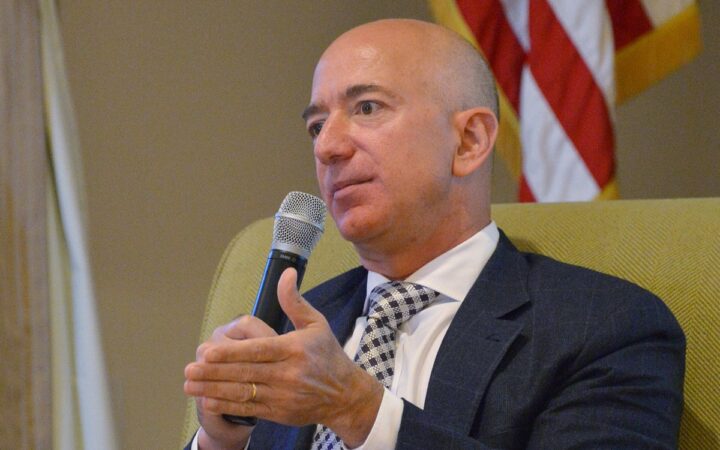
Jeff Bezos Says AI Could Bring Three-Day Workweeks
Jeff Bezos says AI could let families live on one income or work three days a week, but has offered no timetable or plan for sharing the gains.
Low-rank adaptation, known as LoRA, fine-tunes a model by training small added matrices while leaving the original weights frozen. The method assumes that useful task-specific changes can be represented with far fewer parameters than the full model contains. This lowers memory requirements, shortens training, and makes it practical to store separate adapters for different domains or styles. LoRA is common with large language and image models, although adapter quality still depends on data, rank, target layers, and evaluation. It does not update a model’s knowledge automatically or remove inherited risks, and combining several adapters can create interactions that require additional testing before deployment.
Jeff Bezos says AI could let families live on one income or work three days a week, but has offered no timetable or plan for sharing the gains.

Claude Haiku 5.5 cuts costs for everyday AI tasks, with API rates up to 20x below Sonnet and Anthropic-reported benchmark gains over GPT-6 Luna.
Google’s SynthID Detector is now available globally for image, video and audio checks. It detects supported AI watermarks, rather than proving a file is real.
Google Playground turns prompts into browser games without coding. Unity Spark will add a more advanced creation path, with a closed beta coming soon.
Google’s Nano Banana 2.1 improves image quality, text and editing consistency while cutting its image-output token price to a quarter of Nano Banana Pro’s rate.
OpenAI will watermark eligible ChatGPT and Codex text in the EU, but restricted detector access and editing-related limitations complicate the promise of identifying AI writing.
Google unveils Gemini 4 Argon, its most powerful AI model yet, with a one-million-token output limit, introductory API pricing, and a phased rollout.
Anthropic says Claude Opus 5.5 approaches Fable-level performance while costing 40% less to run than Opus 5 on typical workloads. Sonnet and Haiku 5.5 will follow in the coming weeks.
Alibaba unveiled its Zhenwu V900 AI chip and confirmed plans for a Qwen model of up to 10 trillion parameters, alongside a target of more than 20 gigawatts of cloud capacity by 2032.
SpaceXAI has released Grok 4.7, a coding and knowledge work model priced the same as Grok 4.6 but built on a larger base model with new safety testing and benchmark comparisons against rivals.