Key Notes
- Jeff Bezos predicts AI productivity could support three-day workweeks and single-income households.
- Amazon announced roughly 30,000 role reductions across two rounds.
- The forecast includes no timetable or plan for distributing productivity gains.
Jeff Bezos thinks artificial intelligence could eventually let people support their families while working just three days a week. The Amazon founder’s prediction also extends to households where both partners currently work: higher productivity, he argues, could make a single income sufficient. But the prospect of a three-day workweek comes without a timetable or an explanation of how those gains would reach ordinary workers.
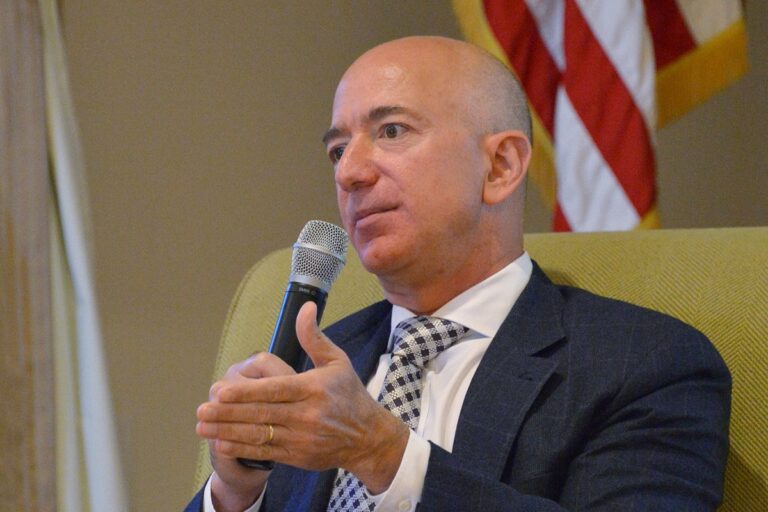
Bezos spoke with Bret Baier in a Fox News interview on Wednesday, October 7. He expects AI to make labor so productive that some people will choose shorter hours or leave employment altogether, potentially creating a shortage of workers rather than persistent mass unemployment.
What Bezos’s Three-Day Workweek Would Require
The distinction is between being able to produce more and being able to earn enough while working less. AI could help someone complete a task faster, but that alone does not determine their pay, their contracted hours or the cost of supporting a household. Employers could use the same productivity improvement to expand output, reduce staffing or increase profits.
For Bezos’s forecast to become a practical option for families, some of the gains would need to reach them through higher real wages, lower living costs or shorter hours without a corresponding loss of income. Those outcomes depend on business decisions, competition, bargaining power and policy. An improvement in a model’s capabilities cannot, by itself, settle how the resulting benefits are shared.
That makes the missing detail consequential. A three-day schedule that preserves a worker’s purchasing power would be a substantial change; a three-day schedule accompanied by a large pay cut would offer a very different bargain. Bezos did not set out a mechanism for delivering the former or identify when it might become widely affordable.
Amazon’s 30,000 Job Cuts Complicate the Picture
Asked about Amazon’s roughly 30,000 job cuts, Bezos attributed the reductions to excessive hiring during the pandemic. His explanation places the immediate restructuring in the context of an earlier expansion, rather than presenting it as evidence that AI has already created the abundance he anticipates.
Amazon’s own announcements establish the scale of those reductions. The company outlined around 14,000 corporate cuts in October 2025, followed by approximately 16,000 role reductions in January 2026. Together, those announcements amount to about 30,000 positions, although they do not establish that every affected role was eliminated because of AI.
The company described its restructuring in terms of removing organizational layers and bureaucracy while directing resources toward priority areas. Our coverage of the January layoffs examined that tension between substantial workforce reductions and continued investment in AI. It is a more immediate picture of changing employment than the shorter working week Bezos envisions.
Amazon’s CEO Has Also Predicted a Smaller Workforce
Andy Jassy has been more explicit about AI’s implications inside Amazon. In a June 2025 staff message, the chief executive said efficiency gains from generative AI and agents were expected to reduce Amazon’s total corporate workforce over the following few years. Some jobs would require fewer people, while other types of work would require more.
That statement does not prove AI caused all of Amazon’s subsequent cuts. It does show why a broad prediction of future labor shortages can coexist with nearer-term expectations of fewer corporate employees at a major AI investor. The effects can differ across occupations, employers and stages of adoption.
A Prediction, Not a New Amazon Work Policy
Bezos’s argument belongs to a wider debate about whether increasingly capable machines will make paid employment less central to everyday life. Elon Musk has put forward a similar vision of universal high income driven by AI and robots. Both forecasts raise the question of how greater productive capacity becomes financial security for people who do not own that technology.
For now, Bezos’s remarks do not amount to an Amazon commitment to introduce a three-day working week. The unresolved issue is not simply how much work AI can perform, but whether families will receive enough of the benefit to choose fewer hours without sacrificing their standard of living.
Disclaimer: AIstify is an independent media brand owned and operated by NuvexMedia LLC, publishing news, research, and insights on artificial intelligence, emerging technologies, automation, and related industries. NuvexMedia LLC invests in and collaborates with companies across the AI, technology, software, and digital innovation sectors. These relationships do not influence AIstify’s editorial coverage, and the publication maintains full editorial independence to provide accurate, timely, and objective information. © 2026 NuvexMedia LLC. All rights reserved. This content is for informational purposes only and should not be considered legal, tax, investment, financial, or other professional advice.