Anthropic Creates Public Benefit Fund With 5% Equity Commitment
Anthropic says its new Public Benefit Fund will begin with 5% of company shares and could grow with its valuation to support major grants and direct distributions.

A KV cache, or key-value cache, speeds up autoregressive transformer inference by storing attention information calculated for tokens that have already been processed. Without the cache, the model would recompute those keys and values each time it generates another token. Reusing them reduces repeated work and improves response latency, especially for long prompts and outputs. The tradeoff is memory: cache size grows with sequence length, batch size, layer count, and model dimensions. Production systems manage this cost with paging, quantization, eviction, prompt caching, and request scheduling. KV caching changes inference efficiency, not the model’s learned knowledge, and cached data must be protected when prompts contain sensitive information.
Anthropic says its new Public Benefit Fund will begin with 5% of company shares and could grow with its valuation to support major grants and direct distributions.
Anthropic is reportedly consulting law firms on how Claude agents could negotiate prices, disputes and work terms while acting for human users.
YC-backed Outlit says its AI agents continuously combine internal records and public signals to flag churn risk and sales opportunities across business accounts.
Anthropic co-founder Jack Clark said an internal scenario puts US GDP at $44 trillion by 2030 if rapidly improving AI drives new industries and faster scientific discovery.
Anthropic’s draft federal AI bill would allow a court-ordered halt only when a frontier model poses an imminent risk of more than $1 billion in damage or over 50 deaths or serious injuries.
Anthropic says junior technical hires fell from 27% to 9% while employee-directed Claude agents logged six times more runtime than their human handlers.
DeepSeek’s V4.1-Flash-1017 claims faster, shorter responses at the same model price while Search and Fetch APIs open its web tools to developers.
Reflection’s Apache 2.0 Beam model has 501B total parameters, 23B active per token and a 1M-token context window for coding and agentic work.
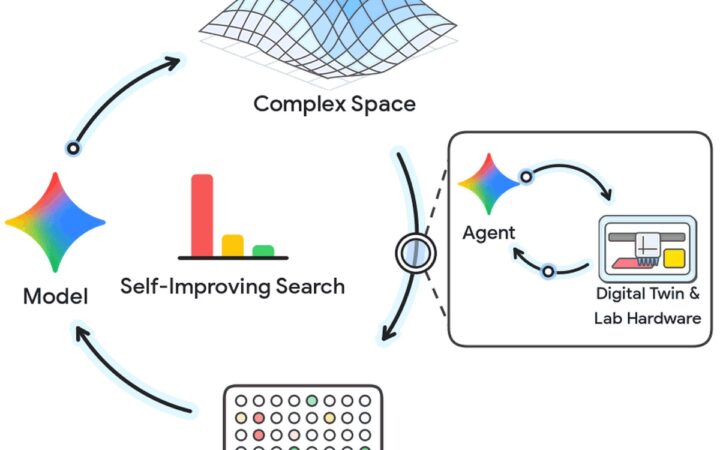
Google Research says its agent workflows use a digital twin, simulation and human authorization to run and refine wet-lab experiments.
OpenAI and Meta warned a federal evidence panel that no universal tool can reliably authenticate every AI-generated image or video.