Key Notes
- Google Research's VERID framework gives AI agents a live digital twin of laboratory hardware, reagents and physical constraints before a robot acts.
- The reported aptamer experiments used repeated wet-lab feedback to revise candidate designs after earlier rounds exposed errors and non-specific binding.
- Google describes the work as human-directed research, with simulation, screening and authorization steps before protocols reach laboratory robots.
Google Research has outlined a set of projects that move AI agents closer to real laboratory work: not simply proposing a molecule on a screen, but planning, simulating and helping execute an experiment on liquid-handling robots. The work is still presented as research rather than a product for autonomous science, but it offers a detailed look at what has to exist before an agent can safely operate around reagents, robotics and imperfect physical measurements.
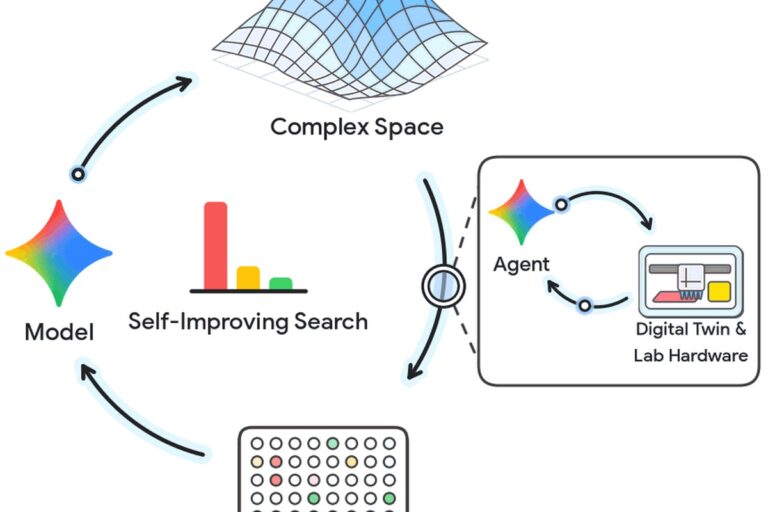
At the center is VERID, short for Verified Infrastructure for Discovery Laboratories. Google describes it as a live digital twin of a laboratory workcell that tracks robot geometry, well volumes, reagents and pipette tips. The system is intended to stop an agent from sending code that is syntactically valid but physically impossible, such as drawing liquid from an empty well or sending a pipette into a container it cannot fit.
A digital twin before a robot moves
According to Google Research, VERID lets agents test a proposed protocol in simulation before it reaches laboratory hardware. The framework combines state tracking, virtual dry runs, hardware safety checks, and synchronized video and action logs. That combination makes the agent’s work easier to review and creates a record when a run produces an unexpected result.
The significance is less about replacing scientists with a chatbot and more about tightening the loop between design and evidence. Many AI systems can generate a plausible biological hypothesis, but their predictions still need an experimental readout. The digital-twin layer gives an agent information about the physical context that a language model alone does not reliably understand.
Three cycles of design, test and revision
Google also reported agent-assisted experiments on aptamers, short DNA sequences that can bind to target proteins. Across three design-test-analyze cycles, the researchers used wet-lab results to alter the next round of candidates. On one target, the reported confirmed on-target hit rate reached 33.5%; on another, it reached 42.1% at 98.5% specificity after the workflow corrected for a failure mode in earlier rounds.
Those numbers should be read as results from the disclosed experiments, not a promise that an agent can discover a drug on demand. In one case, the system initially overvalued sticky sequences that attached to unintended targets. The next round changed the design rules after the real-world data exposed that problem. That feedback cycle is exactly why a lab-in-the-loop approach differs from a purely computational model ranking candidates in isolation.
Protein binders and the human role
In a separate protein-binder project, Google said the team used agent-guided epitope excision to focus computation on the local binding pocket. The company says this sped up a structure-prediction step 8.6x and produced binders for a cancer-associated target with single-digit nanomolar affinity. Google frames the result as a human-agent workflow: scientists set the overall strategy while the system drives tactical exploration and experimental iteration.
That direction connects with the broader race to apply advanced models to biology. Recent work on enzyme discovery has shown the potential of AI in early scientific search, while this effort emphasizes the less glamorous but essential part: validating a hypothesis against a real system. For wet-lab agents, reliability depends on both the model’s reasoning and the controls around the robot.
Google says every designed sequence in its projects passes biosecurity screening, protocols are simulated before execution, and humans authorize and review the work. Those safeguards underline the current boundary: the goal is not an unsupervised laboratory, but a more traceable scientific loop where agents can explore, learn from results and remain subject to human scientific judgment.
Disclaimer: AIstify is an independent media brand owned and operated by NuvexMedia LLC, publishing news, research, and insights on artificial intelligence, emerging technologies, automation, and related industries. NuvexMedia LLC invests in and collaborates with companies across the AI, technology, software, and digital innovation sectors. These relationships do not influence AIstify’s editorial coverage, and the publication maintains full editorial independence to provide accurate, timely, and objective information. © 2026 NuvexMedia LLC. All rights reserved. This content is for informational purposes only and should not be considered legal, tax, investment, financial, or other professional advice.