Google DeepMind Unveils AlphaGenome DNA Prediction Model
Google DeepMind has introduced AlphaGenome, a new AI model designed to analyze long DNA sequences and predict how genetic variations may influence disease development.
A GPU, or graphics processing unit, is a processor built to perform many calculations in parallel. Although originally designed for rendering graphics, this structure is well suited to the matrix and vector operations at the center of deep learning. GPUs accelerate both model training and inference, and multiple units can be connected to handle larger models or datasets. Performance depends not only on raw arithmetic speed but also on memory capacity, memory bandwidth, interconnects, numerical formats, cooling, and software libraries. Consumer, data-center, and integrated GPUs serve different workloads, so the most expensive chip is not automatically the most efficient choice for every AI application.
Google DeepMind has introduced AlphaGenome, a new AI model designed to analyze long DNA sequences and predict how genetic variations may influence disease development.
Amazon is in early discussions to invest tens of billions of dollars in OpenAI, a move that could deepen its position in the global AI race and make it the startup’s largest new backer.
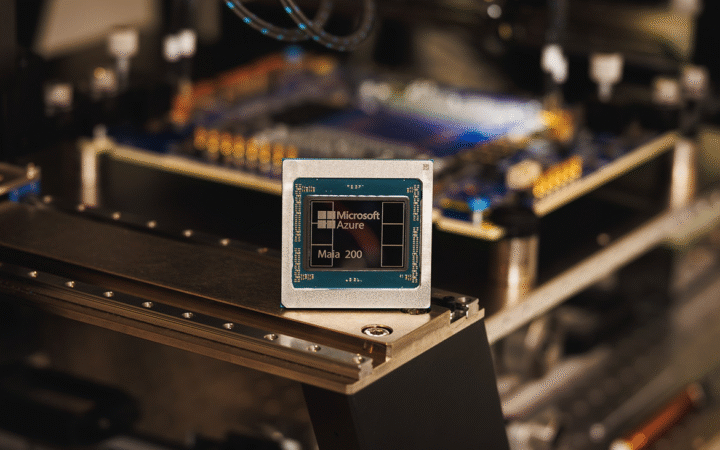
Microsoft has introduced Maia 200, a new AI chip built with TSMC and designed to power GPT-5.2 and Microsoft 365 Copilot, promising faster, more efficient AI performance.
Apple is reportedly working on a pin-shaped AI wearable with cameras and microphones, potentially launching in 2027, signaling increased competition in the AI hardware space.
OpenAI now uses age prediction to adjust ChatGPT’s safety settings for teens. Users 18 and older can verify their age to disable extra restrictions.
OpenAI is on track to unveil its first consumer device in the second half of 2026, signaling a major expansion beyond software as the company explores a new category of AI-native hardware.
OpenAI has invested in Merge Labs, a brain-computer interface startup founded by CEO Sam Altman, as part of a $250 million seed round valuing the company at $850 million.
xAI closed a $20 billion Series E round, exceeding its original target and adding strategic backing from NVIDIA and Cisco. The funding supports expanded data center capacity, large-scale GPU deployment, and continued development of the Grok model family.
Beyond major product launches, CES 2026 is highlighting a wave of unconventional AI-powered devices, from holographic assistants to robotic pets and smart kitchen tools. The gadgets reflect how artificial intelligence is moving into niche consumer applications.
Google released a major upgrade to its Gemini Deep Research agent, giving developers access to advanced autonomous research capabilities through the Interactions API. The company also introduced DeepSearchQA, a benchmark for evaluating multi-step web research agents.