OpenAI Tells Developers to Stop Over-Prompting GPT-5.6
OpenAI’s new GPT-5.6 prompting guide urges developers to write shorter, outcome-first prompts, saying leaner instructions raised scores 10-15% while cutting tokens and cost sharply.

Prompt engineering is the practice of designing instructions and context that help a generative AI system perform a task reliably. A strong prompt clarifies the objective, audience, constraints, source material, desired format, and what the model should do when information is missing. Examples can demonstrate expected behavior, while structured sections make complex requests easier to follow. Prompting cannot add knowledge the model lacks or guarantee factual accuracy, and techniques may behave differently across model versions. Production prompts are treated like other application components: they are versioned, tested against representative and adversarial cases, measured for quality and cost, and paired with retrieval, validation, permissions, or human review when needed.
OpenAI’s new GPT-5.6 prompting guide urges developers to write shorter, outcome-first prompts, saying leaner instructions raised scores 10-15% while cutting tokens and cost sharply.

Anthropic has disabled Claude Fable 5 and Claude Mythos 5 globally after a U.S. government export-control directive restricted access to the models for foreign nationals, prompting the company to challenge the decision publicly.
OneSoil has partnered with Rainbow Weather to bring hyperlocal AI-powered rainfall forecasting to farmers worldwide, helping improve field operations and reduce weather-related losses.
A new study from researchers at Massachusetts Institute of Technology and University of Southern California finds generative AI is rapidly increasing the number of Americans filing lawsuits without lawyers in U.S. federal courts.
Polish startup Viktor has raised $75 million in a funding round led by Accel to expand its AI-powered digital employee platform. The company says its autonomous AI agents can manage operational tasks across enterprise tools for weeks at a time.
Notion has introduced a developer platform that expands its AI agent capabilities with workflow orchestration, external integrations, and custom code execution.
OpenAI has launched GPT-5.5, a new flagship model designed for coding, computer use, knowledge work, and scientific research, with stronger performance, lower token usage, and broader real-world autonomy than GPT-5.4.
OpenAI has introduced Chronicle, a new Codex feature that tracks screen activity and builds context automatically. The tool raises privacy and security concerns.
HappyHorse-1.0, an open-source AI video model, has topped global benchmarks, outperforming leading proprietary systems and signaling a shift in the video generation market.
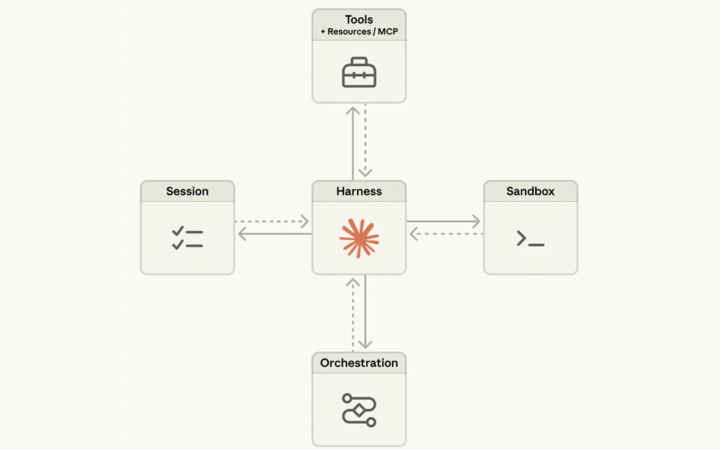
Anthropic has launched Managed Agents, a new system designed to run long-horizon AI tasks by separating reasoning, execution, and memory layers. The approach aims to improve reliability and scalability.