
Key Notes
- SpaceX says it will build its AI computing stack exclusively on NVIDIA architecture and adapt Vera Rubin NVL72 systems for Starmind satellites.
- Elon Musk expects initial launches in 2027, while SpaceX describes a constellation that could eventually contain thousands of AI satellites.
- Cooling, radiation, power and networking remain major engineering constraints, so the announcement is a roadmap rather than proof of an operating orbital data center.
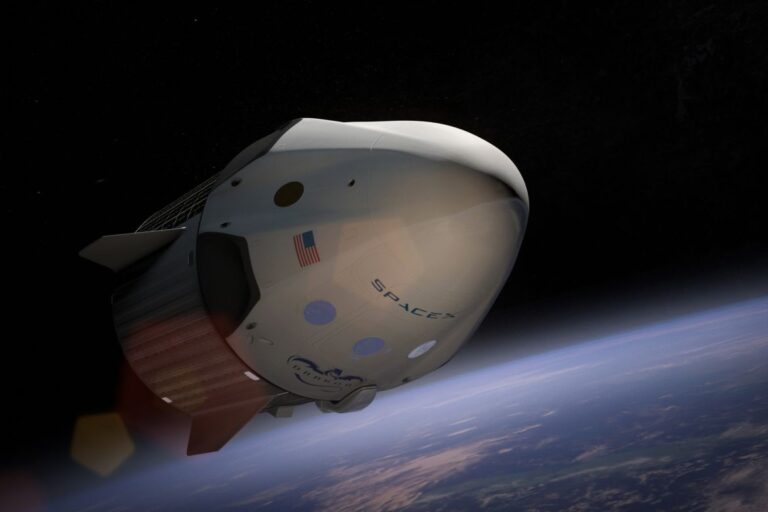
SpaceX has selected NVIDIA‘s Vera Rubin architecture as the computing foundation for Starmind, its planned network of artificial intelligence satellites.
Elon Musk said SpaceX and its AI operations would build exclusively on NVIDIA hardware, describing Vera Rubin as the strongest available architecture. He also said an optimized version of the Vera Rubin NVL72 system could begin launching in 2027, according to Tom’s Hardware.
An NVL72 is a rack-scale computer built around 72 Rubin GPUs and 36 Vera CPUs. SpaceX cannot simply bolt a terrestrial rack into a satellite. The company will need to redesign power delivery, cooling, shielding, packaging and interconnects for launch loads and the radiation environment.
Starmind Moves From Concept to Supplier Choice
SpaceX’s Starmind plan describes thousands of AI satellites beginning in late 2027. The stated goal is to place large amounts of computing capacity in orbit, where solar energy is available without the same land and grid constraints affecting terrestrial data centers.
Choosing a processor architecture reduces one uncertainty. It allows SpaceX and NVIDIA engineers to co-design software, thermal systems and networking around a known compute platform. It also deepens NVIDIA’s role beyond selling chips: orbital infrastructure will require specialized modules and long-term technical support.
AIstify previously detailed SpaceX’s orbital AI data center specifications. The new commitment makes the compute layer more concrete, but it does not resolve the economics.
Physics Is the Hard Part
Terrestrial AI racks consume enormous power and rely on heavy liquid-cooling systems. In a vacuum, heat cannot be removed through ordinary convection; it must be moved to radiators and emitted. Larger radiators add mass and surface area, affecting launch cost and satellite design.
Radiation can corrupt memory and damage electronics that were designed for controlled data-center environments. Redundancy and shielding improve reliability but reduce the performance and mass advantage. Low-latency optical links would also be required to make many satellites behave like one useful compute fabric.
Workload selection will matter. Processing Earth-observation or communications data near the point of collection can reduce downlink demand. Training a frontier model across a moving constellation is harder because distributed training requires exceptionally fast, stable communication.
Why NVIDIA Wins Even Before Launch
The partnership gives NVIDIA a reference customer for an entirely new infrastructure category and helps SpaceX avoid maintaining a separate accelerator software ecosystem. NVIDIA’s CUDA stack and rack-level designs already support the tools used by major AI laboratories.
Exclusivity also creates concentration risk. SpaceX becomes dependent on one supplier’s roadmap, pricing and ability to adapt hardware for space. It may accept that risk because software compatibility and deployment speed outweigh the theoretical savings from a mixed-accelerator fleet.
For now, Starmind should be viewed as an aggressive engineering program, not operating cloud capacity. A successful 2027 launch would prove that an NVL72-class design can survive and compute in orbit. Commercial viability will require many more proofs: reliable cooling, useful uptime, high-bandwidth networking and a cost per unit of compute that competes with rapidly improving ground systems.
Disclaimer: AIstify is an independent media brand owned and operated by NuvexMedia LLC, publishing news, research, and insights on artificial intelligence, emerging technologies, automation, and related industries. NuvexMedia LLC invests in and collaborates with companies across the AI, technology, software, and digital innovation sectors. These relationships do not influence AIstify’s editorial coverage, and the publication maintains full editorial independence to provide accurate, timely, and objective information. © 2026 NuvexMedia LLC. All rights reserved. This content is for informational purposes only and should not be considered legal, tax, investment, financial, or other professional advice.