
Key Notes
- South Korea’s proposed 2027 allocation for AI and three industrial megaprojects totals 21.3 trillion won, nearly twice this year’s level.
- Samsung confirmed Altman’s October 31 executive meeting, while his reported SK meeting has not been confirmed by SK hynix.
- The budget proposal and existing Stargate partnerships are separate initiatives, with no new chip contract established by the visit.
South Korea is pushing a nearly $16 billion AI and semiconductor spending plan while OpenAI chief executive Sam Altman renews ties with the country’s chip industry. The combination highlights Seoul’s ambition to supply the global AI buildout and develop more of the technology itself.
President Lee Jae Myung used his November 2 budget address to seek support for 21.3 trillion won in 2027 spending on AI and three megaprojects: semiconductors, physical AI and AI data centers. The proposed allocation is almost twice this year’s level. It is national industrial spending, rather than an investment in OpenAI.
Altman Returns to a Critical Supply Chain
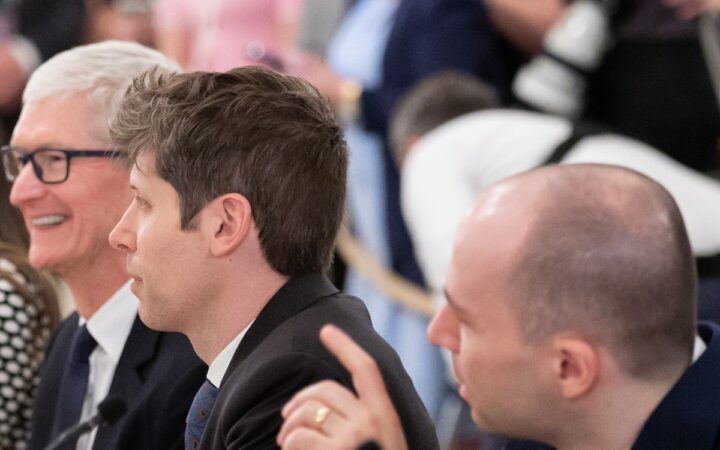
Samsung confirmed that Altman met around 50 executives from its electronics, finance and biotechnology affiliates on October 31 at its training center in Yongin. The discussions covered AI’s development, business opportunities and the implications for corporate decisions and operations.
Altman also held a lunch meeting with SK Group Chairman Chey Tae-won, with SK hynix and SK Telecom executives present, the Korea Economic Daily reported. The precise discussions remain unconfirmed. SK hynix told CNBC it could not confirm the reported meeting, so the visit should not be read as evidence of a newly signed chip contract.
The underlying relationship predates this weekend. In their October 2025 Stargate announcement, OpenAI, Samsung and SK outlined plans to expand advanced memory supplies and explore Korean data center development. They targeted production capacity of 900,000 DRAM wafer starts a month as capacity expanded. That was a planning target, rather than a statement that the capacity had already been delivered.
The agreements also involved SK Telecom and Samsung affiliates assessing opportunities for additional data centers. For OpenAI, those relationships address the physical requirements behind more capable models: sufficient memory, computing infrastructure and places to operate it. A stronger model cannot, by itself, bring another factory or power connection online.
Samsung’s own agenda extends beyond selling components. The company says its AI training effort has covered around 2,300 executives and aims to reach all employees by February 2027. Altman’s appearance was part of that broader attempt to put AI into business operations, alongside the companies’ infrastructure cooperation.
Seoul Wants Its Own Frontier AI Capability
Lee earmarked 4.7 trillion won for frontier AI development, aiming for a sovereign model with performance at the global leading edge. That is an objective for future development, rather than a benchmark result or an announced model launch. It gives the spending push a second dimension: South Korea wants domestic AI capability as well as a larger role in supplying overseas developers.
The speech also identified 2 trillion won for expanding semiconductor production capacity, 500 billion won for physical AI demonstrations across eight areas, and 2.1 trillion won for power, water and industrial-site infrastructure. Those priorities connect the software ambitions to the facilities and industrial applications needed to support them.
The headline allocation is not new money announced for the first time this week. The government’s September budget outline already put the AI and megaproject line at 21.3 trillion won, up 97.2%, within a proposed 820.9 trillion won national budget. Monday’s speech advances the case for parliamentary approval; the president asked lawmakers to finalize the budget and related bills by December 2.
Our earlier coverage of Korea’s megaproject drive examined the much larger, multiyear industrial investment plans behind this strategy. Those private-sector commitments and targets should be kept separate from a single year’s proposed government expenditure. Adding the headline figures together would obscure what is actually being financed.
The delivery test will be whether these plans become usable capacity and useful products. We previously reported on the energy and regulatory obstacles facing Stargate in Britain, a reminder that announced investment depends on local operating conditions. In Korea, parliamentary approval, infrastructure construction and commercial demand will determine how far the public and private ambitions can advance.
For now, the two developments show complementary interests rather than one combined deal. OpenAI is maintaining relationships with major chip and infrastructure partners. Seoul is seeking a larger share of the AI economy, including technology it can develop at home. The scale of the spending proposal signals that ambition; execution will establish its value.
Disclaimer: AIstify is an independent media brand owned and operated by NuvexMedia LLC, publishing news, research, and insights on artificial intelligence, emerging technologies, automation, and related industries. NuvexMedia LLC invests in and collaborates with companies across the AI, technology, software, and digital innovation sectors. These relationships do not influence AIstify’s editorial coverage, and the publication maintains full editorial independence to provide accurate, timely, and objective information. © 2026 NuvexMedia LLC. All rights reserved. This content is for informational purposes only and should not be considered legal, tax, investment, financial, or other professional advice.