Nvidia’s Jensen Huang Softens His ‘China Will Win the AI Race’ Comment
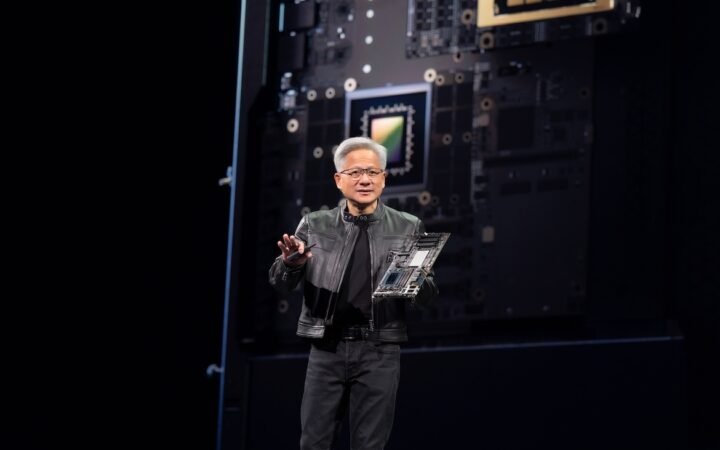
Nvidia CEO Jensen Huang clarified remarks suggesting China would win the AI race, saying the U.S. can stay ahead by innovating faster and empowering global developers.

Inference is the stage when a trained AI model uses new input to produce a prediction, classification, recommendation, or generated response. Training may take days across specialized hardware, while inference happens whenever a user submits a prompt, a camera captures an image, or an application requests a score. Production systems optimize inference for latency, throughput, memory use, energy consumption, and cost without degrading output quality. The model may run in a cloud service, data center, phone, vehicle, or edge device. Monitoring remains necessary because real-world inputs change, hardware can fail, and a model that performed well during evaluation may behave differently under live traffic.
Nvidia CEO Jensen Huang clarified remarks suggesting China would win the AI race, saying the U.S. can stay ahead by innovating faster and empowering global developers.
Pinterest is turning to open source AI models to cut expenses and enhance its visual search and shopping tools, even as the company forecasts softer holiday revenue. CEO Bill Ready says the approach will support performance while keeping infrastructure costs in check.
OpenAI is laying the groundwork for an initial public offering that could value the company at up to $1 trillion, positioning it as one of the most anticipated tech listings in history.
Ark Invest CEO Cathie Wood says humanoid robots could become the most transformative opportunity in artificial intelligence, eclipsing sectors like autonomous transport and healthcare.
Elon Musk has unveiled Grokipedia – an AI-driven encyclopedia built on Grok that aims to offer factual, bias-free knowledge as an alternative to Wikipedia.
A study by the University of Maryland and Microsoft found that Polish outperforms English and other major languages in long-context AI prompts, surprising researchers.
Neobank Revolut has acquired Berlin-based AI travel agent start-up Swifty, integrating its conversational booking technology into Revolut’s loyalty and lifestyle platform for over 65 million users.
Andrew Tulloch, co-founder of the $12 billion AI startup Thinking Machines Lab, has joined Meta after previously rejecting what reports described as a $1.5 billion offer — a figure Meta has since called ‘inaccurate and ridiculous.’
OpenAI has announced a strategic partnership with Broadcom to design and deploy 10 gigawatts of custom AI accelerators, expanding its hardware ecosystem beyond Nvidia and AMD.
Google has unveiled Gemini Enterprise, a next-generation AI platform designed for business productivity and collaboration, positioning itself directly against Microsoft’s Copilot and OpenAI’s enterprise solutions in the race for workplace AI dominance.