Alibaba’s Open-Source HappyHorse Model Tops Global AI Video Leaderboard
HappyHorse-1.0, an open-source AI video model, has topped global benchmarks, outperforming leading proprietary systems and signaling a shift in the video generation market.

In artificial intelligence, a hallucination refers to an output generated by an AI model that appears confident and factual but is actually false or unsupported by real data. This phenomenon often occurs in large language models and generative systems when they fill gaps in knowledge or misinterpret training information. Hallucinations can take the form of incorrect facts, fabricated sources, or unrealistic images, depending on the AI application. They highlight one of the biggest challenges in AI development—ensuring reliability, accuracy, and verifiable outputs. Researchers and developers use techniques like model fine-tuning, retrieval-augmented generation, and human oversight to reduce hallucinations and build more trustworthy systems.
HappyHorse-1.0, an open-source AI video model, has topped global benchmarks, outperforming leading proprietary systems and signaling a shift in the video generation market.

Meta shares climbed 7% after unveiling Muse Spark, its new multimodal AI model, signaling investor confidence in the company’s revamped AI strategy.
OpenAI has introduced a policy blueprint aimed at strengthening U.S. child safety protections in the age of AI. The framework focuses on laws, reporting standards, and built-in safeguards.
Google is adding new mental health features to Gemini, including crisis detection tools and direct hotline access. The company is also committing $30 million to expand global support services.
Anthropic has signed an agreement with the Australian government to collaborate on AI safety and research. The deal includes funding for scientific institutions and expanded use of Claude in healthcare and education.
SoftBank has secured a $40 billion bridge loan to deepen its investment in OpenAI and accelerate its broader AI strategy.
AI-driven bots now generate more internet traffic than humans, according to a new report, highlighting the growing impact of automated systems online.
New research shows that telling AI models they are “experts” can reduce accuracy in tasks like coding and math, while improving safety and alignment outcomes.
Meta introduced four new in-house MTIA chips designed for AI training and inference as the company accelerates data center expansion. The chips aim to improve performance and reduce reliance on external hardware suppliers.
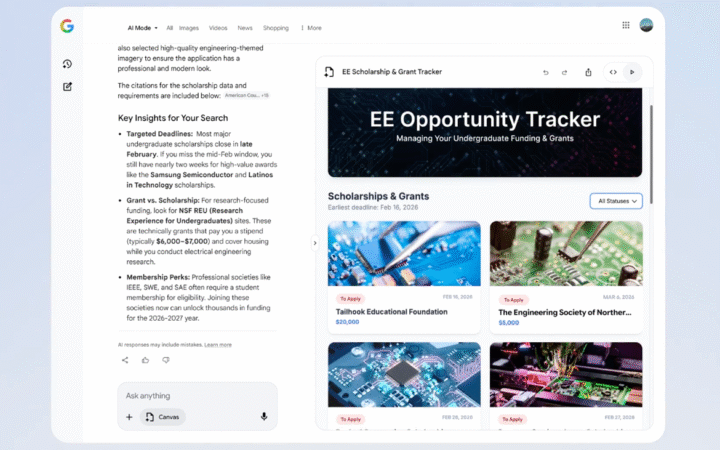
Google has rolled out Canvas in AI Mode to all U.S. users in English, enabling people to create documents, dashboards, and interactive tools directly within Search. The feature provides a dynamic workspace for planning projects and building simple applications.