Google Adds Gemini AI Overviews to Gmail for Workspaces
Google expands Gemini AI Overviews to Gmail and Drive, helping Workspace users summarize emails and retrieve insights faster across conversations.

Causal language modeling, abbreviated CLM, is a training objective in which a model predicts the next token from tokens that came before it. A causal attention mask prevents information from later positions from leaking into each prediction. Repeating this task across large text collections teaches an autoregressive model statistical patterns of language, knowledge associations, and ways to continue a sequence. At inference time, the model generates text token by token using the same left-to-right dependency. CLM differs from masked language modeling, which hides selected tokens inside a sequence and uses surrounding context on both sides. The objective supports open-ended generation but does not guarantee factual or intentional understanding.
Google expands Gemini AI Overviews to Gmail and Drive, helping Workspace users summarize emails and retrieve insights faster across conversations.

Anthropic is actively recruiting a senior executive to source and negotiate data center deals across Europe, signaling the company’s intent to expand its AI compute infrastructure beyond the United States.
GRAI has closed a $9 million seed round to build tools that let listeners remix and interact with music rather than generate it from scratch. The company is betting that the future of music AI lies in social participation, not creation.
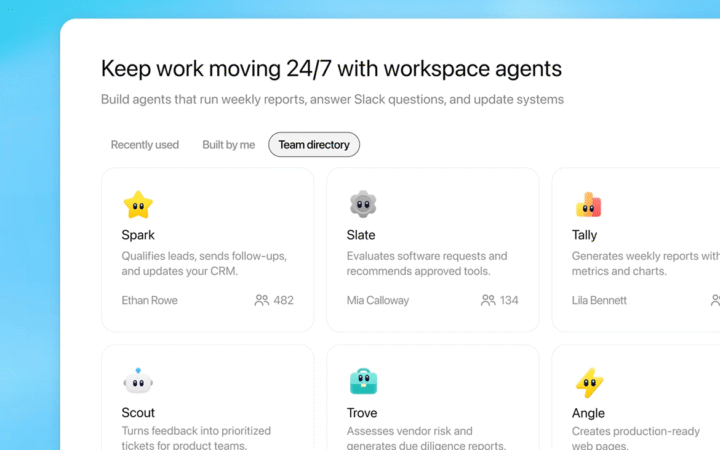
OpenAI has introduced workspace agents in ChatGPT, letting business teams build and share AI agents that autonomously handle multi-step workflows across tools like Slack and internal systems.
Retail investors can now gain exposure to OpenAI through Robinhood’s venture fund, which has taken a $75 million stake in the AI company.
Nvidia and Google Cloud unveiled new AI infrastructure and agentic AI capabilities at Google Cloud Next, targeting large-scale enterprise and industrial deployments.
SpaceX has secured rights to acquire AI coding startup Cursor for up to $60 billion, deepening its push into AI alongside xAI ahead of a potential IPO.
AI startup Recursive Superintelligence has raised $500 million from Nvidia and GV to pursue self-improving AI systems, despite having no public product.
OpenAI has introduced Chronicle, a new Codex feature that tracks screen activity and builds context automatically. The tool raises privacy and security concerns.
OpenAI’s GPT-Image-2 has taken the top spot across all Image Arena benchmarks, outperforming rivals by record margins in human preference rankings.