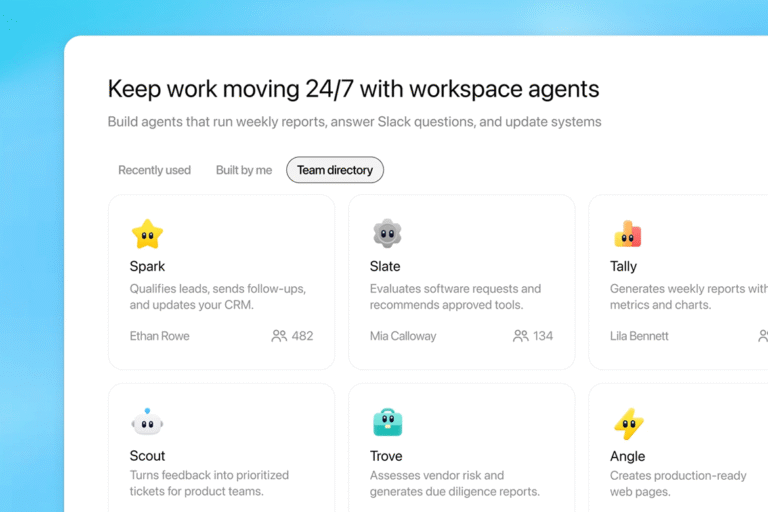

OpenAI on Thursday unveiled workspace agents in ChatGPT, a new feature that allows business teams to build, share, and deploy AI agents capable of handling complex, multi-step workflows without constant human oversight. Available now in research preview for ChatGPT Business, Enterprise, Edu, and Teachers plan subscribers, the agents are powered by Codex and run in the cloud, meaning they continue working even when users are offline. The launch signals OpenAI’s push to move beyond single-user productivity tools and into organization-wide workflow automation.
Unlike the existing GPTs feature, which workspace agents are designed to eventually replace, these agents can operate across connected tools, retain memory between sessions, execute code, and take action inside third-party platforms. Teams can deploy agents directly within ChatGPT or integrate them into Slack, where they can respond to requests, answer questions, and file tickets autonomously. OpenAI cited its own internal use cases as examples: its sales team uses an agent to pull call notes, qualify leads, and draft follow-up emails, while its accounting team uses one to assist with month-end close processes including journal entries and variance analysis.
Setup is designed to be accessible to non-technical users. Team members describe a workflow in plain language and ChatGPT guides them through building the agent, connecting relevant tools, and testing the output. Pre-built templates are available for finance, sales, and marketing use cases. Agents can be scheduled to run at set intervals or triggered by incoming messages. For sensitive actions, such as sending emails or editing files, administrators can require human approval before the agent proceeds.
The Bigger Picture
Workspace agents represent a meaningful shift in how AI fits into business operations. Until now, most enterprise AI tools have focused on helping individual employees work faster. This feature targets the layer above that: the handoffs, approvals, and coordination work that spans teams and systems. For businesses, the practical implication is that routine but high-effort processes, lead qualification, vendor screening, weekly reporting, can be delegated to an agent that follows set policies, logs its activity, and improves with use. Early tester Rippling reported that a workflow previously taking sales reps five to six hours per week now runs automatically, built by a single sales consultant without engineering support.
What Came Before
OpenAI introduced GPTs in late 2023 as customizable versions of ChatGPT for specific tasks, but they were largely limited to single-session, single-user interactions. Workspace agents extend that foundation with persistent memory, cloud execution, and enterprise controls including role-based access, a Compliance API for admin oversight, and built-in defenses against prompt injection attacks.
The move puts OpenAI in more direct competition with enterprise automation platforms such as Microsoft Copilot, Salesforce Agentforce, and ServiceNow, all of which have been building agent-based workflow tools for business customers. Workspace agents will be free through May 6, 2026, after which credit-based pricing takes effect.
Disclaimer: AIstify is an independent media brand owned and operated by NuvexMedia LLC, publishing news, research, and insights on artificial intelligence, emerging technologies, automation, and related industries. NuvexMedia LLC invests in and collaborates with companies across the AI, technology, software, and digital innovation sectors. These relationships do not influence AIstify’s editorial coverage, and the publication maintains full editorial independence to provide accurate, timely, and objective information. © 2026 NuvexMedia LLC. All rights reserved. This content is for informational purposes only and should not be considered legal, tax, investment, financial, or other professional advice.