Salesforce is a leading crm and enterprise ai software company shaping enterprise software, workflow automation, and generative AI tools across AI, cloud, chips, software, devices, and enterprise technology.
Marc Benioff, Parker Harris, Dave Moellenhoff, and Frank Dominguez
Funding
Public company
Valuation
Public market capitalization varies
Employees
70,000+
About Salesforce
Salesforce is a major big technology company in enterprise software, workflow automation, and generative AI tools. It belongs in an AIstify company directory because the largest technology companies increasingly define how artificial intelligence is built, distributed, commercialized, and adopted. These companies influence the market through cloud infrastructure, semiconductors, consumer devices, enterprise software, developer ecosystems, digital commerce, operating systems, data platforms, and AI-enabled workflows. Founded in 1999, Salesforce is headquartered in San Francisco, California, United States. Its leadership field is listed as Marc Benioff, and its business profile is best described as a Public CRM, enterprise software, cloud platform, data, analytics, and AI agent company. The organization is associated with Marc Benioff, Parker Harris, Dave Moellenhoff, and Frank Dominguez. Its major brands, platforms, or programs include Salesforce, Einstein, Agentforce, Slack, Tableau, MuleSoft, Data Cloud.
Within AIstify’s company directory, Salesforce fits into the CRM and Enterprise AI Software category. Employee count is listed as 70,000+, funding status is Public company, valuation is described as Public market capitalization varies, ownership is Public, and stock ticker information is CRM. The company’s products and services include CRM software, AI agents, sales automation, service automation, data cloud, analytics, integration software, collaboration tools. This product surface matters because big tech companies tend to control several layers of the AI value chain at once. One company might supply cloud compute, another might manufacture chips, another might own consumer distribution, and another might provide enterprise software that brings AI into daily business processes. The most important companies are not only building models; they are also shaping procurement, developer tooling, infrastructure spending, data governance, security expectations, and customer adoption.
Salesforce’s relevance can be understood through several practical layers. The first layer is infrastructure: compute, networks, storage, chips, servers, and data centers determine what AI systems can run at scale. The second layer is software: operating systems, cloud platforms, business applications, creative tools, developer frameworks, and databases determine how AI reaches users. The third layer is ecosystem: partners, app stores, marketplaces, system integrators, and enterprise channels determine how quickly technology spreads. The fourth layer is trust: privacy, security, reliability, compliance, and responsible deployment matter when AI becomes part of everyday products and workflows. AI is now central to the competitive strategy of major technology companies. Semiconductor firms are building faster accelerators, memory, networking, and manufacturing equipment for model training and inference. Cloud providers are competing on model hosting, AI agents, developer services, and managed infrastructure.
Enterprise software companies are embedding AI into CRM, ERP, service management, analytics, design, documents, and collaboration. Device companies are bringing AI to phones, PCs, wearables, and edge hardware. Networking and infrastructure vendors are redesigning systems for data-intensive AI workloads. The competitive context around Salesforce is changing quickly. Capital spending on AI infrastructure is reshaping cloud, chip, and data center markets. Generative AI is changing search, creativity, enterprise productivity, customer service, coding, analytics, and business operations. Regulators are paying closer attention to platform power, data use, competition, privacy, and safety. Customers are asking whether AI features produce measurable value, whether vendors can control costs, and whether large platforms can be trusted with sensitive workflows. In this environment, scale is powerful, but execution still matters.
From an operator, investor, or technology buyer perspective, Salesforce is worth tracking because big tech companies can move entire markets with product launches, pricing changes, developer tools, supply agreements, cloud regions, chip roadmaps, AI model releases, and partner programs. AIstify tracks Salesforce with tags including salesforce, big tech, crm ai, enterprise software, ai agents, data cloud, salesforce profile, salesforce company profile. The company’s public website is https://www. salesforce. com/.
For AIstify, this makes Salesforce a useful reference point for tracking how big technology companies shape AI infrastructure, software platforms, chips, cloud services, devices, and enterprise automation.
Click to see more
Products & Business
Products & Services
CRM software
AI agents
sales automation
service automation
data cloud
analytics
integration software
collaboration tools
Platform & Tools
Cloud platforms, developer tools, AI model services, APIs, SDKs, data platforms, chip software, enterprise software marketplaces, or partner ecosystems where available.
Revenue Model
Hardware sales, cloud consumption, software subscriptions, enterprise licenses, usage-based AI services, advertising, marketplace revenue, services contracts, and platform fees.
Key Information
Business Type
Public CRM, enterprise software, cloud platform, data, analytics, and AI agent company
Headquarters
San Francisco, California, United States
Founded Date
1999
Company CEO
Marc Benioff
Founders
Marc Benioff, Parker Harris, Dave Moellenhoff, and Frank Dominguez
Brands
Salesforce, Einstein, Agentforce, Slack, Tableau, MuleSoft, Data Cloud
Nvidia's Jensen Huang and Anthropic's Dario Amodei offered opposing visions for AI safety at Salesforce's Dreamforce conference, days after Amodei called for the industry to deliberately slow down.
Google introduced Gemini 3.8 Live and a reasoning-focused Extended Thinking variant, aimed at production-grade voice agents that can see, switch languages and run tools in the background without breaking conversation.
French AI startup Mistral AI has closed a €3 billion Series D round at a valuation of approximately $24 billion, the largest equity fundraise by a privately held European technology company.
Salesforce agreed to buy Fin, the customer-service AI company formerly known as Intercom, for about $3.6 billion to strengthen its Agentforce platform.
Salesforce has launched Headless 360, exposing its entire platform to AI agents via APIs and tools. The move redefines how enterprise software is accessed and used.
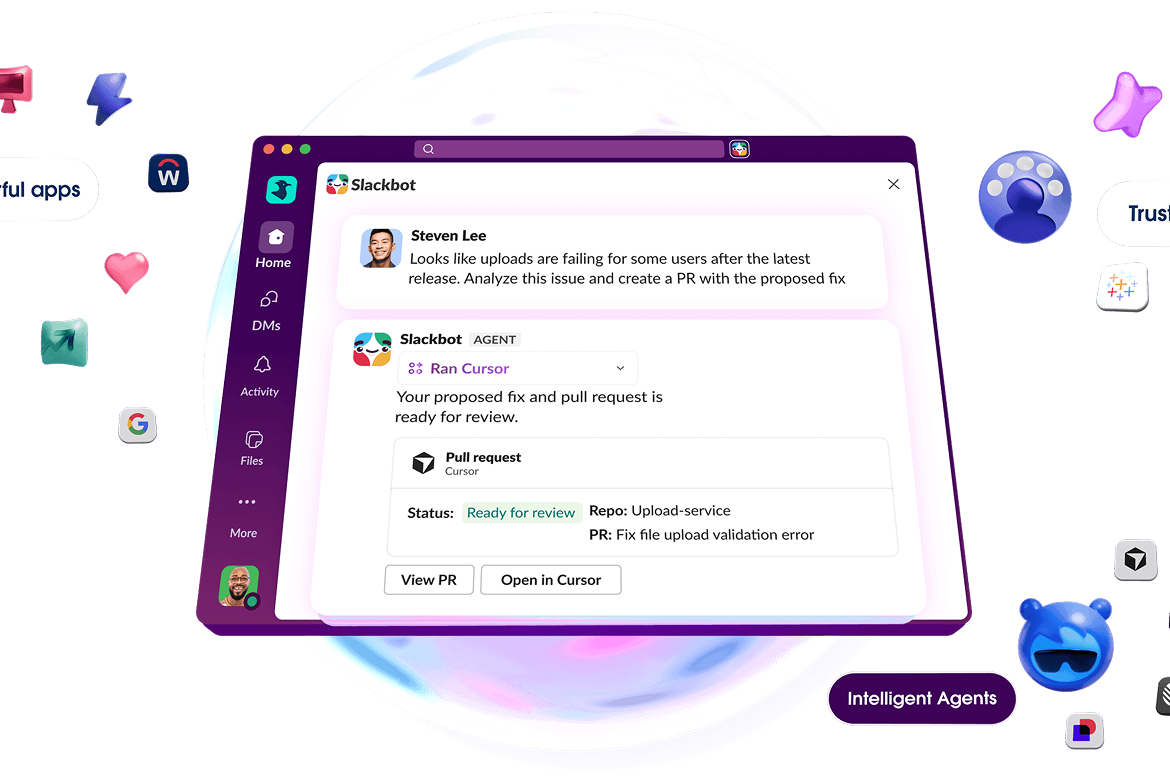
Salesforce is expanding Slackbot into an AI-powered enterprise teammate, integrating workflows, apps, and data into a single conversational interface. The update introduces new capabilities aimed at improving productivity and coordination across teams.
Nvidia is reportedly developing NemoClaw, an open-source platform designed to help companies deploy AI agents for enterprise tasks. The system would include security tools and partnerships with major software providers.
LiveKit, a key provider of AI voice and video technology OpenAI, xAI, and Salesforce, closed a $100 million funding round, valuing the company at $1 billion.