Anthropic Plans to More Than Double Its AI Compute Capacity in 2027
The Claude maker plans to more than double its computing capacity in 2027, the New York Times reports. Its IPO filing puts commitments at $895.4 billion.

Explore the complete archive of AIstify’s news coverage, encompassing all reporting on artificial intelligence across industries, markets, and policy arenas. This archive compiles daily developments, investigative pieces, executive commentary, funding announcements, product launches, and regulatory updates into a single chronological record. It enables readers to track the evolution of AI narratives, corporate strategies, geopolitical shifts, and technological milestones over time.
The Claude maker plans to more than double its computing capacity in 2027, the New York Times reports. Its IPO filing puts commitments at $895.4 billion.

Anthropic says future Claude models could sharply accelerate AI research, leaving less time to evaluate new capabilities and put safeguards in place.
OpenAI’s Grid Protectors Program plans flexible power use at future AI campuses, with a Georgia pilot committed to up to 1,000 MW of demand response.
DRAM prices are roughly twice their end-2025 level, Nikkei reports, as memory suppliers prioritize AI data centers and PC makers face tighter supply.
Falcon Guardian can block agents’ model access through connected AI gateways. Device-level termination and restart prevention are planned extensions.
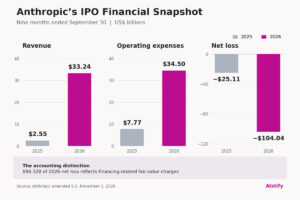
Anthropic’s revenue and spending are surging as IPO investors reportedly favor a $1.5–$1.6 trillion valuation. November launch dates remain tentative.
MIT researchers used GPT-6 Astra to edit Qwen’s weights without retraining, lifting MATH-500 from 7.9% to 48.1% by reducing reasoning loops.
Elon Musk says Grok Bot’s serving costs were unsustainable relative to revenue as subscribers report reaching weekly limits earlier than expected.
Claude Fable 5.1 leads HalachaBench’s Jewish law test at 79.7/100. The AI-graded results are provisional and await rabbinic validation.
Michigan’s December prison classification pilot promises 30% better violence predictions, raising questions about evidence, oversight and the use of AI.