Key Notes
- PhotoCraft has attracted more than 70,000 GitHub stars after rapid development assisted by Claude, but its developers still label the editor an early alpha.
- Published reviews found useful basic editing workflows alongside rough selection tools and unresolved concerns about demanding production work.
- The widely shared 45% readiness estimate describes an older release and should not be treated as a current independent benchmark.
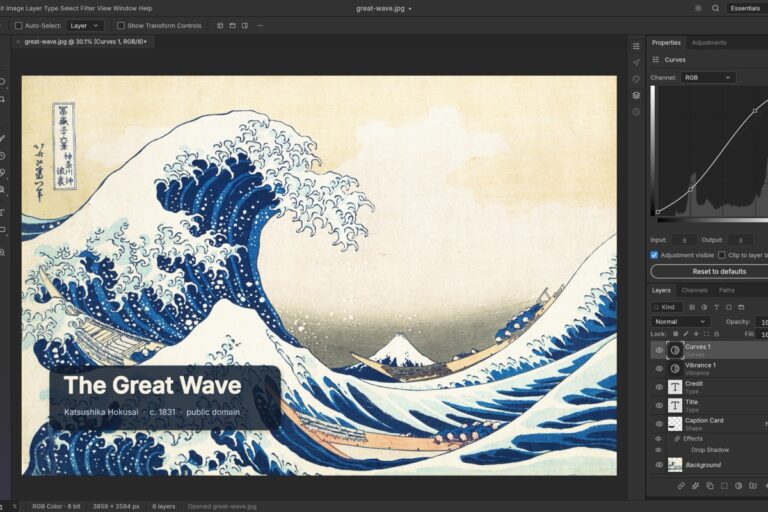
PhotoCraft, a free Photoshop-style image editor built with Claude’s help, has attracted more than 70,000 GitHub stars in three weeks. Developer Brandon Thomas has recreated a striking amount of Adobe’s familiar workspace, from layers and masks to menus and keyboard shortcuts. The open-source project is available for desktop computers and the browser, but its developers still describe it as an early alpha.
The appeal is easy to understand: a recognizable photo editor, no Photoshop subscription, and source code anyone can inspect. Published hands-on tests suggest it can already handle useful everyday work. They also expose a more complicated story than the viral claim that one developer and an AI have effectively rebuilt Photoshop in a few weeks.
The Three-Hour Commit Is Real. It Is Also a Starting Point
The project’s first recorded Git commit is dated September 30 at 06:12 UTC. A second commit, labeled one-shot, followed at 09:02 UTC and added 42,241 lines across 241 files. That is less than three hours between snapshots, although commit timestamps do not establish how much preparation preceded them or whether every feature worked at that point.
By October 21, the repository had accumulated 70,139 stars and more than 3,000 commits. Those figures show enormous interest and continuing development; neither measures how faithfully PhotoCraft reproduces Photoshop. The initial code drop and the application people can download today are separated by weeks of changes.
The release history lists version 0.11.1, published October 20, as the latest release. It contains 13 release entries since October 2, including two release-candidate builds. That pace matters when reading reviews: an absent feature or broken workflow in an early build may not describe the current version.
What You Actually Get for Free
PhotoCraft is written in Rust and offers a Photoshop-like arrangement of tools, adjustment controls and layer panels. Its documented capabilities include groups, masks, blend modes, smart objects, text, filters and layered PSD and PSB files. Desktop builds cover macOS, Windows and Linux, while a WebAssembly version brings the editor into a browser.
The code is available under a choice of MIT or Apache licensing. The official website places it within a wider family of Adobe-style applications, including FilmCraft, VectorCraft and LightCraft. That makes the ambition larger than a single photo editor, although progress in one application should not be mistaken for proof that the entire suite is production-ready.
It also fits a growing category of AI-assisted creative software. We reported on another developer’s Photoshop alternative built with GPT-6 Astra. The interesting competitive pressure comes from making familiar workflows cheaper to reproduce, especially for people who need only a fraction of a professional suite.
The Reviews Agree on the Resemblance, Less on the Polish
Thomas is an experienced software engineer who used Claude Opus 5.5, according to Lifehacker. Its reviewer David Nield tested PhotoCraft for cropping, combining images, adjusting colors and preparing pictures for publication. He found that much of his normal Photoshop workflow transferred across, with familiar panels, dialogs and shortcuts. Selection and snapping could feel clumsy, but the basic work he attempted was successful. He nevertheless stopped short of replacing his Photoshop subscription.
Creative Bloq’s Joe Foley reached a more qualified assessment. PhotoCraft was comparatively convincing, and PSD, TIFF, JPEG and PNG files worked in his test. Automatic selections and masking were less precise, healing and content-aware operations needed improvement, and filter previews failed. These are attributed hands-on findings, rather than tests conducted by AIstify.
Both experiences can be accurate. A tool can be useful for resizing a picture or assembling a simple composite while remaining frustrating for difficult cutouts, retouching or demanding production files. Familiar menus reduce the effort of learning an editor; the behavior behind them determines whether someone can finish a job.
Why the 45% Readiness Figure Needs a Date
The project’s roadmap puts the distinction unusually plainly. Its assessment of version 0.6.0, last updated October 13, counted all 628 Photoshop menu entries as connected to commands and 56 of 68 tools as present. It estimated overall readiness for real work at roughly 45%, compared with about 76% feature breadth.
Those percentages are developer estimates using the project’s own weighting, not an independent benchmark. They describe an older build and should not be presented as a fresh measurement of version 0.11.1. They are nevertheless a useful admission that having a menu entry is different from matching the full behavior, reliability and performance of the original.
File exchange remains particularly important. An open report describes Photoshop refusing to reopen a PhotoCraft-saved file, although its triage notes leave the exact output format and other reproduction details unresolved. Another user report describes a roughly 3.24 GB PSB file with about 200 layers freezing and crashing. These reports establish specific concerns, not that every PSD save or large document fails.
As checked October 21, GitHub search returned 1,795 open issues, with 58 labeled critical. That backlog includes more than confirmed bugs, and the repository’s larger headline total also includes pull requests. Readers should avoid treating either number as a simple count of broken features. Equally, a long feature list does not make unresolved compatibility reports disappear.
The Adobe Comparison Has a Missing Denominator
One comparison circulating around PhotoCraft places a few weeks of AI-assisted development against Adobe’s roughly $4.3 billion in annual research spending. Adobe’s annual filing does report $4.294 billion in research and development for fiscal 2025. That is companywide spending, covering far more than Photoshop, rather than the price of building this one editor.
The broader question is how much AI can compress the process of building and maintaining complex software. Anthropic’s own source-control overhaul illustrates what happens when producing code becomes faster: review, integration and infrastructure become more significant constraints. For an image editor, preserving a customer’s files and producing predictable output are equally consequential constraints.
PhotoCraft already demonstrates how quickly a recognizable, useful application can take shape with AI assistance. Whether it becomes a durable Photoshop alternative will depend on the less spectacular work that follows: reliable file exchange, responsive tools, regression testing and sustained maintenance. For now, it offers a compelling experiment for everyday editing on copies of files, with professional replacement still a goal to prove.
Disclaimer: AIstify is an independent media brand owned and operated by NuvexMedia LLC, publishing news, research, and insights on artificial intelligence, emerging technologies, automation, and related industries. NuvexMedia LLC invests in and collaborates with companies across the AI, technology, software, and digital innovation sectors. These relationships do not influence AIstify’s editorial coverage, and the publication maintains full editorial independence to provide accurate, timely, and objective information. © 2026 NuvexMedia LLC. All rights reserved. This content is for informational purposes only and should not be considered legal, tax, investment, financial, or other professional advice.