
Key Notes
- GPT-6.2 designs yielded 35 binding hits from 322 selected candidates across five protein targets.
- Sequence and antibody redesign experiments also retained binding in many tested variants.
- The research still relied on specialist screening models and does not establish clinical safety or efficacy.
OpenAI has reported laboratory evidence that proteins based on GPT-6.2 designs can attach to biological targets, extending the role of general-purpose language models in molecular engineering. In one experiment, 35 of 322 selected candidates showed binding, with at least one hit for each of five targets.
The company published the findings on November 24 alongside a preprint (PDF) covering protein shapes, amino acid sequences, antibody redesign and molecular interactions. Laboratory work used a pre-release version of GPT-6.2; several of the strongest computational results came from an internal research model.
The distinction between generating a proposal and completing the full experiment runs through the study. GPT produced structures or sequences, while specialist biology models still helped choose candidates and, in the first design campaign, supplied the sequences used to make them.
What OpenAI Means by Intrinsic Protein Design
Proteins are chains of amino acids that fold into three-dimensional shapes. Their structure helps determine what they do, including whether they can attach to another molecule. Designing a useful protein involves finding both a suitable shape and a sequence that can produce it.
The authors use intrinsic to describe tasks the GPT models performed with reasoning and general-purpose coding tools, without calling a pretrained protein model to generate the proposal. In the main computational setting, the models also had no internet access. That definition concerns what tools they used during the task, rather than a claim that their training contained no biological information.
Specialist systems typically handle particular stages of this process. The RFdiffusion research established a powerful approach to generating protein backbones, while ProteinMPNN designs sequences for supplied structures. OpenAI is testing whether one general-purpose model can carry out several such roles and accept revised requirements through a prompt.
That flexibility is the research proposition. A scientist could change the desired attachment site or structural constraint without commissioning a new model for each variation. Whether the resulting molecule works still has to be established experimentally.
The First Lab Campaign Produced 35 Binding Hits
Researchers supplied GPT-6.2 with the structures of five target proteins and indicated where a small designed protein, or minibinder, should attach. The model wrote code to propose three-dimensional backbones. SolubleMPNN then suggested amino acid sequences, and additional specialist models screened candidates before Onava made and tested them.
The paper reports these screening results:
- PD-L1: 5 binding hits among 92 tested candidates
- IL-7Rα: 3 among 93
- TrkA: 1 among 46
- VEGF-A: 8 among 46
- IL-17A: 18 among 45
Together, those results give a 10.9% hit rate among the candidates sent to the laboratory. The range matters: binding was much harder to obtain for some targets than others. It would be misleading to treat the pooled result as a success rate for any protein a user might request.
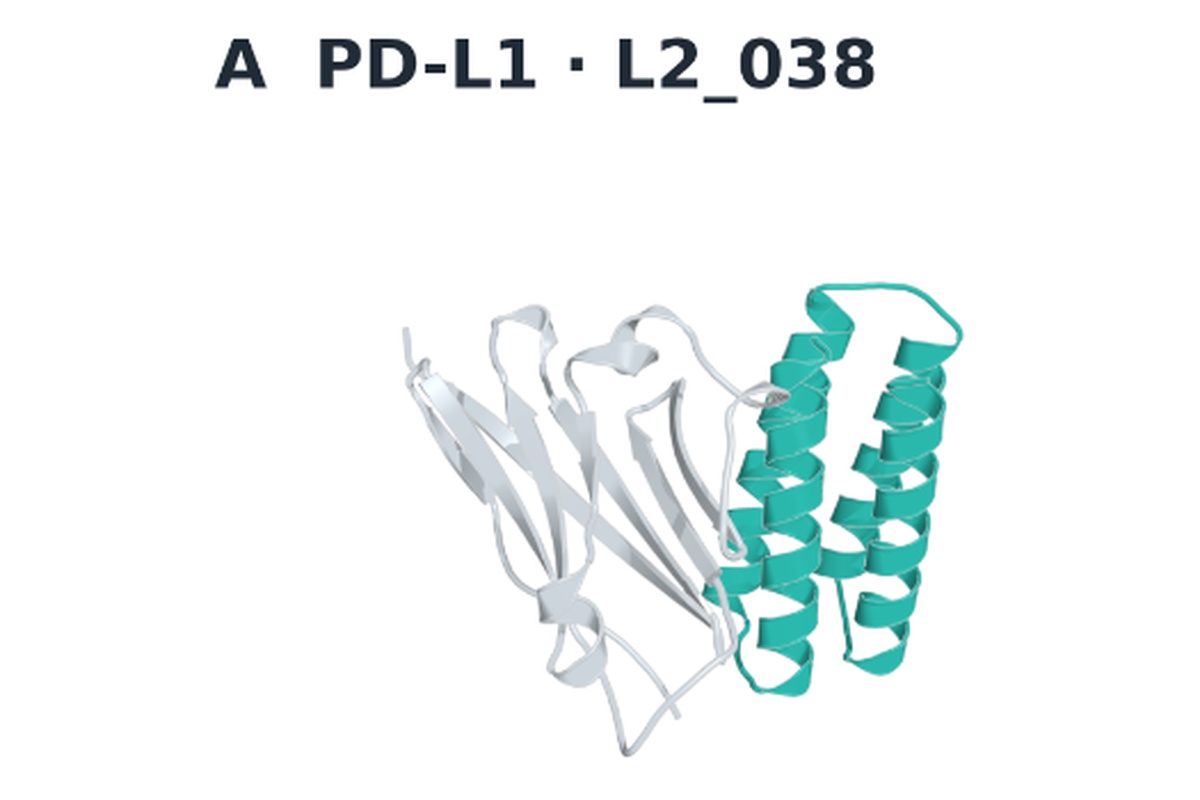
The denominator also describes an already filtered set. It does not count every initial computational proposal. OpenAI notes that earlier RFdiffusion work reported higher hit rates, while differences in filtering and the definition of a hit make a simple ranking unreliable.
New Sequences for Existing Protein Shapes
A second line of experiments reversed the problem: give GPT-6.2 an existing binder shape, withhold the original sequence, and ask it to propose a new sequence. This is commonly called inverse folding. The model could use the structure as a constraint while changing the chain that would produce it.
Initial screens found binding in 75 of 88 MDM2 designs, 26 of 42 VEGF-A designs and 8 of 59 PD-1 designs. Those rates, approximately 85%, 62% and 14%, apply to different target groups in this redesign setting. They should not be substituted for the 10.9% result from the first campaign.
For three unpublished shapes GPT-6.2 had designed earlier, 14 of 107 new sequences also showed binding. The researchers describe substantial changes from the sequences originally assigned by specialist software. That provides stronger evidence of design capability than merely recovering a known sequence from a public structure.
It also illustrates why a protein can have more than one workable sequence. The objective is not necessarily to reproduce one string of amino acids exactly, but to retain a structure and interaction that permit the intended behavior. Specialist prediction models still helped decide which variants to test.
Antibody Fragments Retained Binding After Redesign
The team also tested changes to the loops through which antibody fragments recognize their targets. In one experiment involving small VHH antibodies, GPT-6.2 received structural information and the surrounding sequence, then proposed replacements for the binding loops.
The paper records 184 submitted designs, of which 182 had a reported screening result. Among those 182, 128, or about 70%, screened positive for binding to IL-4Rα. Keeping the reported-result denominator separate from the submission count avoids overstating the precision of the result.
In another experiment, researchers asked for extensive changes to the binding loops of fragments based on therapeutic antibodies. Of 272 designs from five parental antibody families, 179, about 66%, retained binding to PD-1 or PD-L1. These were tests of redesigned fragments, not clinical trials of modified medicines.
Preserving attachment is an important checkpoint, but it leaves other questions open. A redesigned fragment might bind while behaving differently in cells, attaching to unwanted targets or becoming less practical to manufacture. The study does not establish equivalence to the original therapies on those dimensions.
Prompts Could Steer the Shape of a Design
Beyond the laboratory campaigns, OpenAI tested whether instructions could control where a binder attaches and what structural features it contains. The researchers requested proteins dominated by helices, strands or a mixture, sometimes specifying their number. An internal model followed those structural instructions with high fidelity in the computational evaluations.
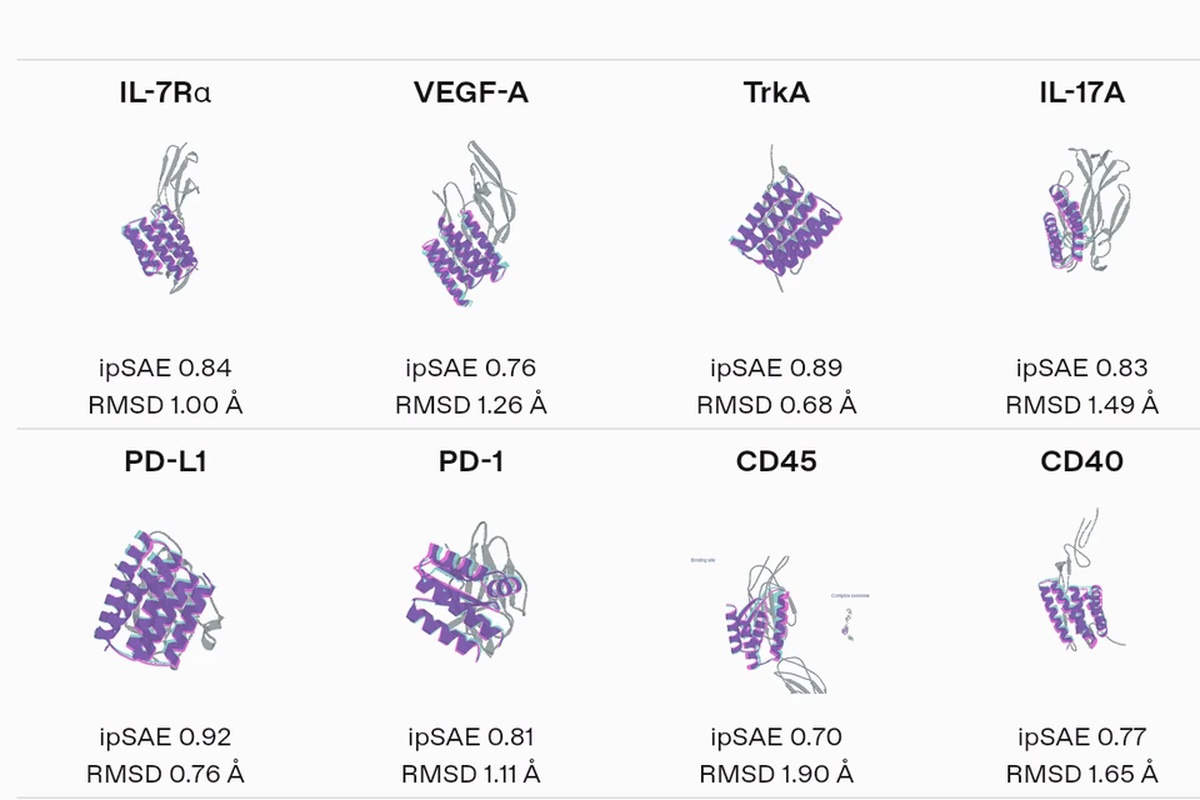
These are useful controls for research because attachment geometry can matter as much as attachment itself. A protein that grips the wrong surface may not produce the effect the scientist intends. Prompt-level constraints offer a way to incorporate additional knowledge before a candidate reaches the laboratory.
The figure above shows computational examples from an internal model. Agreement between a proposed backbone and a predicted refold is evidence about consistency within that modelling workflow. It should be read separately from a measured binding result, and separately again from evidence of biological activity.
Docking Improved, but Whole-Protein Folding Lagged
The study extends to docking: predicting where a molecule fits against a protein and which way it faces. The researchers used datasets with experimentally determined reference structures, allowing predictions to be checked against known arrangements. They also explored supplying extra information, such as the atoms involved in a bond, through the prompt.
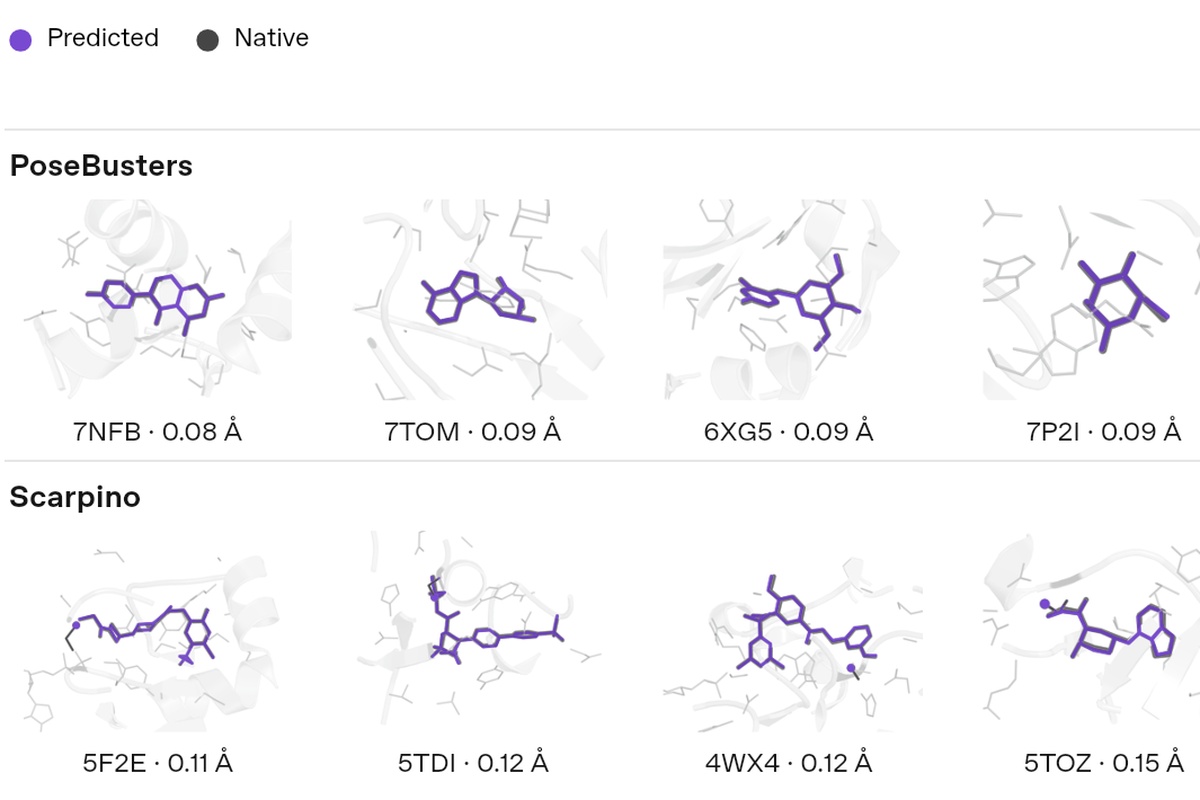
OpenAI reports strong results from GPT-6.2 and its internal model on several docking and sequence tasks. Some of these benchmarks use public structures, so prior exposure or related training examples remain possible explanations for part of the performance. The authors also flag potential artifacts in tests involving predicted structures.
Predicting an entire protein’s fold from its sequence remained a clear weakness. On the study’s whole-structure comparison, GPT-6.2 averaged a TM-score of 0.26 and the internal model 0.38, against 0.93 for ESMFold2. Higher scores indicate a closer structural match. Success on selected component tasks therefore coexists with a substantial deficit on another fundamental task.
That deficit has practical consequences: structure-prediction software was part of the screening process used elsewhere in the work. The evidence supports a more capable contributor to protein engineering, while specialist systems remain important to the broader workflow.
What Binding Does and Does Not Establish
The laboratory results move the evidence beyond attractive computer-generated shapes. They show that some proposed designs can be turned into molecules with a measurable interaction. The assays used for screening and follow-up, however, address attachment rather than the full performance of a research tool or medicine.
A therapeutic candidate also needs an appropriate biological effect, sufficient selectivity, stability and acceptable safety. The paper’s conclusion explicitly sets out further work on functional activity, potency, developability and immune-response risk. None of the reported binding percentages is a measure of clinical efficacy.
The preprint was produced by OpenAI with Onava collaborators, and the main capability comparisons remain findings from that research program. The use of a pre-release GPT-6.2 model and an unnamed internal model also limits what a reader can infer about reproducing the results in an ordinary ChatGPT conversation.
The Next Test Is Useful Biological Function
OpenAI wants scientists to express molecular goals in natural language and revise designs within the same modelling system. Its stated next steps include harder targets, molecules that bind more selectively, and designs that produce a specified effect after binding. Those goals require additional laboratory work.
The announcement follows OpenAI’s recent work on broader tools for science. The company introduced MedChemBench to evaluate medicinal-chemistry decisions, while the GPT-6.2 release emphasized scientific and professional workflows.
For protein design, the next substantive milestone will be evidence that the flexibility demonstrated here improves useful experimental outcomes across a wider range of targets. The authors’ program now turns toward activity in cells and other biological systems, alongside the selectivity and manufacturing properties that binding tests alone cannot answer.
Disclaimer: AIstify is an independent media brand owned and operated by NuvexMedia LLC, publishing news, research, and insights on artificial intelligence, emerging technologies, automation, and related industries. NuvexMedia LLC invests in and collaborates with companies across the AI, technology, software, and digital innovation sectors. These relationships do not influence AIstify’s editorial coverage, and the publication maintains full editorial independence to provide accurate, timely, and objective information. © 2026 NuvexMedia LLC. All rights reserved. This content is for informational purposes only and should not be considered legal, tax, investment, financial, or other professional advice.