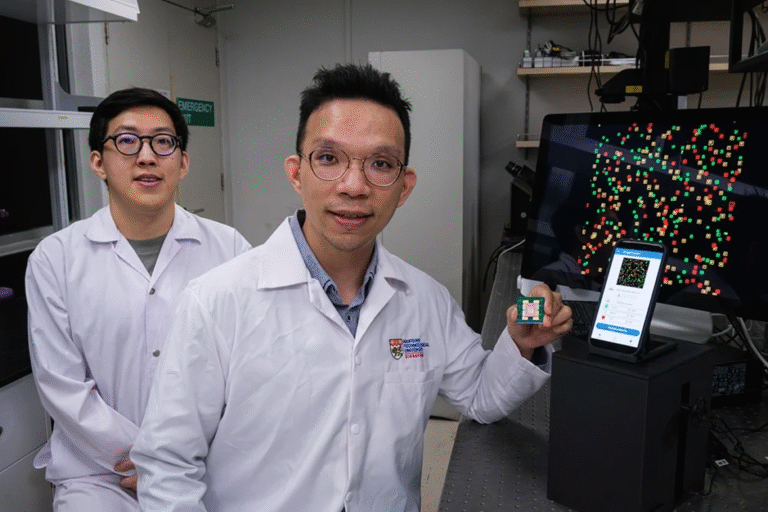

A research team from Nanyang Technological University has developed a new AI-powered biochip capable of rapidly detecting microRNAs, tiny genetic markers linked to diseases including cancer and cardiovascular conditions. The system, described in the journal Advanced Materials, combines nanophotonic sensing with automated image analysis to significantly reduce diagnostic time.
The platform can analyze a small blood sample and detect multiple microRNA biomarkers in about 20 minutes, compared to several hours required by traditional methods such as PCR (polymerase chain reaction). Researchers say the system achieves high sensitivity and accuracy, detecting extremely low concentrations of microRNAs, even down to a few molecules.
The work was led by Associate Professor Chen Yu-Cheng, who said the goal is to create a scalable diagnostic platform capable of screening multiple disease markers quickly and accurately. Initial testing focused on microRNAs linked to non-small cell lung cancer, demonstrating the system’s ability to identify multiple targets simultaneously without complex sample preparation.
How the Technology Works
At the core of the system is a nanophotonic chip embedded with nanocavities, microscopic structures that enhance fluorescent signals when microRNAs bind to specific probes. These cavities amplify weak signals, making it possible to detect even single molecules.
The chip is paired with an AI imaging system that captures and analyzes thousands of signals in a single snapshot. Using a deep learning model based on Mask R-CNN, the system automatically identifies and classifies microRNA signals, removing the need for manual counting and reducing the risk of human error.
Unlike conventional approaches, which often require amplification or labeled probes, the NTU platform directly measures microRNAs in liquid samples. The researchers report accuracy levels exceeding 99 percent across test scenarios, including experiments using both cancer cell extracts and synthetic samples.
Toward Faster, Scalable Diagnostics
The team has also built a compact prototype that includes a camera and a mobile application for real-time analysis. This setup could support point-of-care testing, where results are generated quickly without the need for specialized laboratory infrastructure.
Researchers believe the platform could eventually be adapted for large-scale screening, potentially analyzing hundreds or thousands of biomarkers from blood, saliva, or urine samples. This could open the door to earlier disease detection, better monitoring of treatment response, and more personalized healthcare.
Independent experts note that microRNAs have long been considered promising biomarkers but have been difficult to measure reliably due to their small size and similarity. A system that can accurately detect multiple microRNAs could improve clinical decision-making, particularly in oncology and chronic disease management.
The project is supported by Singapore’s research funding programs, and the team has filed a technology disclosure through NTU’s commercialization arm. Future work will focus on clinical validation and scaling the platform for broader use in healthcare and pharmaceutical research.
Disclaimer: AIstify is an independent media brand owned and operated by NuvexMedia LLC, publishing news, research, and insights on artificial intelligence, emerging technologies, automation, and related industries. NuvexMedia LLC invests in and collaborates with companies across the AI, technology, software, and digital innovation sectors. These relationships do not influence AIstify’s editorial coverage, and the publication maintains full editorial independence to provide accurate, timely, and objective information. © 2026 NuvexMedia LLC. All rights reserved. This content is for informational purposes only and should not be considered legal, tax, investment, financial, or other professional advice.