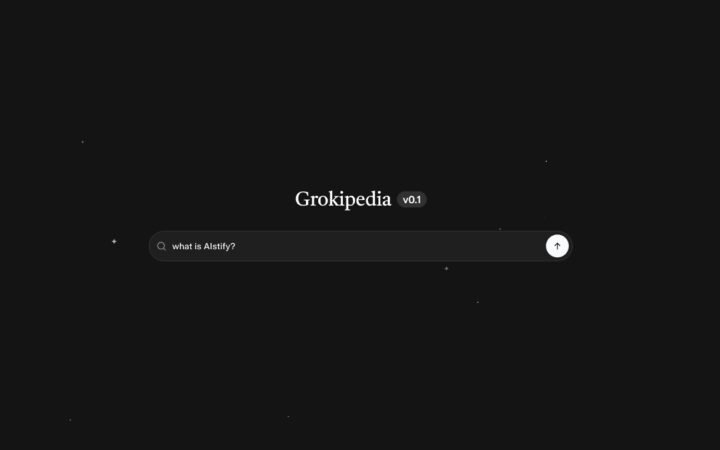
Elon Musk Launches Grokipedia, an AI-Powered Rival to Wikipedia
Elon Musk has unveiled Grokipedia – an AI-driven encyclopedia built on Grok that aims to offer factual, bias-free knowledge as an alternative to Wikipedia.

A Markov chain is a mathematical model for a sequence of states with the Markov property: the probability of the next state depends on the current state rather than the full path taken to reach it. Transition probabilities describe how the process moves, and repeated transitions can reveal long-run behavior or the likelihood of future outcomes. Markov chains appear in queueing, language modeling history, simulation, economics, and reinforcement-learning foundations. They are useful when the current state captures all relevant information, but that assumption may be unrealistic. Designers must define states carefully, estimate transitions from appropriate data, and check whether time-varying or hidden influences invalidate the model.
Elon Musk has unveiled Grokipedia – an AI-driven encyclopedia built on Grok that aims to offer factual, bias-free knowledge as an alternative to Wikipedia.

Andrew Tulloch, co-founder of the $12 billion AI startup Thinking Machines Lab, has joined Meta after previously rejecting what reports described as a $1.5 billion offer — a figure Meta has since called ‘inaccurate and ridiculous.’
Google has unveiled Gemini Enterprise, a next-generation AI platform designed for business productivity and collaboration, positioning itself directly against Microsoft’s Copilot and OpenAI’s enterprise solutions in the race for workplace AI dominance.
Google Cloud and Figma have launched an expanded partnership to embed Google’s generative AI models – including Gemini 2.5 Flash and Imagen 4 – directly into Figma’s design tools, reducing latency and accelerating creative workflows.