Google DeepMind Unveils AlphaGenome DNA Prediction Model
Google DeepMind has introduced AlphaGenome, a new AI model designed to analyze long DNA sequences and predict how genetic variations may influence disease development.

An autoencoder is a neural network trained to reproduce its input after compressing it into a smaller internal representation. The encoder converts the original data into a latent code, and the decoder reconstructs the input from that code. Because the model must preserve useful structure while discarding less important detail, autoencoders support dimensionality reduction, denoising, feature learning, compression, and anomaly detection. A reconstruction that differs greatly from the input may indicate an unfamiliar pattern. Variants can generate new samples, but the compressed representation is shaped by the training data and objective, so it may also preserve bias or omit information needed for another task.
Google DeepMind has introduced AlphaGenome, a new AI model designed to analyze long DNA sequences and predict how genetic variations may influence disease development.

Climate tech startup Rainbow Weather has raised $5.5 million in seed funding to scale its AI-driven platform for hyper-local, real-time weather forecasting and environmental intelligence.
OpenAI now uses age prediction to adjust ChatGPT’s safety settings for teens. Users 18 and older can verify their age to disable extra restrictions.
OpenAI is on track to unveil its first consumer device in the second half of 2026, signaling a major expansion beyond software as the company explores a new category of AI-native hardware.
OpenAI has invested in Merge Labs, a brain-computer interface startup founded by CEO Sam Altman, as part of a $250 million seed round valuing the company at $850 million.
Google released a major upgrade to its Gemini Deep Research agent, giving developers access to advanced autonomous research capabilities through the Interactions API. The company also introduced DeepSearchQA, a benchmark for evaluating multi-step web research agents.
Google introduced the Titans architecture and the MIRAS framework to enable AI models to handle massive contexts and update their internal memory while running, improving performance in long-sequence tasks.
ChatGPT now reaches more than 800 million weekly users, creating a powerful adoption flywheel that is speeding the transition from AI experimentation to full-scale enterprise deployment, according to OpenAI’s new 2025 report.
OpenAI co-founder Ilya Sutskever says the era of scaling compute and data as the main driver of AI progress is ending, arguing that meaningful advances now depend on true scientific breakthroughs and solving AI’s poor generalization.
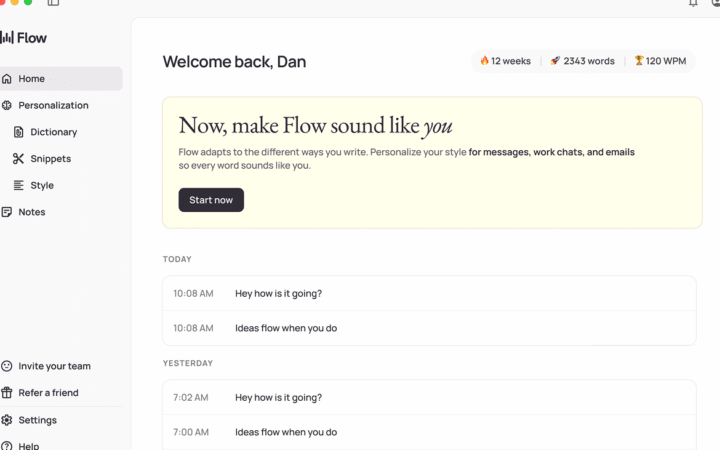
Voice AI startup Wispr has secured another $25M in funding as its Flow dictation app surges in enterprise adoption and user retention, bringing total capital raised to $81M.