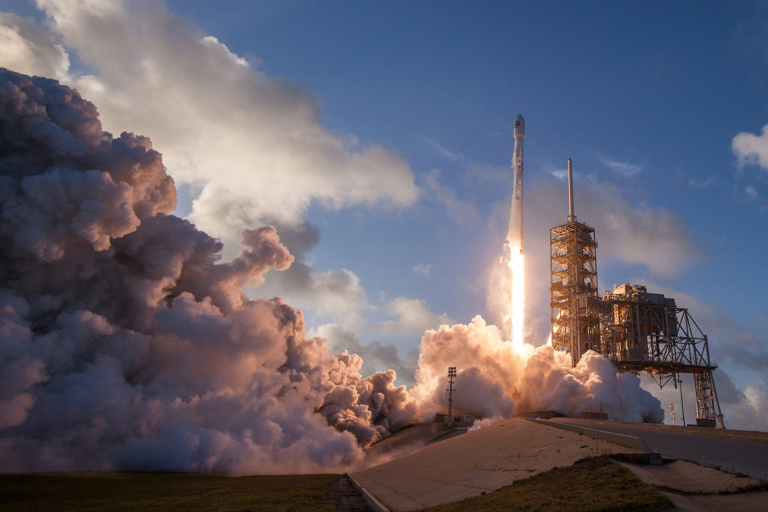
Fresh off the largest IPO on record, SpaceX is asking public investors to back more than rockets. The company is pitching a vertically integrated artificial intelligence strategy that runs from custom chips to data centers, on the ground and eventually in orbit. At a roughly $1.77 trillion valuation, SpaceX would rank as the seventh most-valuable US company, ahead of Meta and Musk’s own Tesla, and worth more than the entire S&P 500 aerospace and defense group. Chief Operating Officer Gwynne Shotwell said the timing finally fits, telling CNBC the building blocks of a public company are now in place.
SpaceX rests on three businesses. Launch is the clearest moat: its Falcon fleet has carried about 80% of all mass sent to orbit since 2023, and the cost to reach low Earth orbit has fallen more than 90% since the Space Shuttle era. Starlink is the profit engine, with more than 10 million subscribers across roughly 9,600 satellites, and its margins fund the rest. The third leg is AI, built mainly around xAI, which SpaceX absorbed earlier this year at a $250 billion valuation. xAI brings the Grok model and the X platform. AI capital spending reached $12.7 billion in 2025 and $7.7 billion in the first quarter of 2026.
The most ambitious piece is orbital. SpaceX tells investors it could begin deploying AI compute satellites as early as 2028, pitching space as a way around the power, land and water limits straining data centers on Earth. Its prospectus calls that business unproven and high-risk. On the ground, SpaceX runs the Colossus data centers near Memphis and has signed multibillion-dollar deals to sell spare compute to Anthropic and Google. It is also building Terafab, a chip and computing project with Tesla that has added Intel as a partner and could cost hundreds of billions. To court developers, it struck a deal with coding startup Cursor, with an option to buy it for $60 billion in stock. Underpinning all of it is Starship, the fully reusable rocket meant to cut launch costs by about 95% and make orbital data centers viable.
Bull Case, Bear Case
- Supporters point to SpaceX’s record of commercializing hard technology and a vertical stack few rivals can match.
- Skeptics question the price. The valuation implies roughly 40 times estimated 2026 revenue and 175 times adjusted earnings, and the company is unprofitable overall.
- Shotwell leaned into the long view, saying, “I do not want to focus on quarterly earnings,” and framing the company as a futuristic bet.
- Governance is unusual. Musk holds more than 80% of the voting power and even controls the decision over his own removal, concentrating risk in one person.
The Long Game
SpaceX did little dealmaking in its first 23 years, then moved fast: a $17 billion Echostar spectrum purchase, the xAI acquisition and the Cursor option. An amended filing said it may issue significant equity for future deals, fueling speculation about an eventual Tesla merger, which Shotwell did not rule out.
Starship remains central and unfinished. SpaceX recently flew its twelfth test, debuting the larger V3 vehicle, and now builds about one Starship a month while aiming for two a week. The deeper goal is unchanged. Musk’s pay package ties a billion shares to milestones that include a permanent Mars colony of at least 1 million people.
Disclaimer: AIstify is an independent media brand owned and operated by NuvexMedia LLC, publishing news, research, and insights on artificial intelligence, emerging technologies, automation, and related industries. NuvexMedia LLC invests in and collaborates with companies across the AI, technology, software, and digital innovation sectors. These relationships do not influence AIstify’s editorial coverage, and the publication maintains full editorial independence to provide accurate, timely, and objective information. © 2026 NuvexMedia LLC. All rights reserved. This content is for informational purposes only and should not be considered legal, tax, investment, financial, or other professional advice.