
Key Notes
- Google Labs’ Tabletop creates collaborative spaces where groups can generate and use interactive tools together.
- Its AI memory is scoped to each space, and members can view, edit or clear those shared memories.
- Access is opening through a waitlist for users aged 18 and older in the United States.
Google is testing a different use for AI-generated apps: helping a group of friends actually agree on a plan. Its new Google Labs experiment, Tabletop, creates shared spaces where people can build and use interactive tools together. The company introduced it on November 11.
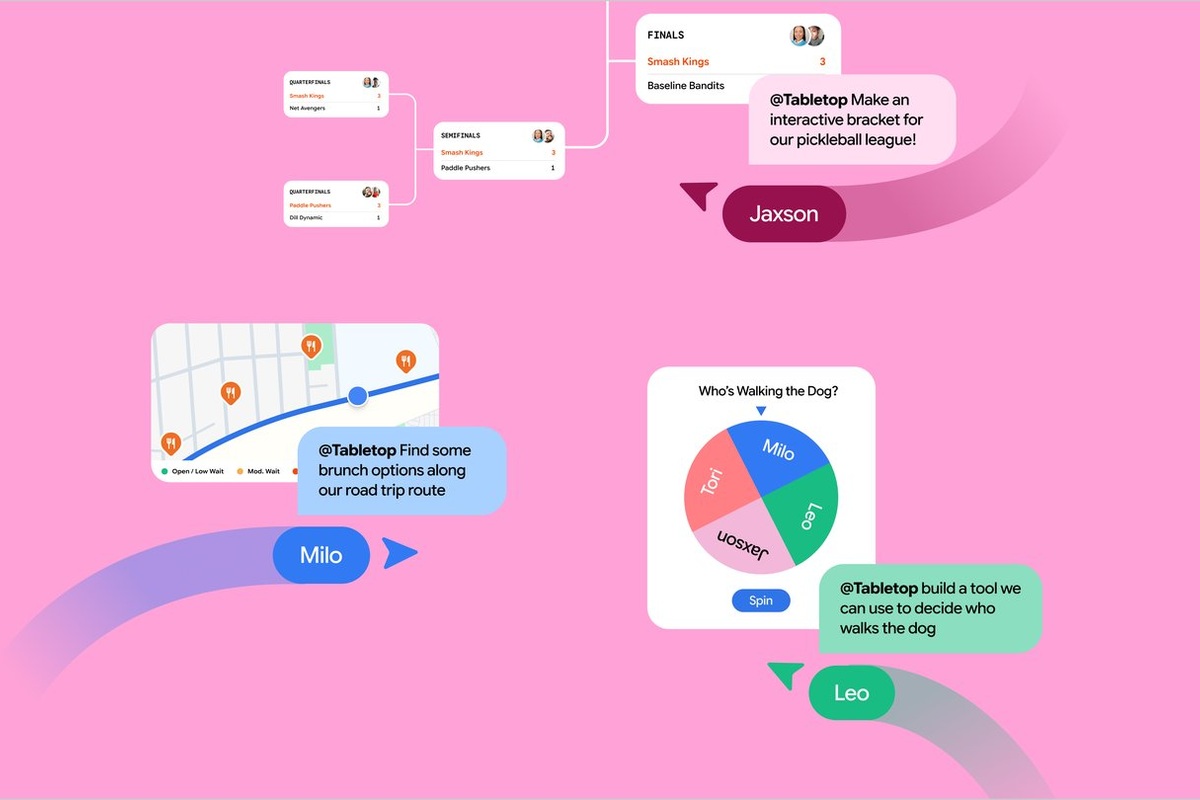
Users can add files, links and ideas, then ask @tabletop to create something useful for the group. Google’s examples include trip itineraries, dinner polls, expense splitters and tournament brackets. A starter template offers another way to begin, and an invitation link brings other participants into the same space.
Small Apps That Everyone Can Use
Google’s FAQ explains how the workspace fits together: a chat for discussion, interactive tabs for tools, and shared context containing information such as files and links. Tabs are miniature web apps that update for participants in real time. Users can ask the AI to change them or edit their code directly.
The product page shows how that could work on a road trip, with route planning, votes on stops, shared budgets and a wheel for choosing dinner. The appeal is a common place to make decisions, rather than another itinerary buried among messages.
The assistant can summarize chats, answer questions and change tabs, keeping discussion and the tools for acting on it in the same workspace.
Shared Memory, Within Each Space
According to the FAQ, Tabletop’s AI memory belongs to the individual space. It does not build a personal profile across different spaces, and members can inspect, change or clear those memories. A space starts out visible only to its creator, with administrators controlling invitations.
Leaving a space removes a user’s access, but does not automatically erase content they contributed. Undeleted messages, tabs and uploaded material remain available to the other members. That distinction matters for groups sharing travel details or personal plans.
The experiment arrives as Anthropic introduced its own collaborative tools inside Claude. Tabletop brings the same broader idea of AI creating interactive working materials to everyday group activities. Access is initially limited to adults in the United States through a waitlist.
Disclaimer: AIstify is an independent media brand owned and operated by NuvexMedia LLC, publishing news, research, and insights on artificial intelligence, emerging technologies, automation, and related industries. NuvexMedia LLC invests in and collaborates with companies across the AI, technology, software, and digital innovation sectors. These relationships do not influence AIstify’s editorial coverage, and the publication maintains full editorial independence to provide accurate, timely, and objective information. © 2026 NuvexMedia LLC. All rights reserved. This content is for informational purposes only and should not be considered legal, tax, investment, financial, or other professional advice.