Sam Altman Says Humanity Is Already Inside the AI Singularity
OpenAI CEO Sam Altman says humanity has already entered the technological singularity, arguing that a transformation once treated as distant science fiction is now unfolding in real time.

Named entity recognition, or NER, finds mentions of specific entities in text and assigns them to categories such as people, organizations, locations, products, dates, or monetary values. It turns unstructured language into structured information that can support search, document analysis, customer service, compliance, and knowledge graphs. Systems may use rules, statistical models, neural networks, or language models. The task becomes difficult when names are ambiguous, new entities appear, categories overlap, or a domain uses specialized terminology. Reliable NER requires representative examples, clear label definitions, multilingual testing where relevant, and evaluation of both whether an entity was found and whether its boundaries and category were correct.
OpenAI CEO Sam Altman says humanity has already entered the technological singularity, arguing that a transformation once treated as distant science fiction is now unfolding in real time.

Ethereum’s Vitalik Buterin argued the gravest AI risk is not rogue superintelligence but a few companies or governments seizing control of it, in a widely shared thread on AI’s future.
Anthropic has disabled Claude Fable 5 and Claude Mythos 5 globally after a U.S. government export-control directive restricted access to the models for foreign nationals, prompting the company to challenge the decision publicly.
OneSoil has partnered with Rainbow Weather to bring hyperlocal AI-powered rainfall forecasting to farmers worldwide, helping improve field operations and reduce weather-related losses.
Tether Data has introduced QVAC MedPsy, a family of compact medical AI models designed for smartphones, laptops, and edge devices. The company claims the models outperform significantly larger healthcare-focused systems while reducing inference costs and token usage.
OpenAI has launched GPT-5.5, a new flagship model designed for coding, computer use, knowledge work, and scientific research, with stronger performance, lower token usage, and broader real-world autonomy than GPT-5.4.
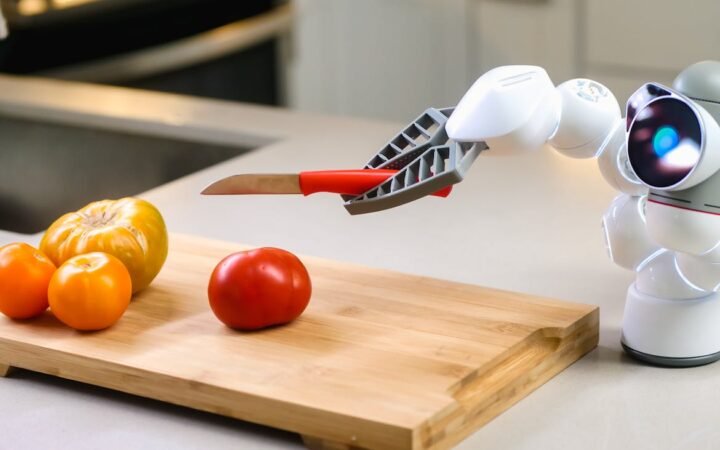
Alibaba has introduced RynnBrain, a new AI model designed to enhance robotic perception and object recognition, advancing China’s push into physical AI and robotics.
ElevenLabs CEO Mati Staniszewski says voice is emerging as the primary way people will interact with AI, as models combine speech with reasoning and agentic capabilities.
A new platform called Rent a Human allows AI agents to outsource tasks to real people when automation falls short, highlighting an unusual hybrid model of human-in-the-loop labor.
Artificial intelligence has become the top investment theme for global family offices, while cryptocurrencies remain largely sidelined, according to JPMorgan’s latest global survey.