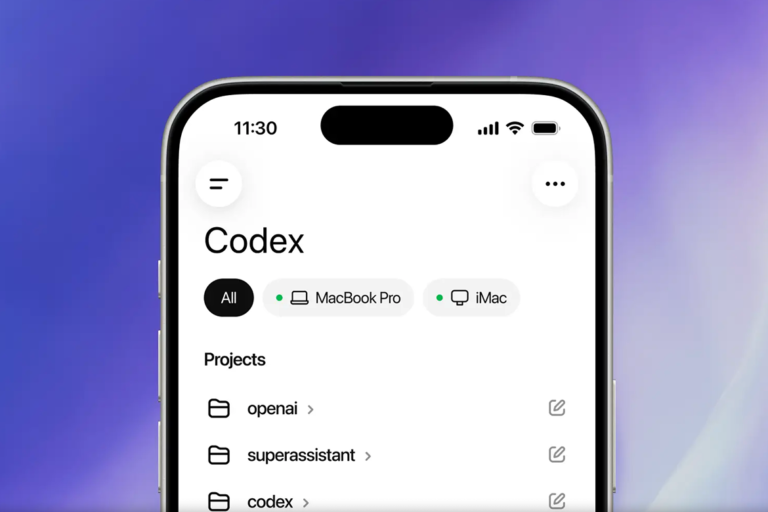

OpenAI has launched mobile support for Codex inside the ChatGPT app, allowing developers to manage AI coding agents and long-running software tasks directly from iOS and Android devices.
The feature is rolling out in preview across all ChatGPT plans, including Free and Go tiers, and enables users to monitor and interact with active Codex sessions running on laptops, remote development machines, or managed enterprise environments. OpenAI said the mobile experience is designed to support a growing shift toward longer-running AI agent workflows that require occasional human guidance rather than constant direct interaction.
Through the ChatGPT mobile app, users can review outputs, approve commands, change models, respond to agent questions, and launch new tasks while work continues remotely on connected machines. OpenAI said files, credentials, and local permissions remain stored on the host device while updates such as screenshots, terminal logs, test results, code diffs, and approvals sync back to the phone in real time.
The company said Codex currently serves more than 4 million weekly users. The mobile integration is intended to reduce interruptions in development workflows by allowing users to intervene only when necessary. OpenAI described scenarios including reviewing refactoring decisions during a commute, approving bug-fix actions remotely, and generating customer support briefings from evolving internal discussions.
Under the hood, the system uses a secure relay layer that keeps trusted machines reachable across devices without exposing them directly to the public internet. Session state and project context remain synchronized across authorized ChatGPT devices tied to the same account.
OpenAI also announced that Remote SSH support is now generally available. The feature allows Codex to connect directly to managed remote environments through standard SSH configurations, enabling developers to work inside enterprise infrastructure while maintaining centralized security policies and dependencies.
Several additional enterprise-focused updates accompanied the launch. OpenAI introduced programmatic access tokens for automation workflows, expanded availability of Hooks for customizing Codex behavior and scanning prompts for secrets, and added HIPAA-compliant support for Codex usage in local enterprise environments.
Support for connecting the mobile app to Codex on Windows systems is expected to arrive later.
The company has also recently expanded its developer-focused AI offerings with new realtime audio systems, including GPT-Realtime-2 for conversational AI agents, a live translation platform supporting more than 70 languages, and a streaming speech-to-text model aimed at voice-driven applications and multilingual automation workflows.
Disclaimer: AIstify is an independent media brand owned and operated by NuvexMedia LLC, publishing news, research, and insights on artificial intelligence, emerging technologies, automation, and related industries. NuvexMedia LLC invests in and collaborates with companies across the AI, technology, software, and digital innovation sectors. These relationships do not influence AIstify’s editorial coverage, and the publication maintains full editorial independence to provide accurate, timely, and objective information. © 2026 NuvexMedia LLC. All rights reserved. This content is for informational purposes only and should not be considered legal, tax, investment, financial, or other professional advice.