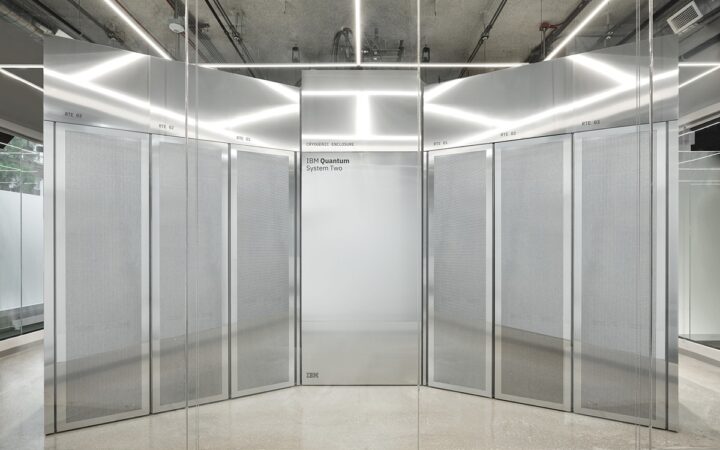
IBM outlined new work with Nvidia and AMD at SC26 to connect quantum processors with GPU supercomputers. The announcements cover scheduling software, error-correction testing and a planned research platform for high-energy and nuclear physics.
IBM and AMD introduced Pelagos, an open-source tool for testing quantum error-correction decoders against simulated errors. Built with Triton, it runs on AMD and Nvidia GPUs. IBM reports tests up to 97 times faster than a single CPU core, under the evaluated conditions.
IBM and Nvidia are also integrating the Quantum Resource Management Interface with Slurm’s Hierarchical Resources feature. IBM’s existing Slurm plugin already lets researchers request quantum resources through job scripts, helping combine them with CPU and GPU workloads.
Separately, IBM, Nvidia and Fermilab plan to launch a modular quantum-computing co-design platform for physics research. IBM and AMD also reported a 7.5-fold speedup in Pelagos’s GPU decoding workload across eight AMD accelerators compared with one GPU.
The effort builds on IBM’s fault-tolerance roadmap, which targets its Starling computer for 2029. At SC26, the emphasis is on fitting quantum hardware into existing supercomputing workflows and testing the classical decoding systems needed to make larger quantum machines reliable.
Disclaimer: AIstify is an independent media brand owned and operated by NuvexMedia LLC, publishing news, research, and insights on artificial intelligence, emerging technologies, automation, and related industries. NuvexMedia LLC invests in and collaborates with companies across the AI, technology, software, and digital innovation sectors. These relationships do not influence AIstify’s editorial coverage, and the publication maintains full editorial independence to provide accurate, timely, and objective information. © 2026 NuvexMedia LLC. All rights reserved. This content is for informational purposes only and should not be considered legal, tax, investment, financial, or other professional advice.