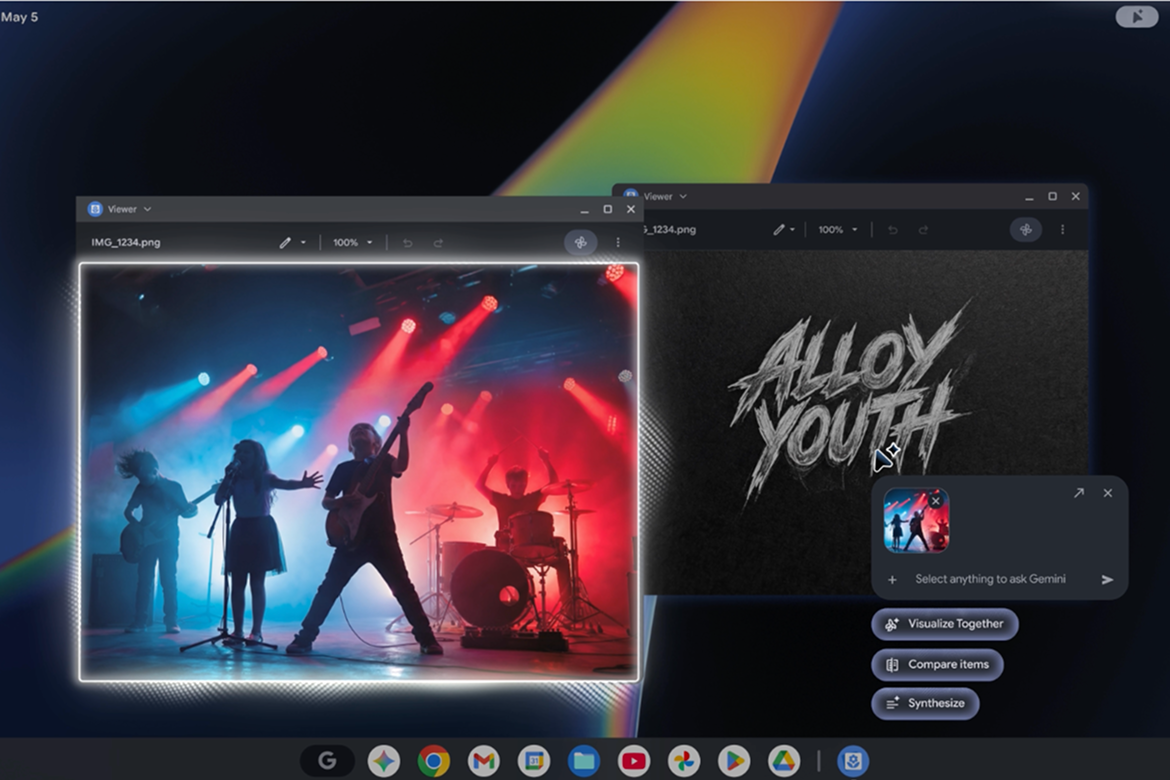

Google Introduces Googlebook Laptops Built Around Gemini AI

Google has unveiled Googlebook, a new laptop category combining Android and ChromeOS technologies with Gemini AI integrated throughout the system. The devices introduce features such as Magic Pointer contextual actions and AI-generated desktop widgets.

By Daniel Mercer Edited by Maria Konash Published:

Google has introduced Googlebook, a new category of laptops designed around Gemini AI and built using a combination of Android and ChromeOS technologies. The company said the devices are intended to shift laptops “from an operating system to an intelligence system,” with AI integrated directly into navigation, multitasking, and desktop interaction.

Googlebook devices run on Android 17 with a redesigned laptop-style interface while retaining integration with Google services and Chrome browsing capabilities. The company described the platform as a fusion of Android’s application ecosystem and ChromeOS infrastructure, optimized for Gemini-powered workflows and cross-device continuity.

One of the central features is Magic Pointer, a new cursor system developed with Google DeepMind. When users move the cursor over content, Gemini can suggest contextual actions automatically. For example, pointing at a date inside an email can trigger meeting creation, while selecting multiple images can generate AI-assisted visual compositions such as virtual furniture placement or outfit previews.

Google is also introducing “Create your Widget,” a system that lets users generate desktop widgets through natural language prompts. Gemini can pull information from Gmail, Calendar, search, reservations, reminders, and other Google services to build personalized dashboards dynamically.

The company said Googlebook is designed to function more fluidly across phones and laptops. Features such as Quick Access allow users to browse and use files stored on Android smartphones directly from the laptop without transferring files manually. Mobile apps can also run inside the desktop environment while preserving workflow continuity.

Googlebook hardware will be manufactured through partnerships with Acer, ASUS, Dell Technologies, HP Inc., and Lenovo. Google said the devices will feature premium materials and a new “glowbar” design element intended to visually distinguish Googlebook laptops.

The first Googlebook devices are scheduled to launch this fall.

Google Pushes Gemini Beyond Apps Into Operating Systems

The launch represents one of Google’s clearest attempts so far to position Gemini not simply as an assistant, but as the core interaction layer for future computing devices.

Rather than opening separate AI applications or chat interfaces, Googlebook integrates Gemini directly into the operating system itself through cursor interactions, contextual actions, dynamic widgets, and continuous multitasking support.

The Magic Pointer feature is especially notable because it changes the cursor from a passive navigation tool into an AI-aware interaction system capable of interpreting onscreen context in real time. That approach mirrors a broader industry shift toward embedding AI directly into operating systems and interface layers rather than treating it as an isolated chatbot.

Google also appears to be using Googlebook to unify parts of Android and ChromeOS development into a more integrated AI-first platform strategy.

AI Becomes Central To Personal Computing Competition

The announcement arrives as major technology companies increasingly compete to redesign personal computing around AI-native interfaces.

Laptop and desktop operating systems are evolving from application-centric environments toward systems where AI continuously interprets user context, predicts intent, and automates actions across workflows.

Googlebook positions Google more directly against AI-integrated computing initiatives from companies including Microsoft and Apple, both of which are also embedding generative AI deeper into operating systems and productivity ecosystems.

By combining Gemini with Android’s application ecosystem and Chrome’s browser dominance, Google is attempting to create a tightly integrated AI computing environment spanning phones, laptops, cloud services, and productivity tools. Meanwhile, OpenAI is reportedly accelerating development of its own AI-focused smartphone, which analyst Ming-Chi Kuo said could enter mass production as early as 2027.

AI & Machine Learning, Consumer Tech, News

Amazon Launches Alexa for Shopping AI Assistant Across Its Store

Amazon has launched Alexa for Shopping, a generative AI assistant that combines Alexa+, Rufus, and customer shopping history to deliver personalized product recommendations, price tracking, and automated purchasing. The assistant is available across Amazon’s app, website, and Echo Show devices.

By Samantha Reed Edited by Maria Konash Published:
Amazon Launches Alexa for Shopping AI Assistant Across Its Store
Amazon launches Alexa for Shopping with AI search, price tracking, automated purchases, and personalized guides. Image: Rubaitul Azad / Unsplash

Amazon has introduced Alexa for Shopping, a new AI-powered shopping assistant designed to combine conversational AI, product expertise, and customer shopping history into a unified retail experience across Amazon’s app, website, and Echo Show devices.

The launch merges capabilities from Alexa+ and Amazon’s Rufus shopping assistant, which the company said helped more than 300 million customers research and compare products in 2025. Alexa for Shopping is now integrated directly into Amazon’s main search bar, allowing users to ask conversational questions, compare products, track orders, generate shopping guides, and automate purchases using natural language.

Amazon said the assistant continuously personalizes recommendations using browsing activity, purchase history, preferences, and conversations across Alexa-enabled devices. The company described the system as a persistent shopping layer that carries context between devices and sessions instead of resetting interactions each time a customer searches.

The assistant can create AI-generated category overviews, compare products side-by-side from search results, surface one-year price history charts, and automatically monitor products for price drops. Customers can also create “Scheduled Actions” that automate recurring shopping tasks such as replenishing household items, tracking book releases, or adding products to carts when prices reach specific targets.

Amazon is also expanding agentic shopping capabilities through Shop Direct and its “Buy for Me” feature. The system can discover products from external retailers and, for eligible items, complete purchases automatically using stored payment and shipping information.

The company said Alexa for Shopping can also generate personalized shopping guides for complex purchases such as laptops, TVs, or appliances by summarizing reviews, features, pricing differences, and category insights across Amazon and the broader web.

In addition to mobile and desktop support, Amazon is bringing the full Amazon storefront experience to Echo Show devices for the first time. Customers can browse and purchase products using voice commands, touch controls, or a combination of both.

Alexa for Shopping is rolling out to all U.S. customers this week and does not require a Prime membership, Alexa app subscription, or Echo device.

Amazon Pushes AI Deeper Into Commerce Automation

The launch marks one of Amazon’s most aggressive attempts yet to transform e-commerce from search-based navigation into AI-assisted decision making and task automation.

Rather than relying on keyword searches and static filters, Alexa for Shopping is designed to function as a persistent shopping assistant that remembers preferences, previous conversations, recurring purchases, family information, and shopping behavior across Amazon’s ecosystem.

Features such as automated cart-building, conversational product research, and price-triggered purchases move Amazon closer to agentic commerce systems where AI actively manages portions of the shopping process on behalf of users.

The integration of Rufus product intelligence with Alexa+ personalization also gives Amazon a broader contextual data advantage across retail, smart home devices, and media services.

AI & Machine Learning, Consumer Tech, News

Google Explores SpaceX Deal For Orbital Data Centers

Google is reportedly in talks with SpaceX and other launch providers as it explores deploying orbital data centers under its Project Suncatcher initiative. The discussions reflect growing interest in space-based AI infrastructure and computing capacity.

By Olivia Grant Edited by Maria Konash Published:
Google Explores SpaceX Deal For Orbital Data Centers
Google explores SpaceX launch deal for orbital AI data centers as Project Suncatcher targets 2027 prototypes. Image: ActionVance / Unsplash

Google is reportedly in talks with SpaceX over a potential rocket launch agreement tied to the company’s efforts to develop orbital data centers, according to a Wall Street Journal report citing people familiar with the discussions.

The report said Google is also holding conversations with other rocket-launch providers as it evaluates infrastructure options for deploying computing systems in space. The initiative is connected to Google’s previously disclosed Project Suncatcher program, which aims to research space-based data center technology and launch two prototype satellites by early 2027.

Project Suncatcher was first revealed in November as part of Google’s long-term exploration of alternative AI infrastructure systems. The project focuses on whether orbital computing platforms could eventually help address growing energy, cooling, and land constraints associated with terrestrial AI data centers.

A partnership with SpaceX would mark another instance of Elon Musk cooperating commercially with AI rivals he has publicly criticized in the past. Musk has repeatedly attacked Google’s AI strategy while simultaneously expanding his own AI infrastructure ambitions through xAI and SpaceX.

Space-Based Computing Gains Attention In AI Industry

The idea of orbital data centers has shifted from theoretical research toward early-stage infrastructure planning as AI companies search for ways to overcome physical limitations facing existing compute expansion.

Space-based infrastructure offers several potential advantages, including access to uninterrupted solar energy, reduced land and cooling constraints, and theoretically massive long-term compute scalability if launch costs continue declining.

However, major technical challenges remain, including radiation exposure, hardware reliability, maintenance logistics, latency management, and the economics of deploying large-scale compute systems into orbit.

AI Infrastructure Race Expands Beyond Earth

Competition in artificial intelligence is expanding into infrastructure ownership and compute deployment strategy rather than focusing solely on model development.

Last week, Anthropic signed an agreement to access the full compute capacity of SpaceXAI’s Colossus 1 supercomputer facility in Memphis, adding more than 220,000 NVIDIA GPUs to support Claude training and inference workloads. The partnership also included discussions around developing multiple gigawatts of orbital compute infrastructure.

The move followed Musk’s decision to merge xAI directly into SpaceX under a new SpaceXAI structure combining AI models, compute infrastructure, and aerospace operations into a single organization. Analysts said the consolidation could give SpaceXAI a unique advantage if orbital AI infrastructure becomes commercially feasible in the coming years.

AI & Machine Learning, Cloud & Infrastructure, News

U.S. Banks Rush To Fix Vulnerabilities Found By Anthropic Mythos

Major U.S. banks are rapidly patching software vulnerabilities uncovered by Anthropic’s Mythos AI model as concerns grow over AI-driven cybersecurity risks. The system is reportedly identifying weaknesses and attack chains at speeds beyond traditional security workflows.

By Maria Konash Published:
U.S. Banks Rush To Fix Vulnerabilities Found By Anthropic Mythos
U.S. banks speed up software patching after Anthropic’s Mythos AI uncovers widespread cybersecurity vulnerabilities. Image: David Vincent / Unsplash

Major U.S. banks are racing to patch IT system vulnerabilities identified by Anthropic’s powerful Mythos AI model, triggering urgent software upgrades and faster cybersecurity remediation processes across the banking sector.

According to sources familiar with the matter, several of the country’s largest financial institutions currently have access to Claude Mythos Preview through Anthropic’s Project Glasswing initiative. As banks analyze the findings, they are reportedly uncovering large numbers of previously low- or moderate-priority weaknesses that the AI system can chain together into higher-risk attack paths.

The vulnerabilities span both proprietary and open-source software, with older legacy systems drawing particular scrutiny because of outdated software support and slower patching cycles. Multiple sources said banks are now fixing vulnerabilities within days that previously may have remained unresolved for weeks.

The accelerated remediation effort is also creating operational pressure inside financial institutions. Sources said some banks may need to temporarily take systems offline more frequently to implement updates and security fixes, though institutions are attempting to minimize disruption for customers.

“This is a wake-up call because cyber risk is moving to machine speed, while much of bank defense still operates at human speed,” said Nitin Seth, co-founder and CEO of data and AI services firm Incedo.

Mythos has reportedly proven especially effective at identifying complex attack chains by linking together multiple seemingly minor weaknesses into broader exploitable vulnerabilities. One banking source described the system as forcing institutions into remediation timelines “never previously contemplated.”

Access to Mythos remains limited because of both safety concerns and infrastructure costs. Anthropic initially restricted availability to Project Glasswing partners and a small group of additional organizations. Banks reportedly using the system include JPMorgan Chase, Goldman Sachs, Citigroup, Bank of America, and Morgan Stanley.

AI-Driven Cybersecurity Changes Banking Operations

The rapid adoption of Mythos highlights how advanced AI systems are beginning to reshape cybersecurity operations inside highly regulated industries.

Unlike conventional vulnerability scanners, Mythos reportedly demonstrates stronger reasoning capabilities capable of connecting isolated weaknesses into realistic attack scenarios. Regulators and cybersecurity experts have increasingly warned that frontier AI systems could dramatically accelerate both cyber defense and cyber offense.

A senior banking regulatory official told Reuters the model had proven “as powerful as anticipated,” particularly in its ability to connect vulnerabilities that human analysts might take far longer to identify.

The pressure is especially acute for banks because financial systems often rely on decades-old infrastructure, proprietary software stacks, and interconnected legacy environments that are difficult to modernize quickly without operational risk.

High Costs Create Uneven Access To Frontier Cyber AI

One major challenge for smaller banks is the cost and infrastructure required to use frontier cybersecurity models effectively.

Anthropic prices Mythos at $25 per million input tokens and $125 per million output tokens, making it significantly more expensive than its widely available Claude Opus 4.7 model. Anthropic has said it will provide $100 million in credits to Project Glasswing participants and Mythos customers to support research-preview usage.

Cybersecurity firms involved in Project Glasswing said the model requires entirely new workflows and methodologies to operate effectively. Adam Meyers of CrowdStrike said his team spent an entire weekend developing processes for using Mythos before actively searching for vulnerabilities.

Anthropic has separately attempted to broaden defensive access through Claude Security and published recommendations for organizations without direct Mythos access. The company has also expanded enterprise cybersecurity offerings through its recently announced financial services AI platform and a separate $1.5 billion AI deployment venture backed by firms including Blackstone and Goldman Sachs aimed at helping organizations operationalize Claude-based systems.

AI & Machine Learning, Cybersecurity & Privacy, Enterprise Tech, News

OpenAI Introduces Daybreak in Response to Anthropic’s Mythos Push

OpenAI has introduced Daybreak, a cybersecurity initiative designed to integrate AI-driven defense directly into software development workflows. The platform combines GPT-5.5 models, Codex Security, and partnerships with major security firms to automate vulnerability analysis and remediation.

By Marcus Lee Edited by Maria Konash Published:
OpenAI Introduces Daybreak in Response to Anthropic’s Mythos Push
OpenAI launches Daybreak with GPT-5.5 and Codex Security to automate vulnerability detection and patching. Image: OpenAI

OpenAI has launched Daybreak, a cybersecurity initiative aimed at embedding AI-driven defense directly into software development and security operations workflows. The company said the platform combines its GPT-5.5 models, the Codex Security agent framework, and partnerships with major cybersecurity firms to help organizations identify, validate, and remediate vulnerabilities faster.

OpenAI described Daybreak as a system designed to move cybersecurity “from discovery to remediation” while integrating defensive intelligence into the software development process itself. Rather than focusing solely on finding vulnerabilities after deployment, the initiative aims to make software “resilient by design.”

The platform uses multiple AI models depending on workflow sensitivity. GPT-5.5 will support general development and analysis tasks, while GPT-5.5 with Trusted Access for Cyber is intended for verified defensive security operations such as secure code review, malware analysis, vulnerability triage, patch validation, and detection engineering.

OpenAI also introduced GPT-5.5-Cyber, a more permissive version intended for specialized authorized workflows including penetration testing, controlled validation, and red teaming activities under stricter verification and account-level controls.

At the center of the initiative is Codex Security, an agentic cybersecurity system capable of scanning repositories, building editable threat models, identifying realistic attack paths, validating high-risk findings, generating patches, and testing fixes directly inside codebases.

In one demonstration, OpenAI showed Codex Security scanning a software repository, prioritizing exploitable vulnerabilities, generating remediation patches, and returning audit-ready evidence documenting the fixes.

The company said Daybreak is designed to reduce vulnerability analysis workflows from hours to minutes while improving prioritization of high-impact security issues and lowering token usage costs during large-scale code analysis.

OpenAI Expands Its Cybersecurity Push

The launch positions OpenAI more directly against Anthropic in the growing market for AI-driven cybersecurity systems.

Anthropic’s Claude Mythos Preview model previously drew attention after reportedly helping identify and patch 271 vulnerabilities in the Firefox browser alone. That announcement intensified concerns in Washington and across the cybersecurity industry about increasingly capable AI systems discovering exploitable software weaknesses faster than organizations can fix them.

Unlike some AI-assisted security tools focused primarily on vulnerability detection, OpenAI said Daybreak is intended to integrate remediation directly into development pipelines through continuous patch validation, secure code review, and automated remediation workflows.

The company emphasized that stronger cyber capabilities also require stricter safeguards. OpenAI said Daybreak combines expanded defensive capabilities with verification systems, monitoring controls, proportional safeguards, and accountability mechanisms intended to limit misuse.

Security Firms And Governments Prepare For AI-Native Defense

OpenAI is launching Daybreak alongside partnerships with several major cybersecurity and infrastructure companies, including Cloudflare, Cisco, CrowdStrike, Palo Alto Networks, Oracle, Akamai Technologies, Fortinet, and Zscaler.

“We’re excited about the potential of OpenAI’s cyber capabilities to bring stronger reasoning and more agentic execution into security workflows,” said Cloudflare CTO Dane Knecht. “It’s a big step forward for teams to be able to leverage frontier models not only to accelerate velocity, but also to improve their security posture.”

The initiative also comes as governments and regulators increasingly focus on AI-powered cyber capabilities following warnings around advanced systems such as Anthropic’s Mythos. Earlier this year, OpenAI separately announced plans to provide European institutions with access to GPT-5.5-Cyber under its broader EU Cyber Action Plan as policymakers intensify oversight of frontier AI security models.

SoftBank Injects $457 Million Into British AI Chipmaker

SoftBank has invested more than $450 million into Graphcore as the Japanese technology group expands its AI infrastructure and semiconductor ambitions. The funding follows SoftBank’s acquisition of the British AI chip company in 2024.

By Olivia Grant Edited by Maria Konash Published:
SoftBank Injects $457 Million Into British AI Chipmaker
SoftBank invests $457M in Graphcore to expand AI chip and infrastructure efforts. Image: Vishnu Mohanan / Unsplash

SoftBank Group has injected more than $450 million into British AI chip company Graphcore as the Japanese technology conglomerate accelerates investments in artificial intelligence infrastructure and semiconductor development.

According to a filing with the UK’s Companies House, Graphcore issued a single share valued at approximately $457 million on April 10. A Graphcore spokesperson confirmed the funding came from SoftBank. Sources familiar with the arrangement told CNBC the investment represents only part of the capital Graphcore is expected to receive from SoftBank this year.

SoftBank acquired Graphcore in 2024 after the UK startup struggled to compete commercially against dominant AI chip suppliers such as Nvidia. Before the acquisition, Graphcore had raised hundreds of millions of dollars and was once positioned as a potential challenger in the rapidly expanding AI accelerator market.

At the time of the acquisition, SoftBank said Graphcore would help support its broader ambitions around artificial general intelligence development. The company has since become part of SoftBank’s growing portfolio of AI infrastructure and semiconductor assets.

The new funding comes as SoftBank sharply increases spending across AI hardware, compute infrastructure, and data center projects. The company is involved in the $500 billion Stargate AI infrastructure initiative alongside OpenAI and Oracle, while also pursuing additional semiconductor and robotics investments globally.

SoftBank founder and CEO Masayoshi Son previously described Graphcore as “a company with deep expertise in chip design,” adding that the acquisition strengthened SoftBank’s semiconductor strategy alongside chip architecture company Arm Holdings.

Graphcore has also expanded internationally since the acquisition. In October, the company announced plans to invest up to £1 billion into a new AI campus in Bengaluru, India, focused on AI, silicon engineering, software, and systems development.

SoftBank Expands Its AI Infrastructure Strategy

The Graphcore funding highlights SoftBank’s broader effort to build an integrated AI infrastructure ecosystem spanning semiconductors, compute, robotics, and large-scale data centers.

Over the past two years, SoftBank has aggressively repositioned itself around AI after previously focusing heavily on venture capital investments through the Vision Fund. The company has since shifted toward owning strategic infrastructure assets directly involved in AI model training and deployment.

In addition to Graphcore and Arm, SoftBank also acquired silicon design company Ampere Computing in 2025. Reports have additionally indicated the company is exploring major AI data center projects in Europe, including a potential $100 billion investment in AI infrastructure in France following discussions with Emmanuel Macron, while also considering a standalone AI and robotics business listing in the United States.

Competition For AI Chips Intensifies

The investment also reflects increasing competition in AI semiconductors as companies seek alternatives to Nvidia’s dominant position in the market for AI accelerators.

While Graphcore struggled to achieve broad commercial adoption independently, SoftBank appears to view the company’s chip architecture and engineering expertise as strategically valuable for future AI systems and infrastructure deployments.

Demand for AI compute hardware has surged globally alongside the rapid expansion of generative AI models and large-scale enterprise AI workloads. That growth has pushed technology companies and investors to secure access not only to chips, but also to energy, networking infrastructure, manufacturing capacity, and advanced semiconductor design talent.

For SoftBank, strengthening Graphcore may provide another pathway to participate directly in the long-term buildout of AI infrastructure rather than relying solely on minority investments in external AI companies.

AI & Machine Learning, Cloud & Infrastructure, News, Startups & Investment