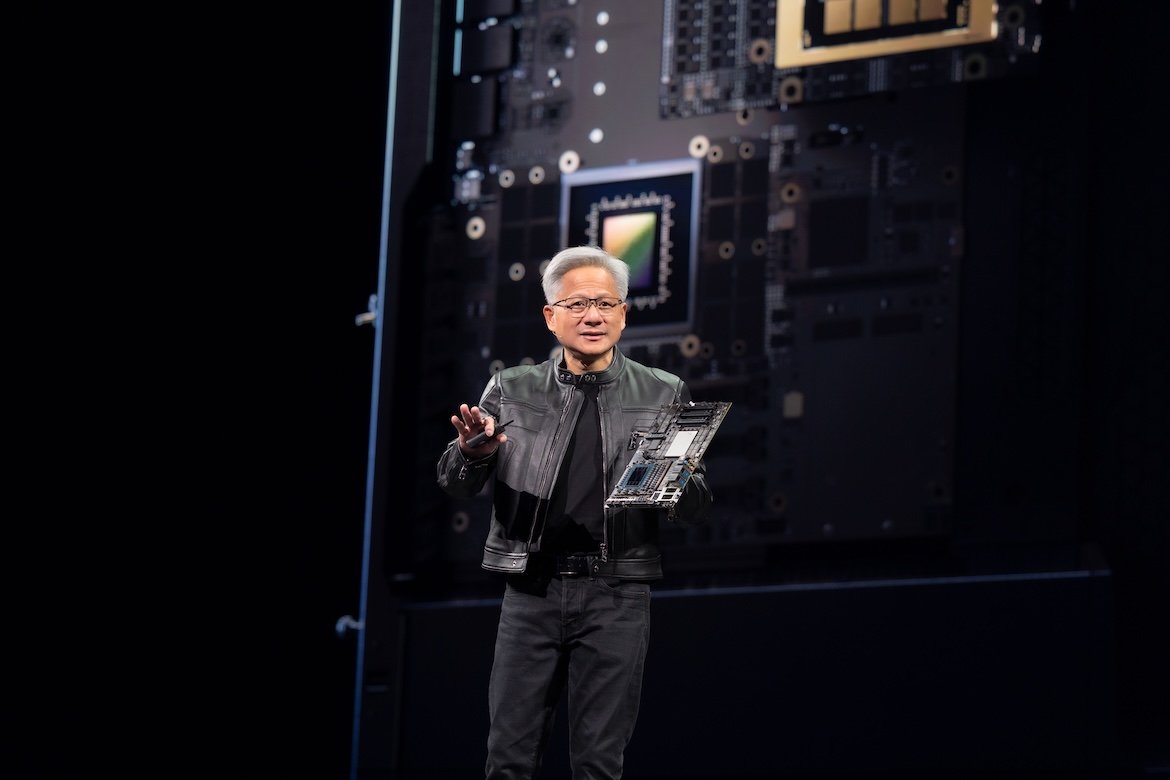

Nvidia CEO Jensen Huang has walked back remarks reportedly made during an interview with the Financial Times, where he was quoted as saying “China is going to win the AI race.” Speaking at the Future of AI Summit in London, Huang’s comments sparked debate about global AI competition and the shifting balance of technological power.
According to multiple attendees, Huang said that China’s cheaper energy costs, large engineering base, and flexible regulatory environment give it a strong foundation to accelerate AI development. The statement, widely circulated after publication, was interpreted as a warning that the United States could fall behind without major investment in computing capacity and innovation.
Hours later, Nvidia released a clarifying statement on Huang’s behalf through the company’s official X account. “As I have long said, China is nanoseconds behind America in AI,” Huang wrote. “It’s vital that America wins by racing ahead and winning developers worldwide.”
A statement from NVIDIA CEO Jensen Huang. pic.twitter.com/Exwx54OYJV
— NVIDIA Newsroom (@nvidianewsroom) November 5, 2025
The follow-up message reflects Huang’s long-standing view that U.S. leadership in AI depends not on isolation, but on innovation speed, open collaboration, and developer engagement. He has repeatedly emphasized that the U.S. must invest aggressively in research, infrastructure, and education to maintain its edge in artificial intelligence.
Huang’s comments also come amid a period of heightened U.S.-China technology tensions. Nvidia, once a dominant supplier of AI chips to China, has seen its market share drop to nearly zero after Beijing launched a national security review of foreign processors earlier this year. China has since promoted its own chipmakers, including Huawei and Birentech, as part of a broader effort to build domestic semiconductor independence.
In response to ongoing export restrictions, Nvidia has sought to diversify its global presence by expanding partnerships in Japan, Singapore, and Germany, and deepening collaborations with OpenAI, AWS, and Oracle. The company is also investing in large-scale AI data centers designed to meet rising global demand for generative AI computing power.
Analysts say Huang’s softened tone reflects an effort to strike a balance between political diplomacy and strategic messaging. “He’s threading the needle,” said Dan Ives, Managing Director at Wedbush Securities. “Nvidia represents U.S. technological strength, but it’s also a global company that can’t ignore the scale and potential of the Chinese market.”
At the London summit, Huang also reiterated his belief that overregulation could hinder Western innovation. He contrasted this with China’s state-backed AI initiatives and government support for energy-intensive infrastructure. “Innovation thrives where builders are empowered,” he said in a separate discussion.
Despite political challenges, Nvidia remains the undisputed global leader in AI chips, controlling more than 80% of the data center GPU market. The company’s hardware underpins most major AI systems – from ChatGPT and Anthropic’s Claude to new frontier models developed by startups and universities worldwide.
As the AI race accelerates, Huang’s revised statement underscores his broader philosophy: success will depend on speed, scale, and openness, not rhetoric. “It’s not about who slows the other down,” he said earlier this year. “It’s about who builds faster, smarter, and for everyone.”