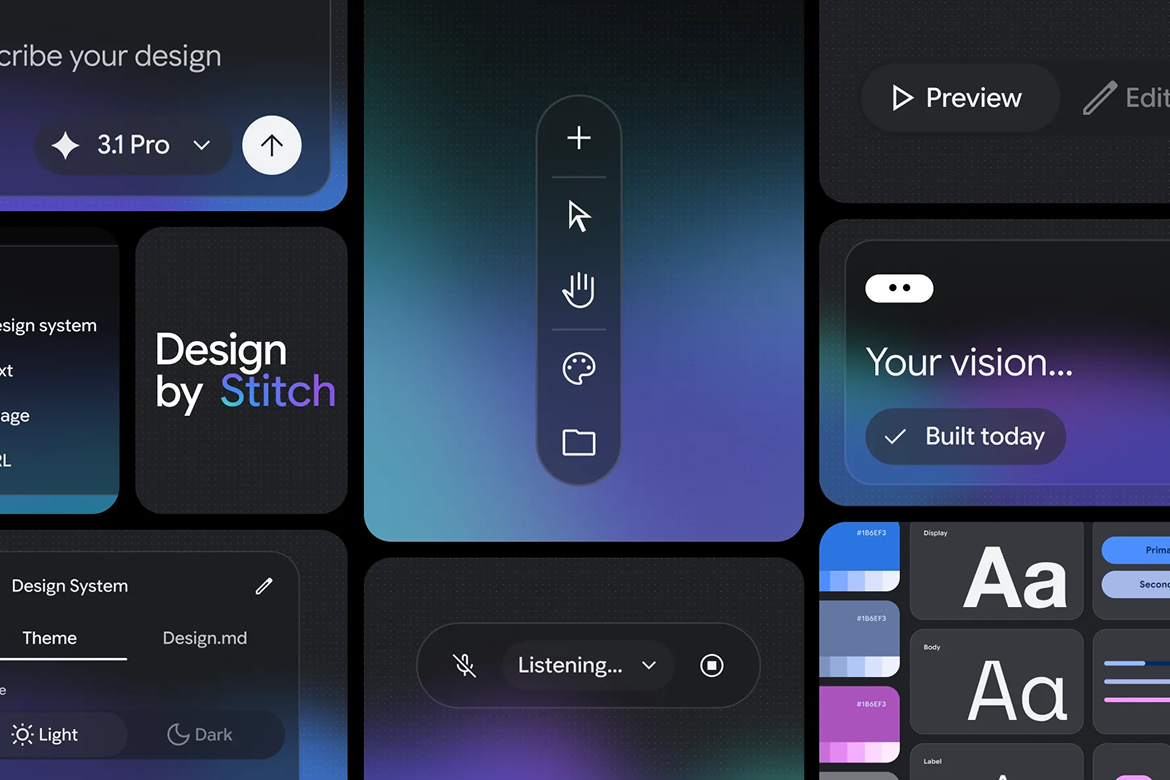

Google has expanded its experimental design tool Stitch into a full AI-native platform, signaling a deeper push into software creation workflows powered by generative AI.
The updated version introduces a redesigned interface centered around an “infinite canvas,” where users can generate, edit, and iterate on user interface designs using natural language, images, or code. The system is designed to move beyond traditional wireframing by allowing users to describe intent, such as business goals or user experience, and automatically generate high-fidelity designs.
The platform also adds a dedicated design agent capable of reasoning across an entire project. This agent can track iterations, suggest improvements, and generate new design directions based on prior work. A companion feature, called Agent Manager, enables users to explore multiple design paths simultaneously while maintaining organization across versions.
AI-Native Workflow and Rapid Prototyping
Stitch’s update reflects a broader shift toward AI-assisted development tools that compress the time between idea and execution. The platform can instantly convert static designs into interactive prototypes, allowing users to simulate user flows and test functionality without manual coding.
Users can generate entire application flows in seconds, with the system automatically creating follow-up screens based on interactions. This enables rapid iteration and continuous refinement, which are critical in early-stage product design.
The addition of voice input further expands accessibility. Users can speak commands directly to the system to modify layouts, generate alternatives, or request design critiques in real time. This approach positions AI as an active collaborator rather than a passive tool.
A key component of the update is a new format called DESIGN.md, a structured file that defines design rules and systems. It allows users to import design frameworks from external sources or reuse them across projects, reducing duplication and standardizing workflows. The format is also designed to integrate with other development tools, enabling smoother transitions from design to production.
Competitive Pressure on Design Tools
The release comes as competition intensifies in the design software market, where AI capabilities are becoming a central differentiator. Stitch’s ability to combine design generation, prototyping, and workflow integration positions it as a potential alternative to established tools.
Following the announcement, shares of Figma declined by approximately 8%, reflecting investor concerns about increased competition. Figma has long been a dominant browser-based interface design platform used widely by designers and developers.
The development also follows Adobe’s attempted $20 billion acquisition of Figma in 2022, which was ultimately blocked by regulators over antitrust concerns. The decision preserved Figma’s independence but left the company facing growing competition from AI-native entrants.
Google’s expansion of Stitch highlights a broader industry trend toward integrating AI directly into creative and development environments. By enabling users to generate functional software from high-level descriptions, these tools aim to reduce reliance on traditional design processes.
As AI continues to reshape software development, platforms like Stitch are positioning themselves at the intersection of design, engineering, and automation, where the boundaries between these roles are becoming increasingly blurred.