AI Chips Explained: How They Power Artificial Intelligence
By Olivia Grant Published: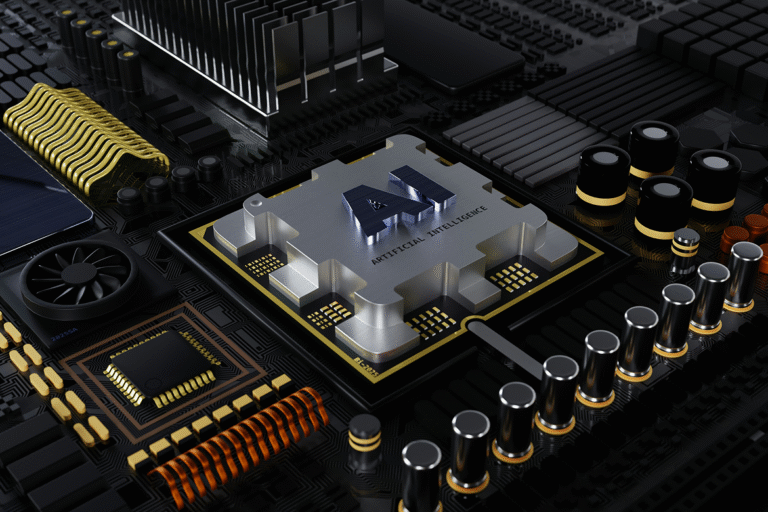
AI chips are specialized processors designed to run artificial intelligence models efficiently. This guide explains what AI chips are, how they work, and why they are essential for modern AI systems.
Artificial intelligence relies not only on software and algorithms but also on powerful hardware. Behind every AI system, from voice assistants and recommendation engines to self-driving cars and advanced research models, there is specialized computing hardware that makes these technologies possible. One of the most important components of this hardware ecosystem is the AI chip.
AI chips are processors designed specifically to handle the demanding calculations required by artificial intelligence models. They enable machines to analyze large amounts of data, run complex algorithms, and generate results quickly and efficiently. Without specialized chips, many modern AI applications would be far slower, more expensive, and less practical.
This guide explains what AI chips are, how they work, why they are important for artificial intelligence, and how they are used in real-world technologies.
What Is an AI Chip?
An AI chip is a specialized semiconductor processor designed to accelerate artificial intelligence tasks. Unlike general-purpose computer processors, AI chips are optimized for the types of mathematical calculations used in machine learning and deep learning.
Most AI models rely heavily on operations such as matrix multiplication, vector processing, and parallel computation. These operations involve processing large sets of numbers simultaneously. Traditional processors can perform these tasks, but they are not optimized for them. AI chips are designed specifically to handle these workloads efficiently.
The purpose of an AI chip is to make AI systems faster, more energy-efficient, and capable of processing massive datasets. These chips are used in everything from cloud data centers to smartphones and smart home devices.
Why AI Needs Specialized Chips
Artificial intelligence models, especially deep learning systems, require enormous computational power. Training a large neural network may involve processing billions of data points and adjusting millions or even billions of parameters.
Traditional central processing units, or CPUs, are designed to handle many different types of tasks. While they are versatile, they are not optimized for the repetitive mathematical operations required by AI.
AI chips solve this problem by focusing on high-speed numerical processing. They are designed to perform many calculations simultaneously, a technique known as parallel processing. This allows AI systems to train models faster and run predictions more efficiently.
As AI models have grown larger and more complex, the demand for specialized hardware has increased significantly. Companies developing AI technologies rely on these chips to manage the massive computational workloads required for modern machine learning.
How AI Chips Work
AI chips operate by accelerating the mathematical operations that power machine learning models. These models rely on neural networks, which process data through layers of mathematical functions.
When data enters a neural network, the system performs calculations using matrices and vectors. Each layer of the network transforms the data by applying weights and mathematical operations. This process requires enormous computational resources, especially when dealing with large datasets.
AI chips contain hardware units optimized for these operations. Instead of processing tasks sequentially, they perform many calculations simultaneously. This architecture allows the chip to handle complex neural network computations far more efficiently than traditional processors.
Another key feature of AI chips is memory optimization. AI workloads require rapid access to large amounts of data, so these chips are designed to move data quickly between memory and processing units. Reducing delays in data transfer helps improve performance and energy efficiency.
By combining specialized processing units with optimized memory systems, AI chips enable fast and efficient AI computations.
Types of AI Chips
Several types of processors are used for artificial intelligence tasks. Each type has different strengths depending on the application.
Central Processing Units
CPUs are the traditional processors found in most computers. They are highly versatile and capable of running many types of software. Early machine learning systems often relied on CPUs for training and inference.
However, CPUs are not optimized for the massive parallel operations required by modern deep learning models. As AI workloads increased, more specialized hardware became necessary.
Graphics Processing Units
Graphics Processing Units, or GPUs, were originally designed to render images and video for computer graphics. However, their architecture is well suited for parallel computation, making them highly effective for machine learning tasks.
GPUs can process thousands of operations simultaneously, allowing them to accelerate neural network training significantly. Today, GPUs are widely used in AI research, data centers, and cloud computing platforms.
Tensor Processing Units
Tensor Processing Units, or TPUs, are specialized chips designed specifically for machine learning workloads. These chips are optimized for tensor operations, which are mathematical structures used in deep learning models.
TPUs are commonly used in large-scale AI training environments where speed and efficiency are critical.
Neural Processing Units
Neural Processing Units, or NPUs, are specialized chips designed to run AI models directly on devices such as smartphones, tablets, and smart cameras.
NPUs allow devices to perform AI tasks locally rather than sending data to the cloud. This improves performance, reduces latency, and enhances privacy.
AI Chips in Data Centers
Large AI systems often run in cloud data centers that contain thousands of specialized processors. These facilities provide the computing power required to train large neural networks and run complex AI services.
Data center AI chips are used for tasks such as training language models, processing massive datasets, and running real-time AI applications. Companies developing advanced AI systems rely on powerful clusters of GPUs, TPUs, or other specialized processors to train their models.
Training large models can require enormous amounts of computation. For example, training a large language model may involve processing trillions of tokens and adjusting billions of parameters. AI chips make this process feasible by dramatically increasing computational speed.
AI Chips in Consumer Devices
AI chips are not limited to data centers. Many modern consumer devices include AI hardware designed to support intelligent features.
Smartphones often include neural processing units that enable tasks such as facial recognition, voice recognition, and real-time image enhancement. These chips allow the device to process AI workloads locally without relying on cloud servers.
Smart home devices also use AI chips to recognize voice commands, detect motion, and automate home systems.
In cameras, AI processors enable features such as scene detection, automatic image enhancement, and object tracking.
By embedding AI chips directly into devices, manufacturers can deliver faster performance while reducing reliance on external servers.
Advantages of AI Chips
AI chips offer several advantages compared with general-purpose processors.
One major benefit is performance. Specialized hardware can perform AI computations far faster than traditional processors.
Another advantage is energy efficiency. AI workloads often require billions of calculations, which can consume significant power. AI chips are optimized to perform these tasks using less energy.
Scalability is also important. AI chips allow large models to be trained and deployed across distributed systems, enabling companies to build increasingly powerful AI technologies.
These advantages make AI chips essential for both research and commercial AI applications.
Challenges in AI Hardware Development
Developing advanced AI chips presents several challenges.
One challenge is manufacturing complexity. Modern semiconductor fabrication requires extremely precise technology and advanced facilities.
Another challenge is cost. Designing and producing specialized chips requires significant investment in research, engineering, and manufacturing.
There is also intense global competition in the AI hardware market. Technology companies and semiconductor manufacturers are investing heavily in developing faster and more efficient AI processors.
Finally, energy consumption remains an ongoing concern. Training large AI models can require substantial electricity, prompting researchers to develop more energy-efficient hardware solutions.
The Future of AI Chips
The demand for AI computing power continues to grow rapidly as artificial intelligence becomes more widely adopted. Researchers and engineers are exploring new chip architectures designed specifically for machine learning workloads.
Emerging technologies include advanced neural accelerators, specialized inference processors, and hardware designed to support next-generation AI models.
Companies are also working to improve energy efficiency and reduce the environmental impact of large-scale AI computing.
As AI systems continue to evolve, hardware innovation will play a critical role in enabling more powerful, accessible, and efficient artificial intelligence technologies.
Conclusion
AI chips are specialized processors designed to handle the intensive computations required by artificial intelligence systems. By optimizing hardware for machine learning workloads, these chips allow AI models to train faster, run more efficiently, and process massive amounts of data.
From data center infrastructure to everyday consumer devices, AI chips are a key component of modern artificial intelligence. They power technologies such as voice assistants, recommendation systems, autonomous vehicles, and advanced research tools.
Understanding AI chips provides valuable insight into the hardware foundation that supports many of today’s AI innovations. As demand for artificial intelligence continues to grow, these specialized processors will remain central to the development of future technologies.