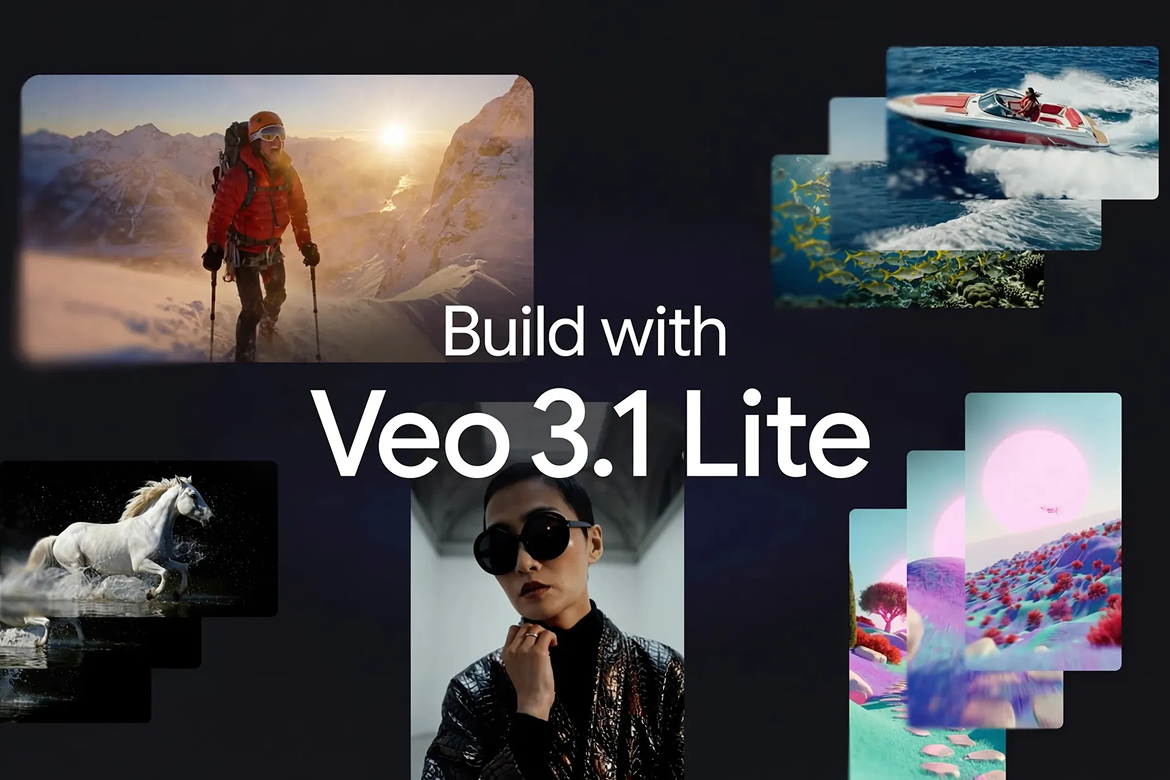

Soon after OpenAI has shut down it’s Sora app, Google has launched Veo 3.1 Lite, its most cost-efficient AI video generation model to date, targeting developers building high-volume video applications. The release expands the Veo 3.1 family with a pricing-focused option designed to lower the barrier to entry for generative video tools.
Veo 3.1 Lite is priced at less than half the cost of Veo 3.1 Fast while maintaining comparable generation speed. The model supports both text-to-video and image-to-video workflows, enabling developers to generate short-form video clips with flexible inputs.
The model offers output in 720p and 1080p resolutions, with support for both landscape (16:9) and portrait (9:16) formats. Video duration can be set to 4, 6, or 8 seconds, allowing developers to adjust costs based on use case requirements.
Pricing highlights the model’s positioning. Veo 3.1 Lite costs approximately $0.05 per second for 720p output and $0.08 per second for 1080p. By comparison, Veo 3.1 Fast is priced at $0.15 per second, with a scheduled reduction to $0.10 for 720p and $0.12 for 1080p starting April 7. The standard Veo 3.1 model remains significantly more expensive at $0.40 per second for HD and up to $0.60 for 4K output.
This creates a cost gap of up to eight times between the Lite and full versions, positioning Lite as a practical option for experimentation, prototyping, and user-generated content scenarios.
Expanding Access to AI Video Tools
The launch reflects Google’s broader push to make generative video more accessible to developers and businesses. By offering a lower-cost model alongside premium options, the company is enabling a wider range of applications, from social media content generation to product prototyping and automated marketing assets.
Veo 3.1 Lite is available through Google’s Gemini API and AI Studio, allowing developers to integrate video generation into existing workflows and applications. The company emphasized that the model is optimized for efficiency while maintaining professional-grade capabilities suitable for production pipelines.
The introduction of Lite comes as competition in AI video intensifies, with multiple companies investing heavily in model development and infrastructure. Pricing and scalability are emerging as key differentiators, particularly for developers seeking to deploy video generation at scale.
While Lite is not positioned as a replacement for higher-end models, it offers a balance between cost and functionality that may appeal to a broader developer base. Its release signals a shift toward more modular AI offerings, where pricing tiers align closely with specific use cases and performance requirements.