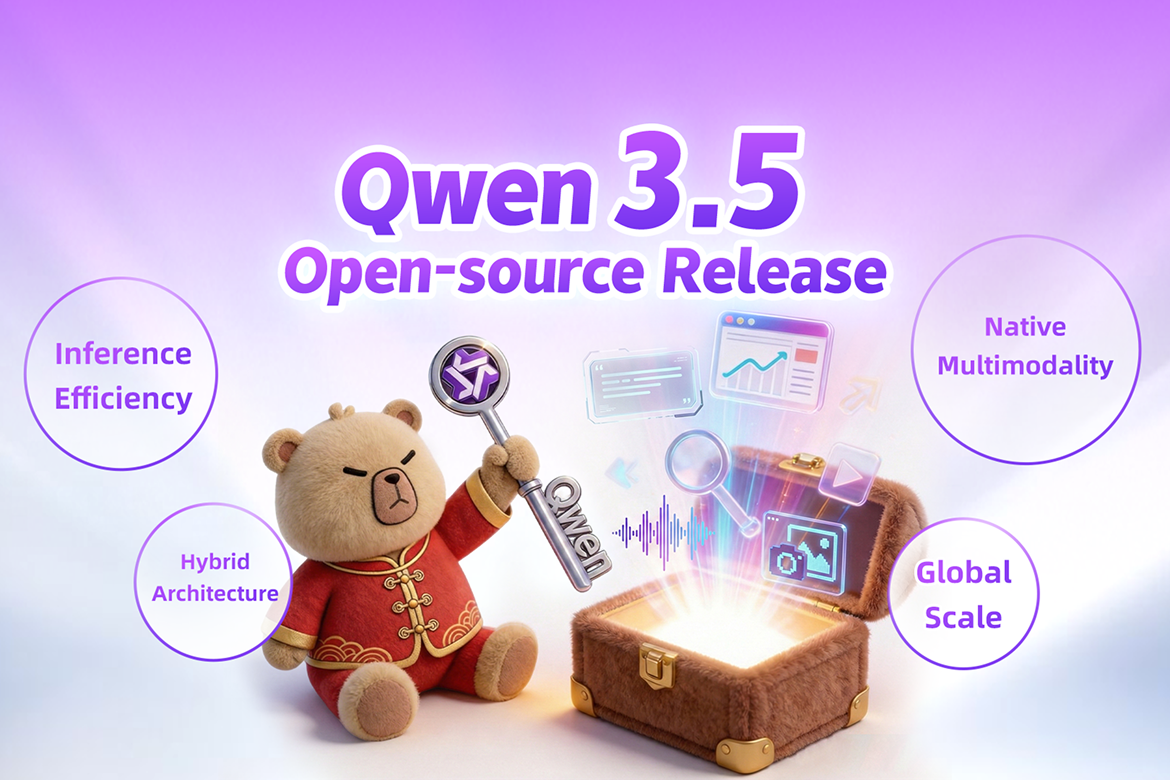

Alibaba on Monday unveiled Qwen 3.5, a new artificial intelligence model designed to execute complex tasks independently, as the company steps up efforts to compete in China’s increasingly crowded AI market.
Alibaba said Qwen 3.5 delivers significant improvements in both performance and cost efficiency. The company claims the model is about 60% cheaper to use and up to eight times more efficient at processing large workloads than its immediate predecessor. The model also introduces what Alibaba calls “visual agentic capabilities,” allowing it to independently take actions across mobile and desktop applications.
The release is aimed in part at driving adoption of Alibaba’s Qwen chatbot app in China. The market is currently dominated by rivals, including ByteDance’s Doubao and DeepSeek, which drew global attention last year after its models gained international traction.
Rising Competition in China’s AI Market
Alibaba said Qwen 3.5 was built for what it described as the agentic AI era, where models are expected to plan, reason, and act with limited human oversight. The company positioned the release as a step toward enabling developers and enterprises to run more advanced AI workloads using the same computing resources.
ByteDance on Saturday released Doubao 2.0, an updated version of its chatbot app that the company said is also designed for agent-based AI use cases. Doubao currently has the largest user base in China, approaching 200 million users, underscoring the scale of competition Alibaba faces domestically.
The rollout of Qwen 3.5 follows recent momentum for Alibaba’s AI products. Earlier this month, a promotional campaign that encouraged users to purchase food and beverages directly through the Qwen chatbot led to a seven-fold increase in active users, despite reports of technical issues during the rollout.
Alibaba was among the first major Chinese technology companies to respond to DeepSeek’s rapid rise last year, releasing its Qwen 2.5-Max model, which it said outperformed one of DeepSeek’s widely used systems. The company did not reference DeepSeek in its Qwen 3.5 announcement.
The benchmarks Alibaba released compared Qwen 3.5 with earlier versions of its own models and several U.S. competitors, including GPT-5.2, Claude Opus 4.5, and Gemini 3 Pro.
DeepSeek is expected to release its next-generation model in the coming days, adding to investor interest in China’s AI sector following the global technology stock volatility triggered by the company’s earlier breakthroughs.
The launch also follows Alibaba’s broader push to expand its AI capabilities beyond software. Earlier this month, the company introduced RynnBrain, a model designed to improve robotic perception and object recognition, supporting China’s efforts to advance physical AI and robotics.