
SoftBank Secures $40B Loan to Expand OpenAI Investment
SoftBank has secured a $40 billion bridge loan to deepen its investment in OpenAI and accelerate its broader AI strategy.
Emergent behavior refers to unexpected or unprogrammed actions that arise when complex AI systems, such as large language models or multi-agent networks, interact with data or their environment. These behaviors are not explicitly designed by developers but emerge from the system’s internal learning patterns and scale. In artificial intelligence, emergent behavior can lead to both impressive outcomes—like new problem-solving abilities—and unpredictable risks, such as biased or unintended responses. Researchers study these phenomena to understand how AI models generalize knowledge and develop capabilities beyond their training data. Managing emergent behavior is a key challenge in ensuring AI systems remain safe, transparent, and aligned with human intentions.
SoftBank has secured a $40 billion bridge loan to deepen its investment in OpenAI and accelerate its broader AI strategy.

AI-driven bots now generate more internet traffic than humans, according to a new report, highlighting the growing impact of automated systems online.

New research shows that telling AI models they are “experts” can reduce accuracy in tasks like coding and math, while improving safety and alignment outcomes.

A Sydney engineer used AI tools including ChatGPT and AlphaFold to help design a personalized mRNA cancer vaccine for his dog with help from university researchers. Early results show significant tumor shrinkage.

Meta introduced four new in-house MTIA chips designed for AI training and inference as the company accelerates data center expansion. The chips aim to improve performance and reduce reliance on external hardware suppliers.

Anthropic has launched the Anthropic Institute to study the societal, economic, and governance challenges posed by advanced AI systems. The initiative will combine research from engineers, economists, and social scientists.
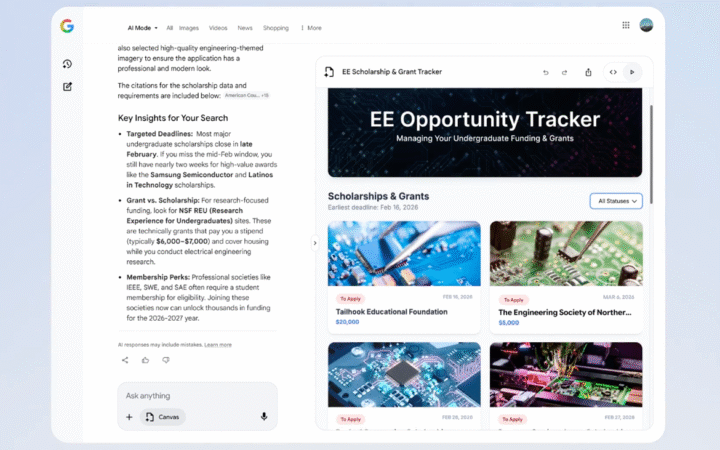
Google has rolled out Canvas in AI Mode to all U.S. users in English, enabling people to create documents, dashboards, and interactive tools directly within Search. The feature provides a dynamic workspace for planning projects and building simple applications.

Researchers report that ChatGPT-5.2 Pro helped simplify and generalize a complex gluon scattering formula, with results presented at the AAAS annual meeting.

Andrej Karpathy argues AI coding agents now fundamentally change programming workflows, enabling long-running autonomous tasks and redefining software engineering.

MSCI introduces AI connectors enabling access to its data via MSCI ONE, ChatGPT, and Claude, debuting IndexAI Insights to deliver conversational index analytics powered by large language models.