
Elon Musk’s AI company xAI has officially rebranded to SpaceXAI, completing its absorption into his rocket company SpaceX. The change went live on July 6, when the xAI account on X switched its handle to SpaceXAI and posted a short animation of the old logo folding into a new emblem that embeds “AI” in the SpaceX mark.
We are now @SpaceXAI. pic.twitter.com/ema66xDWC9
— SpaceXAI (@SpaceXAI) July 6, 2026
The move finalizes a consolidation that began in February, when SpaceX acquired xAI in an all-stock deal, bringing the Grok chatbot, the X social platform and a sprawling AI infrastructure roadmap under one roof. Musk had signaled in May that xAI would be dissolved as a separate entity, with its AI products branded as SpaceXAI. For users and developers, little changes immediately: Grok remains the flagship product, and the existing xAI API and model names still apply until official migration guidance arrives.
The rebrand is largely symbolic, but the symbolism is the point. By dropping the standalone xAI name, Musk is declaring that artificial intelligence is no longer a side project but a core pillar of SpaceX, whose combined empire with Tesla and X is now valued at roughly $3.75 trillion. The timing follows SpaceX’s record-breaking IPO in June, which raised $75 billion at a valuation of about $1.77 trillion, the largest public offering in history and one that briefly made Musk the world’s first trillionaire before the stock later slid.
Those IPO filings revealed how heavily SpaceX is betting on AI. The company spent $12.7 billion on AI capital expenditure in 2025, more than three times what it spent on its space and connectivity businesses, including the Starlink satellite network. The AI segment is currently a net loss, but SpaceX argues it holds the most potential, describing its total addressable market as the largest in human history. The integration has already made SpaceX a major seller of computing power: Anthropic has agreed to pay it about $1.25 billion a month for access to its Colossus data centers, and Google roughly $920 million a month.
The Vision
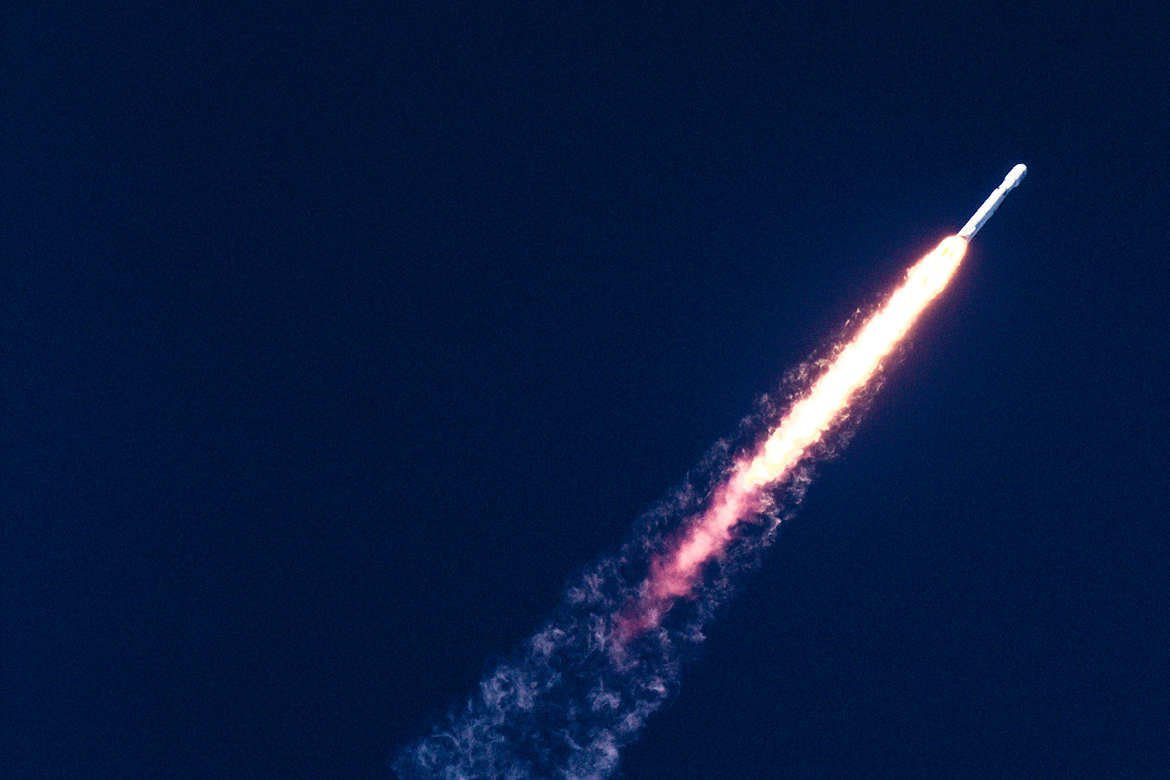
The deeper logic of the merger is moving AI infrastructure off the planet. SpaceX has filed with the US communications regulator to launch satellites designed to work as orbital compute nodes, and it wants to use its Starship rocket to build data-center capacity in space as early as 2028, free from the power and cooling limits constraining AI on Earth.
That vision only makes sense if the AI and the launch capability share the same company, which is the rationale Musk has offered for the consolidation. It reframes the enormous energy and cooling demands now straining terrestrial data centers as a problem SpaceX is uniquely positioned to solve with rockets and solar power in orbit.
The Skeptic’s View
The ambition comes wrapped in considerable risk. SpaceX posted a net loss of $4.9 billion in 2025, its AI division alone is burning billions, and the combined company now carries a valuation many analysts consider stretched.
Orbital data centers remain unproven, facing hard questions about heat dissipation, radiation, servicing and the environmental effect of mega-constellations, and the 2028 timeline is aggressive for technology that does not yet exist at scale.
Grok has also drawn repeated controversy over its outputs, and folding a consumer chatbot and a social network into a publicly traded rocket maker concentrates a wide range of businesses, and their liabilities, under one roof. For now, the rebrand crystallizes Musk’s message that space and AI are inseparable, even as the financial and engineering proof is still years away.