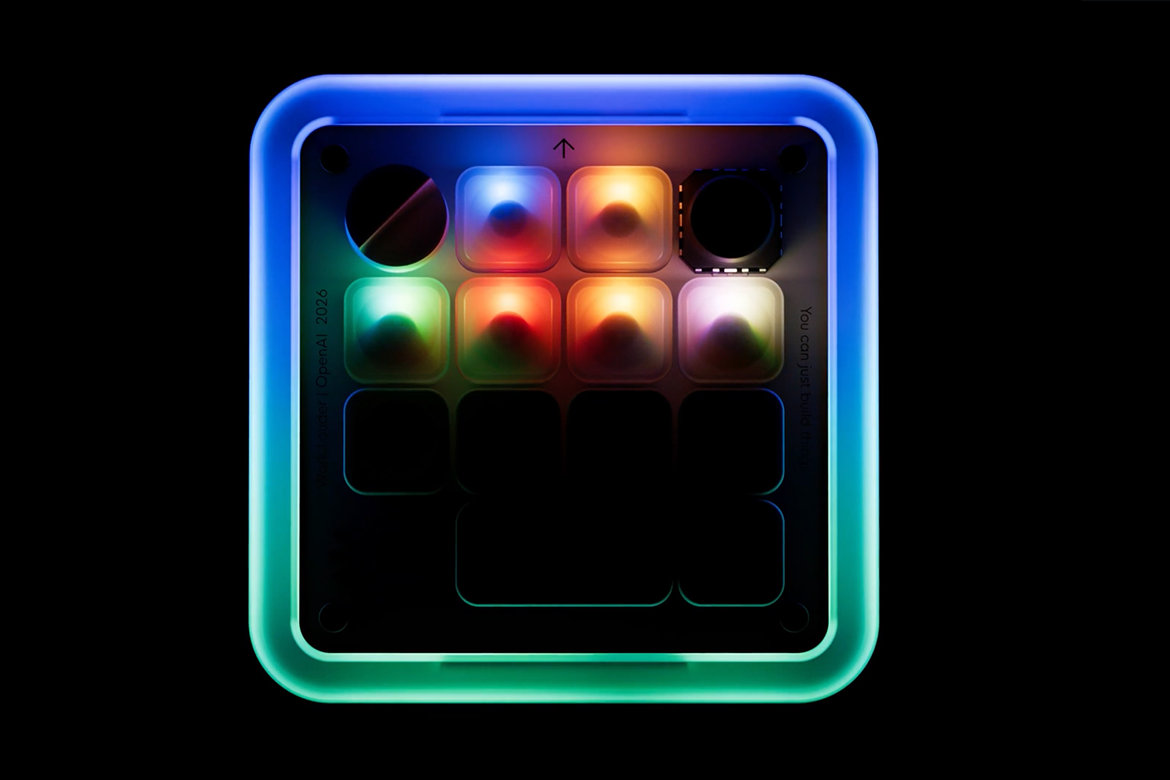

OpenAI is entering the hardware business, but not with the consumer gadget many expected. The company teased its first branded device, a compact programmable macro pad called Codex Micro, built with the boutique keyboard maker Work Louder and set for a full reveal on July 15.
Your favorite Codex shortcuts are getting an upgrade.
July 15th. pic.twitter.com/xZ1ydZyt94
— OpenAI Developers (@OpenAIDevs) June 29, 2026
A macro pad is a small board of keys, dials and switches that sits beside a keyboard, with each button mapped to a shortcut or a chain of actions. Codex Micro is designed to give developers quick physical access to their AI coding agent, Codex, which OpenAI says has more than 5 million weekly users. The teaser, captioned that favorite Codex shortcuts are getting an upgrade, drew nearly a million views in a day despite revealing no specifications.
The device appears to be a rebadged version of Work Louder’s existing Creator Micro 2, whose silhouette matches the teaser. That model packs 13 mechanical keys, a joystick, a rotary dial and a touch sensor into a small footprint, and sells for about $199, a possible hint at Codex Micro’s price.
OpenAI has not confirmed pricing, operating-system support, or whether users can create custom key mappings, and it is unclear whether the pad will hook into code editors through extensions, expose an API, or rely on preset shortcut profiles.
Shown at the AI Engineer World’s Fair, it was described by an OpenAI spokesperson as a keyboard built to supercharge Codex usage. In practice, its buttons would likely map to the repetitive moves of agent-driven coding, such as starting or pausing an agent, reviewing its changes, running tests or firing a saved prompt.
The move is best understood as a low-risk brand play rather than a hardware pivot. By licensing Work Louder’s proven design, OpenAI enters the physical world without building a device from scratch, and it deliberately sidesteps the crowded, failure-strewn AI-gadget market that produced the Humane Pin and Rabbit R1.
Notably, this is not the mysterious consumer device OpenAI is developing with former Apple designer Jony Ive, which the company’s finance chief has said should arrive by the end of the year. OpenAI is running two hardware tracks at once: a niche instrument for power users now, and a mass-market product later.
Why It’s a Shift
For a company that has lived entirely as software in a browser, editor or terminal, even a small co-branded accessory is a change in posture. It signals that OpenAI sees Codex usage as heavy and repetitive enough that physical shortcuts are worth marketing around, and that it views developer experience, not just model quality, as a competitive advantage.
The pad functions as an anchor on a developer’s desk: a coder who grows used to summoning Codex with a satisfying physical key is less likely to switch to a rival tool. It fits a small but telling trend in AI coding, where rival Cursor has handed out dedicated keys and Figma earlier released its own Work Louder pad, turning developer tools into tactile habits.
The Skeptic’s Case
There is an obvious tension in the product. AI coding is marketed on the promise of cutting the number of steps between an idea and working software, letting developers describe what they want in plain language.
A board of dedicated buttons pushes in the opposite direction, adding hardware to a workflow built on natural language, and critics note it may solve a problem the software already solved. Developers running fleets of agents may welcome a tactile shortcut, while others will see a gadget in search of a purpose. Real questions also remain about whether it meaningfully speeds multi-step agent actions or simply remaps existing shortcuts. The answers, along with price and specifications, arrive on July 15.